


Neither Right Nor Left - Just Passionate
The Room Netanyahu’s Coalition Doesn’t Want Voting
The meeting was held in the auditorium of a retirement home in Ganei Tikva. That detail matters more than it might appear, and I will come back to it.
They had set out chairs for something like 370. By the time it began, roughly 300 were filled — 80 percent, give or take, the back rows empty and a few people standing along the side wall. It was, in its way, the most honest number in Israeli politics. Not a rally, not a disappointment. A crowd that showed up.
And what a crowd. Walkers parked at the ends of rows. Wheelchairs in the aisles. Hearing aids being adjusted during the introductions. Overwhelmingly secular — I could count the kippot in the room on one hand, and one of them was on the candidate. This is the generation that built the country: Mapai people, Labor people, people who have been voting since Ben-Gurion and who have watched every promise made to them since. It is not Likud territory and never has been. Nobody in that room came to be flattered.
Behind the stage, two words: ביחד נתקן. Together we will repair.
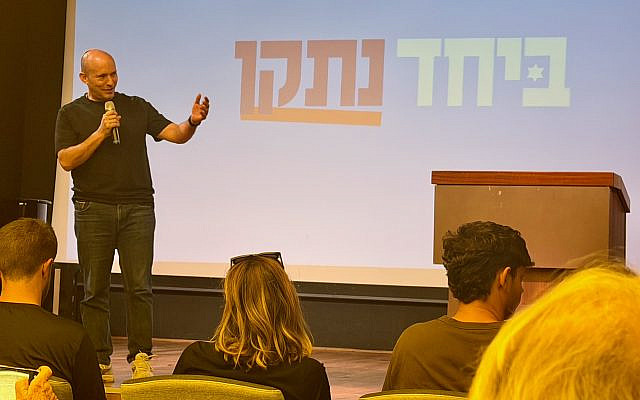
Bennett came out in a black t-shirt and jeans and did not perform. He talked about Yair Lapid early, and without a trace of defensiveness. A man protecting his right flank would have buried that partnership deep in the middle of the speech. He led with it, because it is the evidence. You do not join forces with Yair Lapid unless you are genuinely willing to govern alongside people who see the country differently than you do. He has now done it twice. Whatever else one thinks of him, that is a demonstrated disposition rather than a slogan — and in a secular room full of people who remember him as the settlers’ candidate, it was the right place to start.
Then the plan, and there is one, which is more than most can say.
A true National Commission of Inquiry into October 7, established immediately — not a government-appointed committee engineered to arrive somewhere convenient. Drafting the Haredim, and ending the fiction that has exempted them while other people’s children carry the weight. A hard two-term limit on any prime minister. Repairing the relationship with the diaspora, which this government has treated as an inconvenience to be managed rather than a covenant to be kept.
And then the one that brought the room fully to life: polling stations in retirement homes. The Central Elections Committee has recommended permanently placing ballot boxes in old-age homes, and Netanyahu’s coalition — Likud and Religious Zionism both — has come out against it. The arithmetic is not subtle. It affects somewhere between 35,000 and 40,000 voters, roughly a Knesset seat, and this coalition has evidently concluded those voters are not theirs. Bennett said plainly that people who spent their lives building this country should not have to fight for the ability to cast a ballot from inside the building where they live. I have rarely heard applause with that much anger folded into it.
The moment that landed hardest, though, was a confession. He said his team last time was weak. He said it was his fault. He said he had built a far better one this time. I have sat through a great many Israeli political evenings, and I cannot remember the last time a candidate accepted blame without a subordinate clause attached to soften it.
He then proved the claim by getting off the stage and letting his people talk. Meirav Cohen spoke, forcefully. Yonatan Shalev spoke, forcefully. Neither of them was there as decoration.


What he brings that the rest of the field does not is that he has actually done the job. He was prime minister. He knows where the levers are and which ones are wired to nothing. And he bridges the generational divide in a way few Israeli politicians manage — a man in his fifties, religious, standing in front of three hundred secular octogenarians, holding the room. Half of what they wanted to hear about was their grandchildren.
Afterward I handed him a copy of my book, Broken Covenant: Netanyahu and Israeli Democracy. He took it, and we took a photograph. I have no illusions about how many books a candidate is handed in a campaign season. He took it.

He closed on the line I keep returning to: fixing Israel is the priority, not holding power. That sentence is cheap when anyone says it. It is considerably less cheap coming from a man who has held the office, walked away from it, and is now proposing to bind his own hands with a term limit.
By my count, Bennett checked almost every box in that room. He deserves serious consideration as Israel’s next prime minister. Judging by the faces around me, I was not the only one keeping score — and I did not see many people leave unimpressed.
Source:
Times of Israel · Haaretz · Shomrim