The Room Without Doors
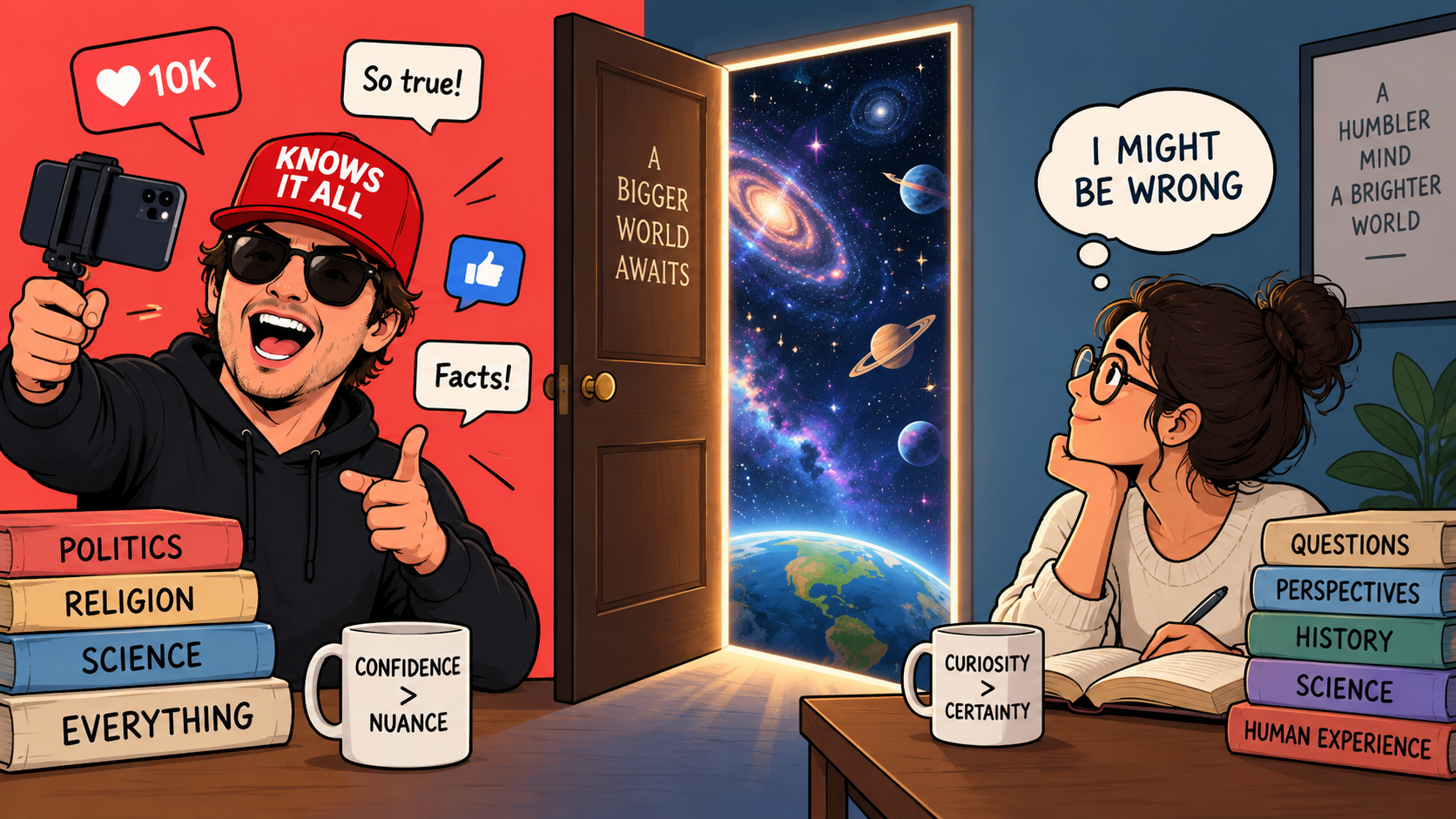
Frequently, when you open social media, you encounter people on camera confidently offering opinions on complex events, especially news, however outside their realm of familiarity. After watching enough of this, one begins to appreciate an unalterable truth:
Fortunate, indeed, are the intellectually lazy, for they are spared one of the great inconveniences of civilization: the realization that they might be ignorant of the subject under discussion.
The internet has democratized access to knowledge. With minimal curiosity, an open mind, a few keystrokes, and a basic command of English vocabulary, almost any subject on earth can be studied in depth, from multiple perspectives and through competing sources. Yet the chasm of ignorance appears to be widening faster than a black hole swallowing a photon of light.
The intellectually lazy person possesses a remarkable gift. He knows a little about something and promptly concludes that he knows enough about everything. His intellectual map is a one-cent postage stamp, yet from it he surveys the universe with the confidence of Eratosthenes. The boundaries of his knowledge quietly become, in his imagination, the boundaries of reality itself.
Socrates taught that intellectual humility was not an admission of stupidity, but a recognition that awareness of one’s own ignorance is itself a form of wisdom. The intellectually lazy person performs the opposite trick: he converts ignorance into certainty and then wears that certainty with pride, like a graduation gown awarded for a doctorate in every subject.
Modern psychology gives us a useful name for part of this phenomenon: the Dunning–Kruger effect, which suggests that people with limited competence can sometimes lack the very competence required to recognize their limitations.
The intellectually lazy person therefore enjoys extraordinary efficiency. Why read ten books when one Instagram post will do? Why study an opposing argument when a caricature of it is so much easier to defeat? Why wrestle with complexity when a slogan can flatten it into something comfortably simple?
Nietzsche understood another dimension of the problem: the human appetite for certainty is often entangled with pride, identity, and the desire to feel superior. We do not merely hold ideas; sometimes our ideas hold us. They become part of our identity. An opinion can become a badge of belonging and abandoning it can feel less like correcting an error than surrendering a piece of oneself.
George Orwell, meanwhile, repeatedly warned of the corruption of language by ideology. Once words become political weapons rather than instruments of thought, intellectual laziness becomes wonderfully convenient. Call something “fascist,” “woke,” “communal,” or “leftist,” and the investigation can end before it begins. The label does the thinking. The thinker may now go home.
There is also a second class of the intellectually lazy: the vocal lazy. These people not just avoid thinking, but they compensate for it with volume. Others then use them as intellectual scaffolding. The loud person supplies the slogans, the quieter people supply the applause, and together they construct magnificent air castles of grand proclamations whose Styrofoam foundations consist largely of assumptions.
As someone interested in the freedom of religion, I have encountered this phenomenon firsthand when perusing posts about Hinduism, Judaism, and Islam. Fortunately, the Jains, Buddhists and Sikhs are generally spared till date. Some people use their ‘particular religion’-sounding names or their perceived association with that society, as a credential, as though it automatically grants credibility to their criticism of that religion. There is, of course, nothing inherently wrong with criticizing religious traditions. Every civilization contains ideas, customs, and institutions that deserve serious criticism and, in some cases, outright rejection. But criticism without serious knowledge can become merely fashionable ignorance wearing scholarly looking spectacles.
The same principle applies to defenders of a religion. Blind reverence is not scholarship either. A civilization does not become great because every claim made in its name is true. Nor does criticism become profound merely because it is directed at a civilization one dislikes.
The genuine intellectual therefore occupies an uncomfortable middle ground. He questions his own side. He understands the other side. He distinguishes criticism from contempt and disagreement from hatred. He changes his mind when the evidence demands it. And occasionally, he is willing to utter the most terrifying confession, “I don’t know.”
The intellectually lazy person is spared all this suffering. Today, ignorant people are often remarkably confident, while the intellectually curious are often increasingly uncertain. The more curious people learn, the more questions appear. Every answer opens another door; every door reveals another corridor; every corridor leads to another room.
The intellectually lazy person has discovered something far more comfortable. There are no doors if you have already decided there is nothing outside the room.