
The Route Holds
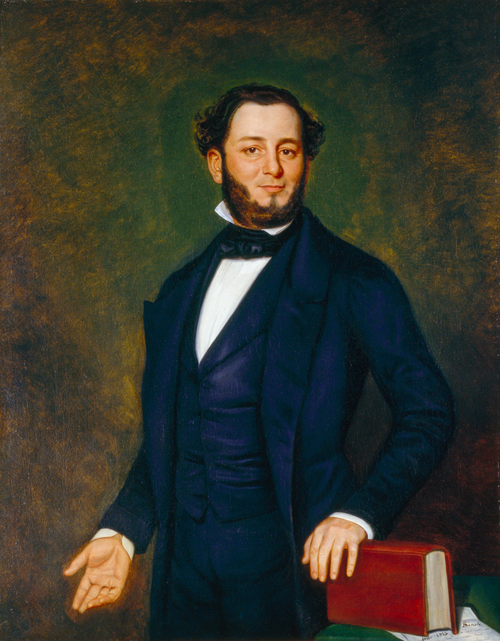
The Route Holds is a work of historical fiction inspired by the life of Judah Benjamin during the final years of the Confederacy. It draws upon the historical figures, places, and circumstances of his life while imagining the events and people encountered along one particular journey.
Chapter 1 — The Cotton Must Arrive
The Confederate cabinet room possessed the stubborn composure of a government that had not yet learned how to mourn itself.
Maps lay pinned flat against paneled walls whose varnish had darkened with years of tobacco smoke and candle soot. Their borders had begun to curl at the edges despite the brass tacks driven through them. Lines drawn only weeks before had already been erased and redrawn with a nervous economy that suggested both urgency and disbelief.
Light entered reluctantly through tall windows set high enough to discourage distraction. It fell in narrow oblique bands across the long table, illuminating documents, hands, and occasionally a face, before dissolving again into the room’s practiced dimness.
Judah Benjamin listened.
He had long ago discovered that listening was not passive. It was a form of strategic patience — an investment whose dividends appeared only after others had exhausted themselves.
Victor Beauregard began to speak.
He did not raise his voice. Planters of his lineage rarely did. Authority, in his understanding, was not asserted; it was cultivated. Like land. Like reputation. Like the continuity of a name that must never be seen to fracture.
“The difficulty,” Beauregard said, resting his fingers lightly upon the papers before him, “is that the Austrians are willing to receive the cotton, but they will not make the payment in a manner that can be entered plainly upon their books.”
Judah looked down at the memorandum.
The shipment was already at sea. Bales purchased through Confederate channels were making their way toward the port in Trieste, where a merchant house connected to the Habsburg commercial network had agreed to receive them. The house was willing to take the cotton. What it would not do was record a purchase from Richmond openly on its books.
Judah turned another page.
Brother Pike had not yet spoken.
He sat with his hands folded, posture neither rigid nor relaxed, like a man awaiting the arrival of a document whose existence he had already accepted. His gaze moved slowly from speaker to speaker, not in curiosity, but in quiet verification.
President Davis allowed the exchange to continue.
He had learned that interventions made too early merely redirected conflict rather than resolving it.
Judah finally lifted his eyes.
“You are treating the cotton and the payment as one transaction.”
Beauregard looked at him.
“They are one transaction.”
“No,” Judah said. “They are two.”
The room became still.
“The cotton must arrive,” Judah continued. “The buyer must take possession. That is the commercial fact. The difficulty is the obligation created by the purchase.”
He tapped the memorandum with one finger.
“If the buyer cannot acknowledge the Confederate payment without creating a political problem, then don’t ask him to acknowledge it.”
Judah continued.
“Record the value elsewhere. Defer the obligation. Let the shipment be completed as a commercial transaction while the corresponding payment is carried forward through a registry that does not require the buyer to declare, in so many words, whom he has financed.”
Beauregard’s expression tightened, as if being presented with a strange, new method of cultivation.
“You would separate the shipment from the obligation.”
“Temporarily.”
“And when does the obligation become due?”
“When the circumstances permit it to be settled without making the settlement itself the story.”
For the first time, Davis spoke.
“And you believe the Austrians would accept this?”
“I believe they would prefer it to refusing the cotton they have already agreed to purchase.”
Judah closed the memorandum.
The proposal did not eliminate the political difficulty.
It merely prevented the difficulty from attaching itself to the cargo.
Brother Pike spoke for the first time.
“Things are separating.”
Judah looked toward him.
Pike’s eyes remained upon the papers.
“Cotton from payment,” he said. “Men from countries. One thing from another.”
No one answered.
Pike folded his hands again.
“That is how it begins.”
Judah regarded him for a moment.
“Begins what?”
Pike looked up.
“The reckoning.”
The room remained silent for half a breath.
Then Beauregard returned to the memorandum, and the cabinet continued as though nothing unusual had been said.
Chapter 2 — The Obligation
Judah returned to his office through corridors that seemed unchanged and yet subtly thinner than he remembered.
Clerks passed carrying bundles of correspondence tied with ribbon that had been reused enough times to acquire its own memory. Doors opened briefly to reveal desks crowded with ledgers, ink-stained sleeves, bent shoulders. Then closed again.
The building continued to function.
Judah’s office remained undisturbed. Papers lay arranged in the careful geometry he preferred — an order that suggested mastery even when events themselves resisted arrangement.
Isaac stood by the window.
He had removed his coat. His sleeves were rolled back just far enough to reveal the pale crescents at his wrists — old marks from his bondage that had long since healed but never entirely vanished. He carried himself with the composure of someone who had learned to exist in rooms without claiming them.
“The obligation?” Isaac asked.
Judah placed his gloves upon the desk before answering.
“The cotton will be received,” he said. “The payment will be carried separately.”
Isaac waited.
“It must ultimately be satisfied to Baron Friedrich von Hohenwart. The destination will be recorded. You will not.”
Isaac nodded once.
The arrangement required a man to carry the obligation without becoming part of the transaction that had created it. Isaac understood the distinction without needing it explained.
Outside, somewhere deeper in the building, a bell rang to mark an hour whose significance would soon be reduced to notation.
Isaac departed before evening.
No clerk recorded the precise moment at which he ceased to belong to the building’s circulation.
Chapter 3 — The Form Holds
Several weeks had passed since the shipment departed.
The correspondence had arrived. The receipt had been confirmed. The obligation had been discharged.
Isaac had not returned.
Judah went to Beauregard.
Beauregard received him standing.
The room was larger than his and arranged with the deliberate restraint of a man who believed space itself should reflect continuity. Maps hung along the paneled walls, their edges pinned flat with an insistence that suggested both discipline and denial. A long table occupied the center, cleared of all but a single folio left open as though interruption had been temporary.
Morning light entered without warmth.
“Benjamin,” Beauregard said.
Judah inclined his head.
“I wanted to ask about the recent shipment.”
“The matter is concluded.”
“The cargo arrived?”
“Yes.”
“The obligation?”
“Satisfied.”
Judah paused.
“And the man who carried it?”
Beauregard regarded him.
“He was not part of the obligation.”
“He was sent with it.”
“Yes.”
“He was expected to return.”
Beauregard’s expression did not change.
“The transaction has been completed.”
“I am not asking about the transaction.”
A brief silence followed.
Beauregard moved to the window and rested his hands behind his back. The posture was familiar — inherited rather than learned — the stance of a man accustomed to surveying land he expected to endure.
“You are attentive,” he said.
“I am attentive.”
“Then attend to this.”
He did not turn as he spoke.
“A government does not preserve itself by accounting for every movement. It preserves itself by maintaining the form within which movement can be understood.”
Judah said nothing.
“The shipment arrived. The obligation was satisfied. The form holds.”
“And if a man does not return?”
Beauregard allowed himself the smallest pause. Then he turned from the window.
“Then we continue.”
Judah inclined his head.
“Of course.”
Judah left the room.
Chapter 4 — Routes Exists First
In the corridor, the building resumed around him.
Clerks passed. Doors opened and closed. Paper moved through hands that did not require explanation to continue their work.
The system did not require Isaac, it required continuity.
The treasury offices lay deeper within the building, where light arrived filtered and indirect, and the air carried the persistent scent of ink, dust, and handled paper.
Judah paused at the threshold of Caleb Broussard’s office.
The door was open.
Inside, Caleb sat at a desk that appeared insufficient for the volume of material it supported. Ledgers were stacked not in neat alignment but in functional proximity — arranged according to use rather than appearance. His pen moved quickly, pausing only when calculation required verification.
He wrote as though interruptions were not an event but a condition to be anticipated.
The habit had not been acquired here.
In New Orleans, movement did not wait to be understood. It passed through the port in overlapping sequences — manifests altered between dock and warehouse, cargo reclassified in transit, ownership shifting without announcement. The ledger followed only if it adapted.
“Mr. Broussard,” Judah said.
Caleb looked up.
“Secretary.”
Judah stepped inside and closed the door.
“I have a question about the shipment.”
Caleb set down his pen.
“The one from several weeks ago?”
“Yes.”
“The obligation was settled.”
“I know.”
Caleb waited.
“The man who carried it did not return.”
“No.”
Judah studied him.
“You knew?”
“I read the same reports you did.”
“Then where is he?”
Caleb leaned back.
“He was sent with the shipment.”
“Yes.”
“The shipment arrived.”
“Yes.”
“And yet he did not return with it.”
Caleb nodded.
“Then the shipment and the man have ceased to be the same thing.”
Judah was silent.
Caleb turned one of the ledgers toward him.
“Look.”
The page was divided into columns: ports, depots, transfers, consignments.
“The ledger doesn’t follow people,” Caleb said. “It follows things; cargo, ownership, obligations, whatever needs to move.”
“And people?”
“People move with them.”
Judah looked down at the page.
“And if the person needs to continue?”
Caleb’s eyes lifted.
“Then he finds something that is already moving.”
Judah looked at him.
Caleb tapped the ledger.
“A shipment does not ask why a man is beside it. It asks whether the shipment itself is in order.”
Judah considered this.
“And the man becomes—”
“A condition.”
The word settled between them.
“Not a destination,” Caleb continued. “Not a name on the route. A condition of the movement.”
Judah looked again at the columns.
“Routes exist first.”
Caleb nodded.
“Names come later.”
Silence settled between them.
Judah closed the ledger.
The smell of ink was sharper here — metallic, insistent.
The machinery did not interpret.
It processed.
“Thank you,” Judah said.
Caleb inclined his head.
Judah left with the sense that he had not been advised.
He had been shown.
Chapter 5 — The Reckoning Proceeds
Judah left the treasury offices slowly.
The building seemed different now. Not changed, but revealed. Men moved through corridors. Papers moved between hands. Doors opened and closed.
Movement required no explanation until someone demanded one.
He turned down a corridor he rarely used.
Brother Pike stood beside a window.
Judah almost continued past him.
“Secretary,” Pike said.
Judah stopped.
“Brother Pike.”
Pike regarded him for a moment.
“You have found a road.”
Judah studied him.
“I don’t recall mentioning one.”
“You didn’t.”
The answer unsettled him.
Judah looked toward the window.
“It isn’t ready yet.”
“Separation will not wait.”
Judah considered him.
“I won’t remain.”
“I know.”
“How?”
Pike looked past him, toward the corridor.
“Things announce themselves before they are recorded.”
Judah thought of the ledgers.
“The road can close, I should move quickly.”
Pike nodded
“Yes, but you are only thinking about the road.”
“What else is there?”
“What comes after.”
Judah looked at him.
“And what comes after?”
Pike’s expression did not change.
“The Reckoning.”
Judah shook his head, a bell sounded somewhere deeper in the building.
Judah glanced toward the sound.
When he looked back, Pike was watching him.
“I haven’t decided.”
“Yes, you have.”
Judah said nothing.
“You seem very certain.”
Pike looked toward the window again.
“No, only attentive.”
Judah considered him for a moment.
Then he nodded.
“Good day, Brother Pike.”
“Secretary.”
Judah walked past him.
Behind him, Pike remained beside the window.
He said quietly to himself, “The reckoning proceeds.”
Chapter 6 — I Will Not Return
Judah closed the door to his office with more care than usual.
The latch settled into place with a small, precise sound.
The room had not changed.
The desk remained in its exact alignment. Papers lay arranged in their familiar geometry. Everything remained in order, but that fact now felt provisional.
Judah removed his coat and placed it across the back of the chair.
He did not sit.
He reached for the notice detailing the cotton obligation.
The paper bore the marks of passage — handled, folded, opened, resealed.
When Judah set it down, he noticed another document beneath it.
Smaller. Unremarkable. Folded once.
No signature. No seal.
He opened it.
The contents were brief.
Judah read it once.
Then again.
The phrasing was exact.
The destination will be recorded. You will not.
He heard his own voice from several weeks before.
Then he read the line beneath it.
I am well, I will not return.
Judah stopped.
He read it again.
For several moments, Judah remained still.
There was no explanation.
No indication of where Isaac had gone.
Only the certainty that Isaac lived and had chosen not to come back.
Outside, footsteps passed in steady intervals. A voice somewhere in the building called out figures that would soon be entered into a ledger and no longer questioned.
Judah folded the note along its original crease.
The room was orderly.
The building continued.
But somewhere beyond it, Isaac had found a way to continue without returning.
Judah looked toward the door.
Then he opened it and stepped into the corridor.
Chapter 7 — It Requires An Attendant
The treasury offices were quieter when Judah returned.
Caleb looked up as he entered.
“Secretary.”
Judah closed the door.
“I need a route.”
Caleb regarded him for a moment.
“Why?”
“Because I intend to use it.”
Caleb nodded.
He went to the shelves and selected a bundle of papers.
“This one.”
Judah followed him to the desk.
The manifest was short. Several entries had been amended in different hands.
“What is it?”
“A shipment.”
“Of what?”
“Provisions. Machinery. It doesn’t matter.”
Caleb tapped the page.
“It has an irregularity.”
Judah looked at him.
“What kind?”
“It requires an attendant.”
“For what?”
Caleb shrugged.
“Something that needs watching.”
Judah studied the manifest.
“I shall take the role of the attendant?”
“Precisely.”
Caleb turned another page.
“You stay with the shipment until it changes hands.”
“And then?”
“The route continues.”
Judah looked at the manifest again.
“There will be questions.”
“Yes.”
“At customs.”
“Yes.”
Caleb closed the bundle.
“Pay the officer.”
Judah paused.
“A bribe?”
Caleb smiled
“Make him comfortable.”
Judah nodded.
“When does it depart?”
“Tonight.”
Caleb retied the bundle.
Judah opened the door.
“Caleb, thank you.”
“Of course, Secretary.”
This time, Judah knew where he was going.
Chapter 8 — Shema Yisrael
Judah left the treasury offices before dusk.
By nightfall he was at the harbor.
The vessel lay beyond the customs buildings. It was smaller than Judah had expected. Its cargo had already been loaded. Men moved along the deck, checking ropes and securing crates.
Judah approached the customs gate.
The officer looked at him.
“Papers.”
Judah stopped.
There were none.
The officer waited.
Judah reached into his coat and placed the money on the desk.
The officer looked at it.
Then at Judah.
“Attendant?”
Judah nodded.
The officer glanced toward the manifest.
“What shipment?”
Judah gave him the name.
The officer checked the entry. His finger moved down the page.
He looked back at Judah.
Then he took the money.
He made a small mark beside the entry and waved Judah through.
Judah walked past the desk.
The harbor opened before him.
He turned toward the vessel.
Then he heard a voice behind him.
“Secretary.”
Judah stopped.
He turned.
Brother Pike stood several paces away.
Judah nearly jumped.
“How did you know I was here?”
Pike looked toward the vessel.
“I thought you might take this harbor.”
Judah stared at him.
“Why?”
Pike was quiet for a moment.
“Some roads are easier to find than others.”
Judah waited.
Pike looked back at him.
“Go.”
Judah hesitated.
Pike stepped closer.
“Your return is required for the reckoning.”
Judah looked at him.
There was something in Pike’s face that made further questions impossible.
Judah nodded, still confused.
He turned and walked toward the vessel.
Behind him, Pike remained where he was.
Judah reached the gangway.
A sailor looked at him.
“Attendant?”
Judah nodded.
The sailor moved aside.
Judah stepped onto the deck.
No one stopped him.
The gangway was pulled in.
The harbor began to recede.
Judah stood at the rail.
The vessel moved into the dark water.
Judah closed his eyes.
“Shema Yisrael—”
A sailor nearby heard Judah and asked,
“Returning to Israel?”
Judah opened his eyes and he looked back toward the harbor.
Pike’s final words returned to him.
Your return is required for the reckoning.
He considered the sailor’s question.
“If you think Judgement Day is upon us, then yes”
The sailor gazed at Judah quizzically then returned to his work.
Judah remained at the rail.
Behind him, the vessel continued.
Ahead, there was only darkness.
The route held.