


Where history exposes power and moral failure
The Sacred Memory of Maximilian Kolbe
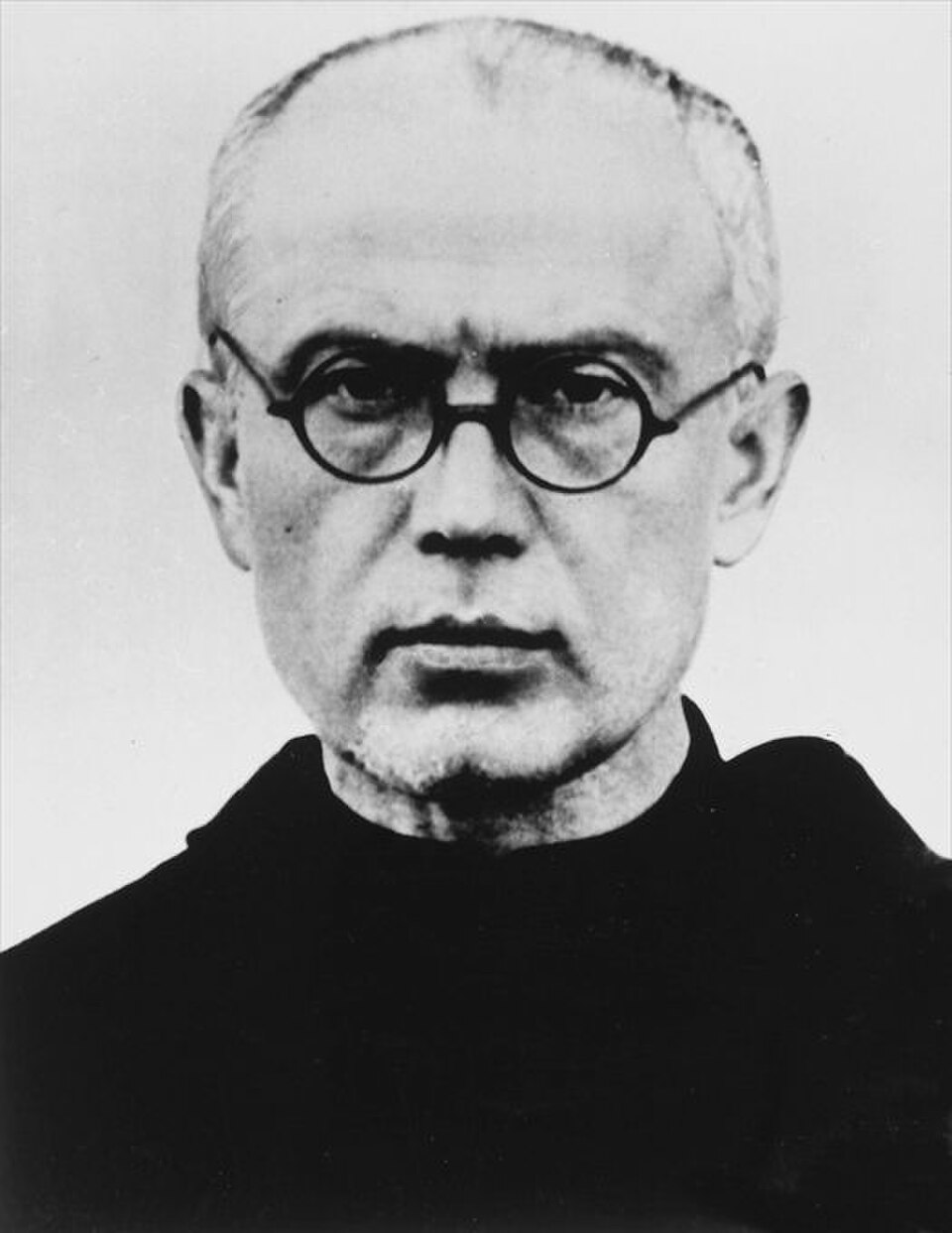
Fr. Maximilian Kolbe, 1939. Public domain; author unknown. Via Wikimedia Commons.
Holocaust cinema repeatedly confronts a problem that is artistic, moral, and historiographical at once: the catastrophe exceeds ordinary narrative comprehension. Millions of Jews murdered across ghettos, forests, camps, death marches, shooting pits, and gas chambers cannot be absorbed through numbers alone. Film narrows its lens because narrative almost always does. One individual life becomes the vessel through which viewers are invited to approach the dead.
The selection of that vessel is never ideologically neutral.
Certain victims become culturally central because their biographies can be integrated more readily into the theological, national, or moral self-image of later societies. Others remain comparatively marginal because they resist sentimentalization or complicate the stories descendants, institutions, and audiences prefer to tell about themselves. Holocaust memory, like all public memory, is shaped not only by what is remembered, but by what kinds of suffering later cultures find symbolically usable.
This tension appears repeatedly in representations of Maximilian Kolbe, the Polish Franciscan friar killed at Auschwitz in 1941 after volunteering to die in place of another prisoner selected for starvation. Kolbe’s action was undeniably courageous. Few human beings possess the moral fortitude required to walk knowingly toward death for another person under conditions of exterminatory terror. His sacrifice deserves remembrance and respect.
Kolbe’s historical position, however, was more complicated than later devotional memory sometimes permits. Before the war, publications associated with the Franciscan movement he led circulated material reflecting contemporary Polish Catholic antisemitic tropes and nationalist hostility toward Jews. This does not erase the courage of his final action at Auschwitz, nor does it place him in moral equivalence with the architects of Nazi extermination. It does reveal how unstable sanctified memory becomes when historically situated individuals are transformed into purified symbolic figures. The smoothing away of contradiction in the service of reverence belongs to the broader laundering instinct that so often shapes Holocaust representation.
Historical memory requires proportionality and perspective as well as reverence.
Kolbe was one of many millions of victims of the Holocaust who performed an extraordinary act under extraordinary conditions. The historical record of Nazi persecution contains innumerable examples of courage, resistance, solidarity, and self-sacrifice among Jews and non-Jews alike, many of whose names remain comparatively obscure outside specialized historical study. Mordechai Anielewicz, the twenty-three-year-old commander of the Jewish Fighting Organization during the Warsaw Ghetto Uprising, led a doomed resistance against the SS while fully aware the uprising could not succeed militarily.
Roza Robota, a Jewish prisoner at Auschwitz associated with the Hashomer Hatzair resistance movement, helped smuggle gunpowder later used in the revolt that damaged Crematorium IV in October 1944. Captured and tortured for weeks alongside Ala Gertner, Estusia Wajcblum, and Regina Safirsztajn, Robota refused to betray her co-conspirators before her public execution. Near Lille in September 1944, French Resistance fighters Félix Cadras and Georges Lhermitte broke open a deportation convoy known as the Train de Loos, allowing fellow prisoners to escape before being recaptured and executed themselves.
These examples do not diminish Kolbe’s sacrifice. They restore it to its proper historical scale. Auschwitz and the broader Holocaust were saturated with courage, much of it Jewish, political, collective, anonymous, and inconvenient to later devotional simplicity.
The difficulty emerges when one victim’s biography is elevated so aggressively that the surrounding catastrophe begins to recede into symbolic backdrop. In certain representations of Kolbe, Auschwitz risks transformation from a site of Jewish extermination and industrialized state murder into the setting for a Christian narrative of sanctified suffering and transcendent redemption. The moral center of gravity shifts quietly. Jewish suffering remains visible within such narratives, but often in a newly subordinate position, functioning less as the historical core of the catastrophe than as the emotional infrastructure supporting someone else’s theological drama.
Recent cinematic treatments such as Triumph of the Heart illustrate the instability of this territory particularly clearly. The concern lies in the framing choices through which Auschwitz itself risks becoming narratively subordinate to a Christian drama of sanctity and redemption. In such representations, the camp can begin to function less as the historical site of Jewish extermination and industrialized state murder than as the symbolic setting through which one spiritually legible figure achieves transcendence. The result is narrative displacement rather than direct falsification. Jewish suffering remains present, but increasingly as atmosphere, emotional scaffolding, and moral scenery surrounding a story whose interpretive center lies elsewhere.
This pattern belongs to a broader phenomenon within Holocaust memory. Societies frequently soften, universalize, or sanitize victims in ways that make them easier for later generations to inherit. The politically difficult victim becomes morally generic. The refugee becomes an immigrant seeking opportunity. The anti-fascist partisan becomes a vaguely admirable dissenter detached from political commitments that later audiences find uncomfortable. The homosexual victim becomes tragic while the sexuality that produced the persecution quietly disappears from public narration. The Disabled murdered under Aktion T4 become casualties of abstract medical cruelty rather than victims of organized state killing carried out through bureaucratic systems operating with procedural calm.
Even Kolbe’s canonization reveals the extent to which institutional memory reshapes historical specificity around morally resonant figures. Traditional Catholic martyrdom centered upon the concept of Odium Fidei: death inflicted specifically out of hatred for the Christian faith. Kolbe was not executed because Nazi authorities sought to eliminate Catholic theology. He died because he volunteered to take another prisoner’s place within Auschwitz’s exterminatory machinery. In canonizing him, Pope John Paul II designated Kolbe a “Martyr of Charity,” reflecting a meaningful theological development within modern Catholic understandings of sanctity and sacrifice.
Catholics are entirely entitled to revere Kolbe and to find spiritual significance in his action. The historical concern emerges when theological elevation migrates into Holocaust representation itself and Auschwitz begins functioning less as the historical center of the narrative than as the crucible through which Christian transcendence is revealed. The Holocaust was never a generalized morality tale about human suffering. Its central targets were Jews. Antisemitism was foundational to Nazi ideology, not incidental to it. Any representation that gradually displaces that reality beneath universalized spiritual symbolism risks distorting the catastrophe it seeks to commemorate.
Public memory frequently rewards narratives capable of producing consolation. Industrialized extermination offers very little consolation on its own. Narratives of redemptive suffering, moral purification, saintly sacrifice, or transcendent meaning become culturally attractive because they soften the unbearable scale and bureaucratic horror of what occurred.
Auschwitz was not constructed as a stage for someone else’s spiritual revelation. It was a machinery of extermination that converted human beings into transport categories, labor units, medical specimens, administrative burdens, and ash. Jews were deported there because antisemitism stood at the ideological center of Nazi racial policy. Others persecuted by the regime entered that machinery through related structures of racial, political, social, religious, and biological exclusion. The dead who emerged from it did not arrive prearranged into emotionally satisfying symbolic hierarchies.
Maximilian Kolbe deserves remembrance as a man who performed an act of extraordinary courage under conditions designed to annihilate human dignity. Historical memory cannot responsibly permit the gradual inflation of one sanctified biography until the surrounding reality of Auschwitz itself becomes secondary to the theological or emotional needs of later audiences. That danger becomes particularly acute when the historical ambiguities, prejudices, and contradictions surrounding an individual life are softened in order to preserve a cleaner symbolic narrative for posterity. Once Holocaust victims cease to exist as historically situated people and instead become vessels carrying meanings imposed later by institutions, nations, descendants, or religious cultures, remembrance begins slipping toward something else entirely: the conversion of catastrophe into symbolic property for the living.
Selected Sources
- Saul Friedländer, Nazi Germany and the Jews, 1933–1945.
- Raul Hilberg, The Destruction of the European Jews.
- Primo Levi, The Drowned and the Saved.
- Lawrence L. Langer, Holocaust Testimonies: The Ruins of Memory.
- James E. Young, The Texture of Memory: Holocaust Memorials and Meaning.
- Tim Cole, Selling the Holocaust: From Auschwitz to Schindler: How History Is Bought, Packaged, and Sold.
- Alvin H. Rosenfeld, The End of the Holocaust.
- Oren Baruch Stier, Holocaust Icons: Symbolizing the Shoah in History and Memory.
- United States Holocaust Memorial Museum, “Warsaw Ghetto Uprising” and related Holocaust Encyclopedia entries on Jewish resistance.
- Yad Vashem, materials on the Warsaw Ghetto Uprising, Jewish resistance, Auschwitz, and Roza Robota.
- Vatican and Catholic sources on Maximilian Kolbe’s canonization, Odium Fidei, and “Martyr of Charity.”
- Triumph of the Heart, official film materials and promotional description.
- Maximilian Kolbe, selected writings and editorial publications in Rycerz Niepokalanej (Knight of the Immaculata), 1920s–1930s.