The sanctuaries in my heart
The heat and traffic are oppressive. As I ascend the hills of Jerusalem, I say a private prayer of thanks that I am traveling by hybrid car in 2025 and not climbing with braying animals to the holy Temple in the first century. That Temple, of course, is no longer. But even today, David’s city boasts a spiritual shrine: the modern and regal National Library of Israel.
I drag myself to Jerusalem even though my keyboard tapping could easily be done in my bed. I go for the vibe — a modern version of the mishnaic teaching to “cleave in the dust of scholars’ feet.” As I enter the sleek building, the generous air conditioning helps unstick my sweaty orange t-shirt from my back. I survey the crowd and am immediately sorry that I did not stick to all black, that I did not dress more intellectual, more adult.
In the sanctuary of the building – the multi-floor reading room—I am lulled by the hum of whispers, clicking computers, and rustling papers. It is a productive quiet that soothes me, like crickets on a summer night. I settle into the soft royal blue upholstered chair and gaze up at the spiraling ceiling, toward the heavens. As far as my eyes can see, there are walls and partitions of wooden bookcases. The tomes are as numerous as the People of the Book, as uncountable as the stars in the sky and grains of sand by the sea. Sharing my table are real scholars, curled urgently over their texts, scratching hieroglyphics in spiral notebooks. Though I have nothing to write and nothing to read, I am uplifted by their proximity. Blanketed by the holiness of this Jerusalem temple, I wade into memory.
* * *
Just a few months ago I was in a different Jerusalem — Lublin — which is known as the “Jerusalem of Poland.” Lublin’s Jewish community reaches back to the 1300s, and it was once a center of Jewish intellectual and mystical life, thus earning its moniker.
In the center of the city sits Lublin’s Jewish temple, the building that once housed the Yeshivat Chochmei Lublin. Set back from the street, the multi-story columned edifice is encircled by a wrought iron gate. In its heyday in the early 20th century, the academy was a Hasidic version of Harvard, and it attracted applicants from all over Europe and even North America. It was known for its rigorous admission requirements; indeed, just to apply, young men first had to demonstrate that they knew hundreds of pages of the Talmud by heart.
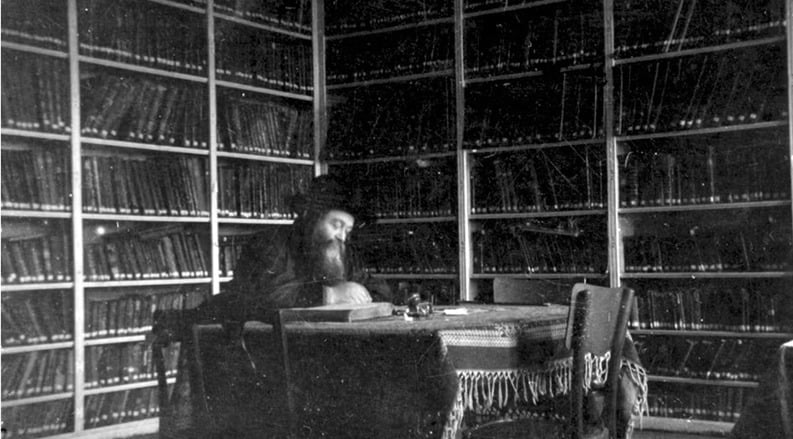
The crowning jewel of the yeshiva was its library. It was reputed to include tens of thousands of books, including many rare and valuable editions, each imprinted with a purple-ink library stamp designating its ownership. After the war, it was commonly believed that when the Nazis incinerated Lublin’s Jews, they also turned the contents of the library into ash. In later years, however, it became clear that there was no systematic burning of the yeshiva library, notwithstanding Nazi propaganda claims. Instead, the ownerless volumes from the yeshiva library were scattered, like Jews sent to the Diaspora.
But just as Ezekiel prophesied the resurrection of the Jewish people from dry bones and the return of Jews to their homeland, there is a steady stream of books with the purple yeshiva stamp that are slowly finding their way back to their original home in Yeshivat Chochmei Lublin.
I was a courier for one of those volumes on a recent trip and I felt heavy with purpose and historical significance. To me, it seemed more like a return for burial than for Ezekiel’s rebirth. There are no local students to pore over the pages, and the books are placed into glass display cases rather than on open shelves. Yet as I ceremoniously entrusted the tome to the dedicated non-Jewish staff, I had the sense that the stamp on the inside cover of the book exhaled with relief. It was home.
* * *
There is yet another temple in my life, and it sits thousands of miles from both Jerusalem and Lublin. My childhood home in a quiet, leafy corner of the Bronx no longer pulses with its daily rituals, but like the Temple of Jerusalem, it lives on in my heart. For half a century, it bore witness to our family’s service. With the sun’s ascent, my mother stood by the Formica kitchen counter and layered sandwiches. By midday, the fresh scent of laundry wafted up the stairs, and as the stars opened their eyes, we were lulled to sleep by soft readings of “The Secret Garden.” All day, all week, the hymns of bickering wove through the hallways until the sweet smell of baked chicken announced the upcoming day of rest.
But days folded into weeks into years, and soon the house emptied and grew silent. The paint bubbled, the moldings crumbled, and soon dusty square markings were all that remained on the walls. On a hot summer afternoon, I climbed through the debris in the house searching for the flask of holy oil. In the basement boiler room, under crates of light bulbs and batteries, I found it: a pile of sefarim, holy books. The covers were distended from water damage, and the pages were yellowed and crumbling at the edges. But I gripped them close.
As I contemplated my find, I sat crosslegged on the cold cement floor. I opened each book expectantly, each time searching the inside cover for my grandfather’s stamp: “A. Malina.” Once, that stamp was meant to claim ownership of the book. I imagine that my grandfather, orphaned and forced to leave school at the age of 13, took great pride in his modest library, in this stamp. For me, the books themselves are incidental. I don’t yearn for copies of chumashim or siddurim. What I crave is my grandfather’s stamp. It connects me to my father. As I finger the fraying binding, I feel closer to my father’s hands. Effortlessly my hand twists into our secret handshake, his long fingers coordinating with mine as he drops me off at elementary school with a wink and a grin.
* * *
Sitting in the National Library in Jerusalem, I do not find a wellspring of creative genius. But I do accomplish one meaningful task. Logging on to the library WiFi, I purchase for $10.99 a book stamp from Amazon. When it arrives, I plan to leave my imprint on the books in my personal library. It is my hope that one day, someone will want to sit in the sanctuary that I have built and to search for my name in those books. Perhaps, they will even learn to cherish the temples that lived in my heart.