
Teen Politcal Commentator and Israel Activist
The Senate Race That Could Change America’s Future
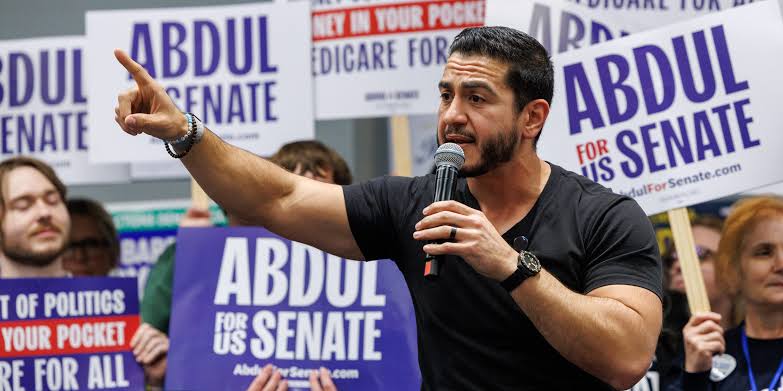
U.S. Senate candidate Abdul El-Sayed speaks at the Michigan Democratic Party Endorsement Convention in Detroit on April 19, 2026. Photo: Andrew Roth/Sipa USA via AP
I’m only 16 years old.
I can’t vote. I don’t hold public office. But like millions of teenagers, I will inherit whatever America today’s voters choose to build.
That is why the possibility of Abdul El-Sayed becoming a United States senator deeply concerns me.
This election is about far more than one Senate seat. It is about the direction of our country, the values we defend, and whether the next generation inherits a civilization confident enough to protect freedom, or one too afraid to stand for it.
For years, we’ve watched a dangerous trend spread across college campuses, social media, and even our political institutions. Anti-Western rhetoric has become fashionable and even celebrated in some circles. America’s founding principles are increasingly dismissed as something to apologize for instead of preserve. America’s allies are scrutinized more harshly than its adversaries. Extremism is too often excused when it comes wrapped in the language of “justice.”
As a proud American Jewish teenager, I have watched antisemitism explode in ways my grandparents never imagined they would see again. I’ve been called names online simply because I support a country the size of New Jersey. Some of my closest friends have hidden their Jewish identities out of fear. Across the West, hatred that many believed belonged to history has returned with shocking speed.
This isn’t just a Jewish problem.
This is an American problem.
When hatred toward one minority becomes acceptable, the principles that protect everyone begin to erode.
That is why this Senate race matters.
Abdul El-Sayed’s candidacy represents a larger debate about the future direction of the Democratic Party, America, Western Civilization and the values that should guide our foreign policy.
El-Sayed has been a vocal critic of US policy toward Israel and has called for ending unconditional military aid to Israel. His campaign has also been associated with figures such as Hasan Piker, a political commentator whose rhetoric on America, Israel, and Western institutions has sparked intense controversy. To many Americans, this represents a much larger question than one country’s foreign policy, it’s simply about confronting rising extremism and defending the values that have shaped the free world.
This is not about Israel. It is about America and Western Civilization as a whole.
The decisions made by American leaders affect our national security, our alliances, and the future stability of the world. When elected officials embrace policies or movements that many believe weaken America’s ability to confront its enemies or support its allies, every American has a reason to pay attention.
As someone who has spent years documenting the realities of anti-Americanism and antisemitism, visiting communities affected by terrorism, and speaking with survivors and leaders on the front lines, I worry about what these policies could mean for America’s closest allies and for the global fight against extremism.
At a time when Jewish communities around the world are experiencing historic levels of hatred, when democratic allies face serious threats, and when America’s enemies are watching closely, I believe strength, clarity, and moral confidence are more important than ever.
The United States Senate is not merely another political office. Senators shape foreign policy, confirm judges, influence national security, and determine the direction of America for decades. The people elected today will make decisions that affect my generation long after today’s headlines fade away.
Whether you support or oppose Abdul El-Sayed, I urge you to carefully examine his record, his priorities, and the vision he brings to the country. Elections deserve serious thought because the consequences extend far beyond one campaign.
My generation has grown up in an age where algorithms reward outrage over truth, slogans over substance, and ideology over dialogue. Too many young people are learning history from viral videos instead of books, and politics from influencers instead of facts.
Western civilization is not perfect. No civilization is. But it gave the world constitutional government, individual liberty, freedom of speech, religious freedom, scientific advancement, and the rule of law. Those ideals are worth improving, certainly not abandoning.
History teaches that free societies do not disappear overnight. They weaken gradually, one compromise at a time, when people stop defending the institutions and values that made them free in the first place.
As someone who has spent the last several years speaking with government officials, terror survivors, released hostages, military leaders, lawmakers, and students across the world, I have learned one lesson above all others:
Freedom survives only when good people refuse to be complacent.
I’m 16 years old.
I cannot cast a ballot.
But I can speak.
And I hope those who can vote understand what is at stake, not only for today’s America, but for the generation that will inherit it.
Related Topics