
The Seven-Word T-Shirt Test
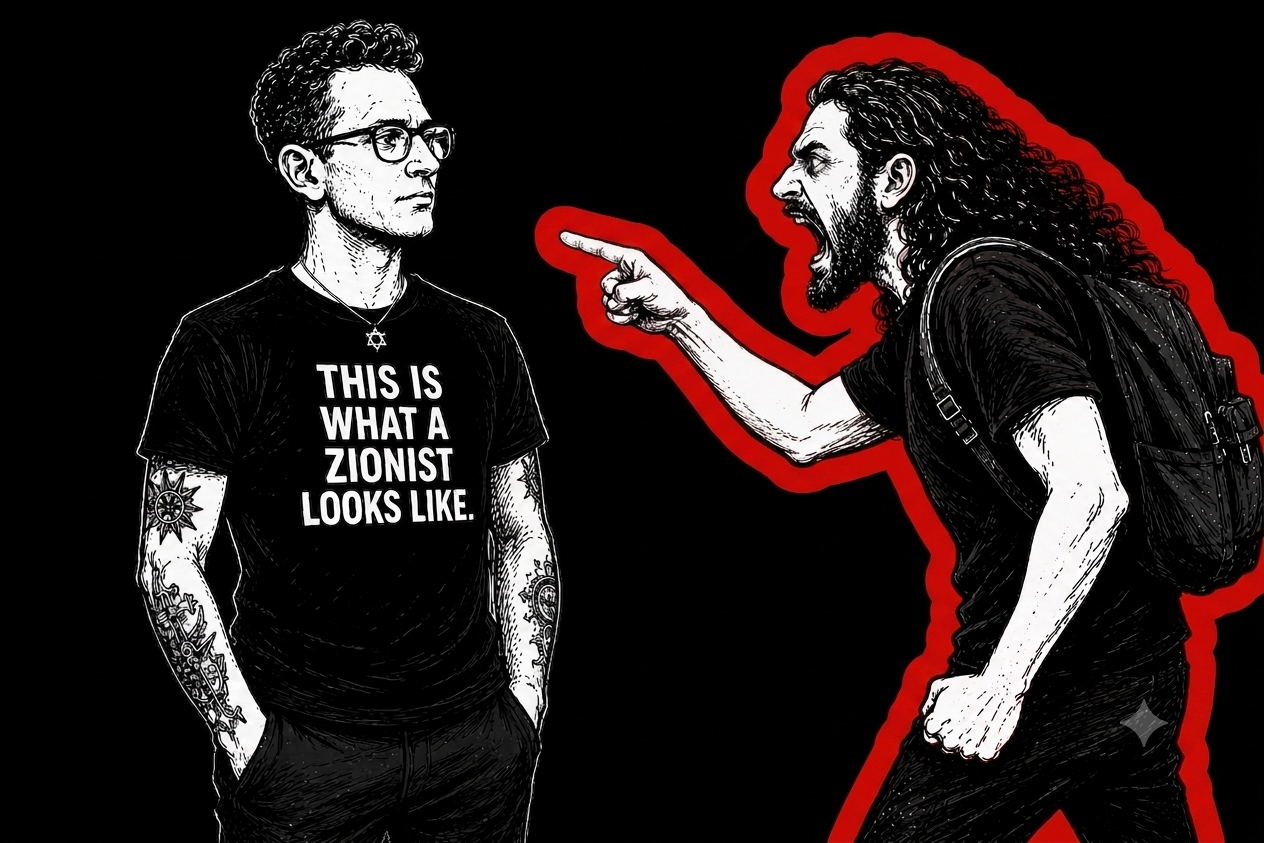
I don’t know how, but I noticed that something was off before he even opened his mouth.
Surrounded by crowds of people eating lunch, NYU students posing for graduation photos, and tourists soaking up the early summer sun, my mother and I sat in the shade, people-watching and taking in the improbable peacefulness of Elizabeth Street Garden. Then, as if out of nowhere, a tattooed, long-haired man—someone who looked as though, in another life, he might have been part of my social circle—did a double take at my shirt.
“Are you proud of what you’re wearing?” he asked, his irritation unmistakable.
“I am,” I replied. “I actually made it.”
That was all it took.
Keeping his distance not out of respect, but—so I could only assume—out of pure hatred, he began shouting. Before long, he launched into one ideological talking point after another, citing debunked statistics, making false accusations, and recycling slogans he seemed to mistake for arguments. Though I remained calm, responded respectfully, and repeatedly tried to engage him in civil conversation, he only grew more agitated. Eventually, he told my mother and me to go back to where we came from.
He wasn’t drunk. He wasn’t high. He wasn’t mentally unwell. He was just another hate-filled guy eating lunch in downtown Manhattan.
Though my mother wanted to leave, I refused. I would not let a hateful stranger drive us out of a public garden. I would not let his tirade determine where I could or could not be. If I ever “went back to where I came from,” it would not be because a full-grown adult, consumed by hatred and throwing a childlike tantrum, had ordered me to. Keeping my voice calm, my posture steady, and my temper in check, I stood my ground. Only after I returned home did my hands begin to shake.
I was not shaken because one man hated me. I was shaken by how casually that hatred had erupted in one of the most beautiful corners of New York City. I was shaken because hatred had simply become part of the landscape. I was shaken because nobody seemed to even bat an eye.
I hadn’t insulted him. I hadn’t threatened him. I hadn’t mocked him or even looked in his direction before he spoke to me. I hadn’t started a conversation, let alone an argument. My mother and I had simply been sitting in the shade, enjoying a beautiful afternoon in one of New York City’s most peaceful public gardens. All it took was a black cotton T-shirt.
Not a weapon. Not a flag. Not a political speech. Just seven words. Seven words that made part of me impossible to miss. Seven words that, in another lifetime, might not even have earned a second glance. Seven seemingly innocuous words printed across my chest:
THIS IS WHAT A ZIONIST LOOKS LIKE.
Why had those words enraged him? What was so offensive about publicly identifying myself as a Zionist? How had Zionism—the belief in the Jewish people’s right to self-determination in their ancestral homeland—become so controversial? When he looked at my shirt, what did he think he was seeing?
The answer, I eventually realized, had little to do with the words printed across my chest. He was not reacting to what the shirt actually said. He was reacting to everything he had been taught the word “Zionist” represented. Long before he even saw me, an ideology had already decided what he would see. That ideology is what I call American Intellectual Antisemitism.
Presenting itself as morally urgent and intellectually sophisticated, American Intellectual Antisemitism operates through a remarkably simple trick. It reduces a complex national, historical, political, and religious conflict to a childlike story of oppressors and oppressed, then forces every fact, event, and person into one category or the other. Beginning with a moral conclusion, it bends history, evidence, and language to fit it. “Genocide” becomes a libel detached from intent, evidence, or context. “Apartheid” becomes an empty slogan divorced from history. Loyal to the ideology rather than the truth, the goal of American Intellectual Antisemitism is not to describe reality. Its goal is to replace it.
Of all the words distorted through this process, none has suffered more than “Zionism.” Once associated with Jewish return, revival, and self-determination in the Jewish people’s ancestral homeland, Zionism has been dragged through the ideological mud and transformed into a catch-all term for racism, colonialism, supremacy, and unrestrained violence. Once its actual definition ceases to matter, American Intellectual Antisemitism redefines Zionism however it wishes to do so and then condemns the caricature it has itself created.
The truth could hardly be more different.
Long before Zionism became a modern political movement, the longing it organized found continuous expression in the Jewish people’s spiritual bond with, and physical presence in, the land of Israel. Modern Zionism did not invent that longing. It simply organized it, offering Jews the possibility of taking their collective fate into their own hands.
That, in essence, was what my shirt meant. It was neither an endorsement of any particular Israeli government nor a statement about the current war. It simply expressed my belief that the Jewish people deserve the same right to self-determination as every other people. Yet when the man in the garden looked at my shirt, he did not see that belief. He saw the caricature an ideology had placed over it. He did not see a son spending an afternoon with his mother. He did not see a father of two young children, a former professor, or a fellow New Yorker. He saw a colonizer, a supremacist, and a genocidaire. He wasn’t screaming because he understood what Zionism meant. He was screaming because he saw only what he had been taught to see.
Ironically, the man’s reaction is precisely why I made the shirt. Not because I wanted to provoke hatred, but because I refused to surrender my identity to it. Every time I pull that shirt over my head, I reclaim a word others have tried to turn into a slur. That shirt puts a human face back onto a word American Intellectual Antisemitism has spent decades trying to dehumanize. That shirt is my refusal to hide who I am.
Visibility changes societies because it changes what people believe is normal. With every thumbs-up on the street, every “thank you for wearing that” on the subway, and every “I wish I had your courage,” I am reminded that I wear the shirt not only for myself, but for every other Jew who wants to stop hiding. I am reminded that every visible Zionist makes it easier for another to be visible. Concealment is contagious, but so is courage.
That is why my shirt is more than just an assertion of my identity. It is also a test. Every time I wear it—whether to a public garden, a darkened pub, a college campus, or a neighborhood café—I learn something about the society around me. Whenever I wear it without a second thought, I learn one thing. Whenever I hesitate before putting it on, I learn another. The shirt has become my own personal litmus test, revealing where I can comfortably be myself and where my identity must first pass someone else’s ideological inspection.
The point is not to make everyone wear my shirt. It is not even to make everyone agree with the words printed across it. The point is to show that we Jews have the same right as everyone else to be ourselves in public. The point is to refuse to apologize for who we are.
So take the test. Wear this shirt or make your own. Put on a Magen David, an Israeli pin, or anything else that makes your Zionist identity visible. Notice who smiles, who thanks you, who recoils, and who treats your mere presence as a provocation. Every time you do, you’ll learn something new—not only about the people around you, but about society itself.
The day those seven words no longer feel safe on the streets of New York will be the day I know it’s time to leave. Until then, I will keep wearing them. Because the goal is not a society where every Jew wears a Zionist shirt. The goal is building a society where wearing one requires no courage at all.
–
American Intellectual Antisemitism: The Anti-Jewish Movement Tearing Through Our Universities (Wicked Son/Post Hill Press) is now available for pre-order.