Jewish DNP-CNM student sharing Torah-rooted birth wisdom
The Shame of Silence, the Necessity of Rest
Alta Franco
I didn’t expect to encounter open political hostility toward Jews during my graduate nursing program. But that is exactly what happened; casually, publicly, and without anyone blinking.
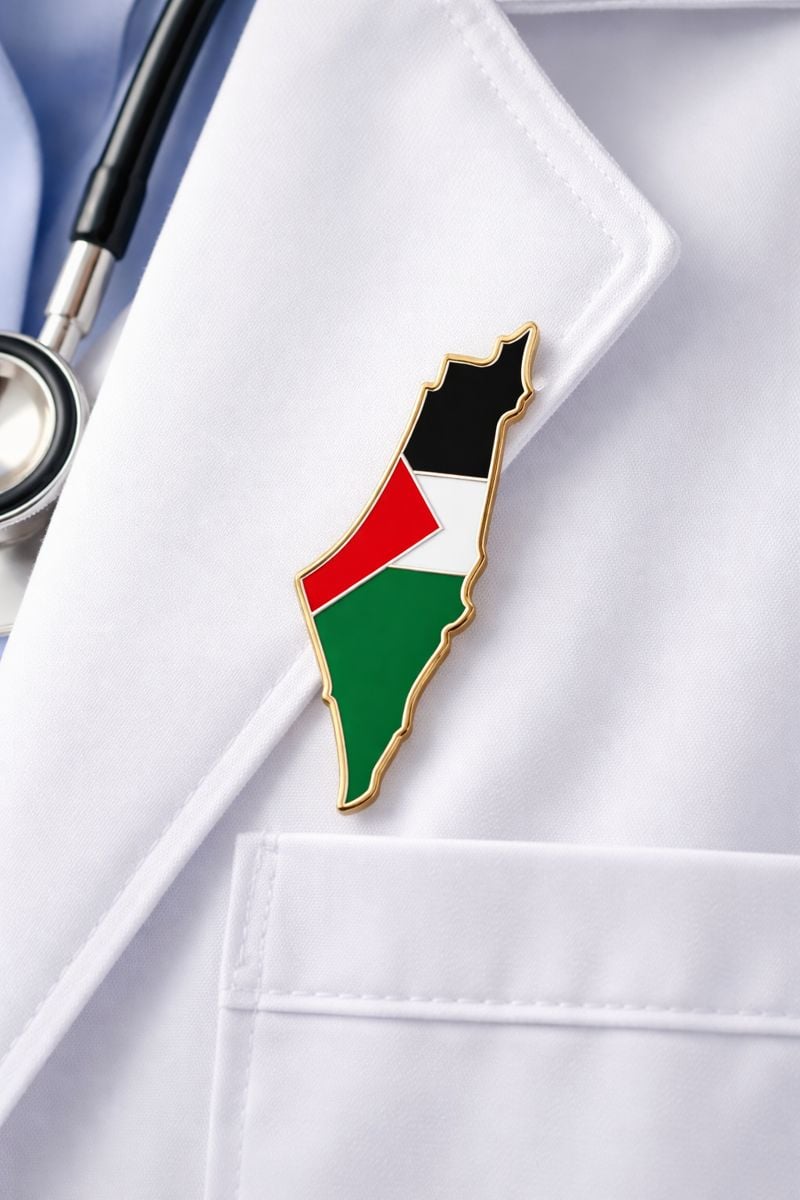
I was walking behind a preceptor when I noticed it: a pin on their badge shaped like the State of Israel, filled in with the Palestinian flag. Not a peace symbol. Not a coexistence message. A map that replaces Israel with another nation. A visual argument for erasing a country and, by extension, its people. They wore it alongside their hospital ID, as if it were no different from a Pride sticker or a stethoscope charm. And no one reacted. Not students, not faculty, not preceptors. In a clinical environment that audits our professionalism down to our shoelaces, an erasure symbol was treated as entirely acceptable. This is how antisemitism often manifests in progressive spaces. Not through slurs or vandalism, but through symbols and statements so normalized that questioning them becomes the real offense.
Healthcare prides itself on cultural sensitivity and trauma-informed care. Yet somehow, antisemitism is allowed to exist as an “exception”. Too political to confront, too “complicated” to name. But it isn’t complicated. A symbol advocating the elimination of the world’s only Jewish state is not nuance. It is hate.
Bias in healthcare is not theoretical. It shapes who is believed, whose pain is dismissed, and whose humanity is instinctively recognized. If a provider can comfortably wear an erasure symbol on their badge, how will they treat a visibly Jewish patient? Or a Jewish colleague or student with a Hebrew name?
Research shows that bias in clinical settings, explicit or implicit, affects communication, diagnostic accuracy, and patient trust. When antisemitism is treated as “too political” to acknowledge as bias, it undermines those commitments.
Jewish students in healthcare programs across the country report similar experiences. After October 7, antisemitic incidents on U.S. campuses tripled. Jewish students in health professions describe avoiding self-identification and fearing academic or social repercussions if they challenge antisemitic rhetoric.
When I reported the pin, the legal department told me it was ‘protected speech.’ Perhaps, but so is wearing a white supremacist emblem or a pin endorsing conversion therapy. Protected speech is not professional conduct. This is not a call for censorship. It is a call for consistency, integrity, and the recognition that Jewish safety is not optional. Institutions must explicitly recognize antisemitism as a form of bias, apply professionalism standards uniformly, and ensure faculty are trained to identify and address contemporary forms of antisemitism, including symbolic erasure.
The Moment I Tried to Speak
Ironically, during a lecture on positionality and power dynamics in healthcare, I carefully tried to raise the issue. I did not mention the exact pin, but instead, albeit poorly, described what such political statements might feel like for patients experiencing the most vulnerable days of their lives. The conversation immediately shifted into rehearsed statements about how supporting one group does not diminish support for another. But that wasn’t the conversation I wanted to have.
To explain fully would have required vulnerability: speaking openly about my Jewish identity, the rise in antisemitism in this country and on my campus, and the fear I weigh each time I decide whether to take my children to Jewish events, a decision I had had to make almost every night that week. I would have needed to articulate why the existence of the Jewish state matters to me, why symbolic erasure is not neutral, and why seeing that symbol on a provider’s uniform feels like a threat.
My internal voice began calculating the cost. If I spoke, I would need to regulate my emotions, steady my voice, and deliver a concise, neutral history lesson to my peers. I was being asked, once again, to turn generational and modern-day trauma into a teachable moment. That is not my job. My job was to learn the political theory being taught. And yet, my responsibility was also to truth, to Jewish patients facing discrimination, and to my ancestors who had no voice in this room.
I am usually ready for that conversation. Anyone who knows me knows how deeply I love being Jewish. My pride, strength, and resilience come from that identity. I am used to advocating for my people’s right to exist. But in that moment, I couldn’t. I was exhausted. I did not want to argue for my right to feel safe. I did not want to defend why Jewish lives are worth protecting. I did not want to justify the legitimacy of my fear. So I stayed silent.
And as I drove home, the familiar cocktail of anger and disappointment settled in. I am strong. I am capable. I am a fighter. And yet I nodded along instead of using my voice. My mother would have been so disappointed.
I called a colleague I’ve collaborated with on Jewish safety initiatives on campus. He stood with me when our university was pressured to denounce Israel, days after October 7, using rhetoric rooted in misinformation, racism, and violence.
I told him what happened. He listened. He reminded me that silence does not equal failure. Choosing self-preservation is not a weakness. Jews are allowed to rest, even in the face of hostility. Constant vigilance is not sustainable. Protecting my emotional well-being is as legitimate as speaking out.
He also reminded me that the work continues. There will be other moments. And in those moments, I will speak again.
Because I stayed silent in that classroom.
Because Jewish providers and patients navigate an increasingly hostile healthcare environment toward them.
Because symbols matter.
Because power dynamics matter.
Because positionality matters.
Because free speech does not mean freedom to intimidate patients.
The people caring for laboring families, the ones holding space for life’s most sacred moments, should not be wearing symbols advocating the destruction of another people’s homeland.
We can support vulnerable populations without erasing others. We can champion human rights without endorsing hatred. And we can create safe healthcare environments only when we acknowledge that Jews, too, deserve safety.
Today I rested. Tomorrow, I will speak again.
Related Topics