
Author of a new book, "The Dangerous Covenant"
The Shameless World
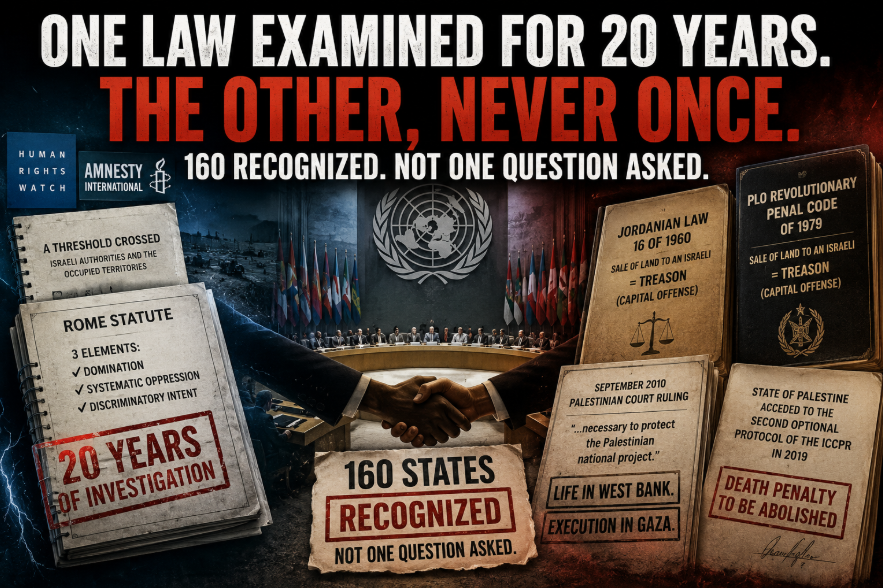
In June, in New York, the diplomats gathered again. Saudi Arabia and France sat at the head of the table. By the week’s end, some 160 states recognized a Palestinian state that does not yet exist — no agreed borders, no army answerable to a single command, no election held since 2006. The recognitions were described as a moral necessity, long overdue. Nobody at that table called the entity they were recognizing an apartheid state. That silence is worth examining — not for what was said, but for what an entire legal architecture, built over twenty years, has never once been asked to say.
The word “apartheid” did not arrive casually where it has been applied. It arrived through work. Human Rights Watch spent years compiling A Threshold Crossed, mapping Israeli law against the Rome Statute’s three elements: domination, systematic oppression, discriminatory intent. Amnesty International followed with its own investigation, tracing what it called four strategies of control across four decades. The UN Committee on the Elimination of Racial Discrimination issued findings against Israel in 2007, again in 2012, again in 2019. Special Rapporteurs to the Human Rights Council — Dugard, Lynk, Albanese — filed successive reports building the same case from different angles. Whatever one concludes about its findings, this is not a slogan. It is a juridical campaign, built citation by citation, converting policy outcomes into legal intent through two decades of sustained argument. Someone built that machine, deliberately, over a long time.
Now turn to the other side of the map. Jordanian Law 16 of 1960, still governing the West Bank, and the PLO’s Revolutionary Penal Code of 1979, still governing Gaza, both classify the sale of land to an Israeli as treason — a capital offense. In September 2010, a Palestinian court reaffirmed the principle explicitly, in writing: the ruling was necessary, the prosecution said, “to protect the Palestinian national project.” President Mahmoud Abbas has not signed an execution order since 2006, so in the West Bank the sentence that lands is typically life with hard labor — the Palestinian-American Issam Akel received exactly that in 2018 for selling a house in Jerusalem. In Gaza, under Hamas, no such restraint applies; executions for this and related offenses have proceeded without any presidential signature at all. And beneath both jurisdictions, less visible than any courtroom, men have been killed outside any trial for the offense of having sold. No Israeli, no Jew, has any lawful path to residency or citizenship in the territory the Palestinian Authority administers, or in the state its founding documents describe. This is not inferred from settlement patterns or checkpoint maps, requiring years of legal reconstruction to establish intent from effect. It is written into the code as intent from the start — and in 2019 the State of Palestine acceded to the Second Optional Protocol of the ICCPR, binding itself in writing to work toward abolishing the death penalty. The treaty and the treason statute have coexisted for seven years. No institution has asked which one governs.
That is the asymmetry, stated plainly. On one side, twenty years of institutions laboring to establish intent from policy outcomes. On the other, an explicit statute needing no such labor, sitting in open tension with its own author’s signed treaty obligation — and it has drawn not one UN report, not one Special Rapporteur mission, not one NGO investigation of the kind mounted against Israel. Amnesty International, which produces detailed annual findings on Israeli land law, has never produced an equivalent study of Jordanian Law 16 or the PLO Penal Code. Human Rights Watch, which built a three-hundred-page case from years of indirect evidence, has never opened a comparable file on a direct, still-standing capital statute. The apparatus that took two decades to construct against one party has never once been turned toward the other. Not for lack of evidence — the evidence sits in open court records and a signed international treaty. For lack of interest.
The same asymmetry holds inside the institutions built specifically to hold Israel accountable — worth noting precisely, because the two clearest cases are documented to different standards. Take Jewish Voice for Peace, America’s largest Jewish anti-Zionist organization, some 32,000 dues-paying members. Across two years of war, how many times has JVP publicly demanded that Hamas release the hostages, disarm, or stop firing from Gaza’s hospitals and residential blocks? Not once, as a demand addressed to Hamas directly. The tally of demands aimed at Israel and at JVP’s own government runs into the dozens. The organization explains the asymmetry itself, in its own FAQ, unprompted: it doesn’t consider it its place to tell Palestinians what political outcome is right for them. Telling Israel is precisely its mission. Take B’Tselem next, Israel’s oldest and most-cited human rights organization, author of the 2021 report calling Israel a “regime of Jewish supremacy.” Here the evidence is firmer still — it sits in the organization’s own founding charter, which states that when B’Tselem was established in 1989, it limited its mandate to the West Bank and Gaza, the sector of Israeli responsibility, and refrained from addressing human rights inside Israel itself, let alone Hamas’s conduct in Gaza. That is not a drift in priorities. It is a founding principle, in writing.
The recognitions themselves make the pattern legible. The statements from London, Ottawa, Canberra, Paris last September came wrapped in conditions: Hamas must disarm, the Authority must hold elections, governance must be reformed. These are real conditions, worth stating plainly. But read them closely, and not one mentions the law that forbids a Jew from owning land or residing within the borders of the state being recognized. A hundred and sixty governments found room to condition recognition on election timetables. Not one found room to condition it on this.
None of this is an argument that the case built against Israel is false; that is a separate discussion, requiring its own reckoning with the Rome Statute’s elements and the CERD findings on their own terms. What it establishes is narrower, and I think more damning: a fully built, tested legal instrument sits unused before an explicit statute that would require no construction at all to indict. That is not a gap in the law. It is a decision, made somewhere, about which party gets investigated and which gets recognized without ever being asked the question.
They call it recognition. It reads more like a verdict rendered in advance — not because the facts were weighed and found wanting, but because for one side, the facts were never going to be requested. Indifference has no address. This has one. It sat in the room in New York in June, signed a hundred and sixty names, and felt no need to explain why the statute on its own author’s desk went unread.
Related Topics
Related Posts