
The Sin of Jeroboam and the Tragedy of Big Boss
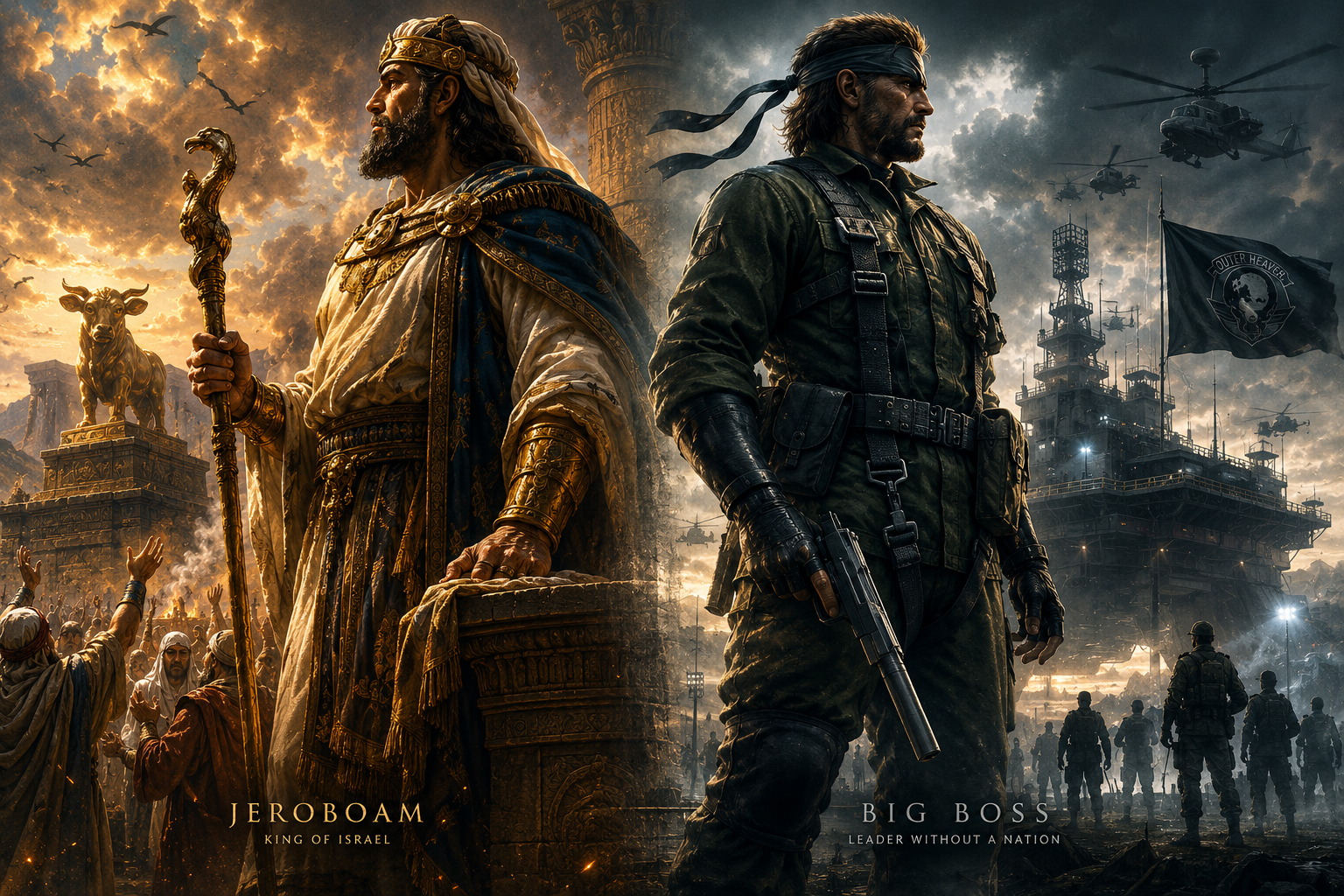
One of the recurring refrains in the books of Kings is that later rulers of Israel “walked in the sins of Jeroboam.” The phrase appears so often that it becomes almost liturgical. Jeroboam’s actions are not treated merely as personal failures, but as a turning of the civilizational wheel that reshapes the moral and political trajectory of generations to come.
Oddly enough, one of the closest modern fictional parallels to Jeroboam may be Big Boss from the Metal Gear series.
This is not because the two men are aesthetically similar. One is a biblical king presiding over the fragmentation of ancient Israel; the other is a fictional soldier navigating the geopolitical chaos of the late Cold War. The similarity lies deeper. Both men respond to genuine crises of legitimacy by constructing alternative sovereignty structures that eventually perpetuate the very disorders they hoped to escape.
Importantly, the biblical narrative does not initially portray Jeroboam as a straightforward usurper or villain. The division of the kingdom emerges from a broader collapse already underway. Solomon’s reign had become increasingly burdened by excess, forced labor, and idolatrous accommodation. When the people ask Rehoboam, Solomon’s son, to lighten these burdens, he responds not with wisdom but with arrogance: “My father chastised you with whips, but I will chastise you with scorpions.”
The kingdom fractures immediately afterward.
Even more significantly, Jeroboam’s rise is framed through prophetic legitimacy. The prophet Ahijah tells him that God will tear the kingdom away from Solomon’s house. Jeroboam therefore initially appears not as a destroyer of Israel, but almost as a corrective force arising from the failures of the Davidic monarchy itself.
That nuance matters because the “sin of Jeroboam” is not simply that the northern kingdom existed. The problem emerges in how Jeroboam chooses to stabilize it.
Fearing that continued pilgrimage to Jerusalem will eventually draw the northern tribes back under Davidic authority, Jeroboam establishes alternative centers of worship at Bethel and Dan. The move is politically rational. He is attempting to preserve the sovereignty and cohesion of the northern kingdom.
But in solving the political problem, he institutionalizes a spiritual deviation that later generations inherit as normal.
That is why the text continually returns to him. Jeroboam’s significance is not confined to his own reign. He alters the possibility space of the civilization itself.
Big Boss undergoes a remarkably similar transformation in Metal Gear Solid: Peace Walker.
At the conclusion of the game, Big Boss has lost faith in the moral legitimacy of nation-states. The sacrifice of his mentor, The Boss, becomes the central wound around which his worldview crystallizes. Rather than accepting her final sacrificial act as a transcendence of war, he interprets it as betrayal: the abandonment of the warrior identity itself.
Like Jeroboam, Big Boss is responding to real failures. The world around him is increasingly unstable, manipulative, and morally hollow. States treat soldiers as disposable instruments. Covert systems supersede democratic accountability. The old order is visibly eroding while a new one has not yet fully arrived.
His response is not nihilism, but the construction of an alternative sovereignty structure. Outer Heaven and Militaires Sans Frontières become attempts to establish autonomous territory for soldiers outside the control of nations. Like Jeroboam, Big Boss believes he is preserving something essential from a collapsing legitimacy order.
And like Jeroboam, he is not entirely wrong.
This is precisely what makes the tragedy compelling.
Outer Heaven initially appears defensive rather than expansionary. It is framed as protection for soldiers discarded by states. Yet over time, its existence becomes dependent upon the perpetuation of militarized conflict itself. A society built around warrior sovereignty acquires strong incentives for war to remain permanent. What begins as refuge gradually transforms into ontology.
The same dynamic appears in Jeroboam’s reforms. Once alternative worship structures are established, the political system itself becomes dependent upon maintaining separation from Jerusalem. Emergency measures harden into inherited institutions. Future generations are born into systems they did not choose.
The books of Kings understand this phenomenon with terrifying clarity. Sin is never merely individual misconduct. It becomes institutional, ritualized, geographic, and self-reinforcing. A founder turns the wheel, and later generations inherit the momentum.
This is why both Jeroboam and Big Boss are tragic figures rather than simple villains.
Neither begins from pure malice. Both respond to genuine instability. Both seek preservation. Both believe they are protecting their people from absorption into systems they no longer trust.
But both create alternative orders that eventually reshape the souls of those living within them.
The tragedy is not simply that they sinned. The tragedy is that their solutions became civilizationally generative.