Advancing Women's Health, One Policy at a Time
Featured Post
The sirens only we can hear
This isn't a plea to be nicer. It's a reminder that Israelis exhausted by years of war need compassion as much as they need security
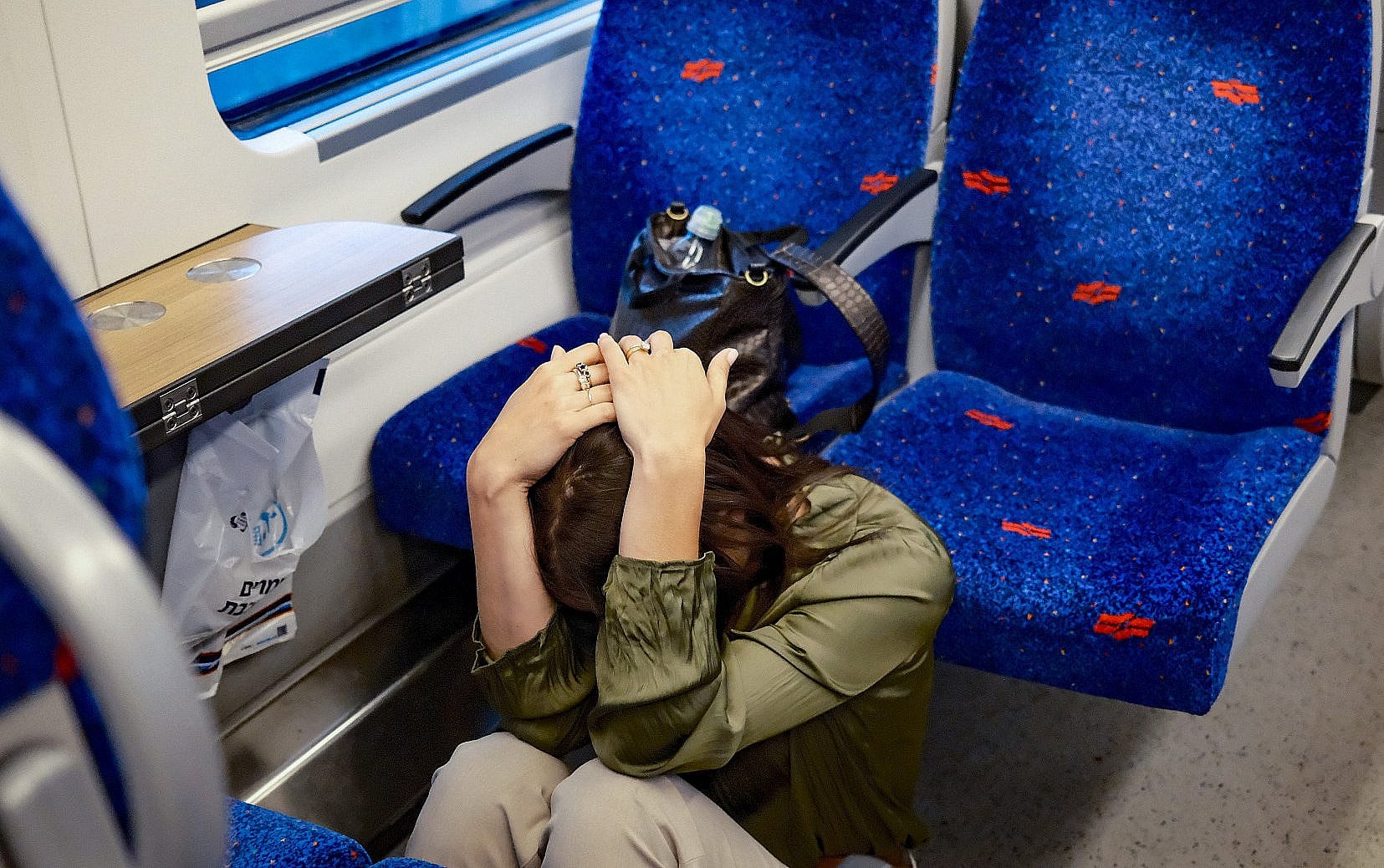
People take cover as siren warns of incoming missile fired from Yemen, on the train in Jerusalem, May 13, 2025. Photo by Dor Pazuelo/Flash90
I came home one morning after one of those night shifts, deep into the COVID-19 pandemic, where we did not stop moving for eight hours straight. Literally. We did not eat, drink, or sit down for a second. I had been in two cesarean sections, cared for more women than I can remember, run endlessly back and forth from the COVID ward to the labor and delivery ward, and delivered five babies.
I got home, situated each kid in their Zoom classes, put in the laundry, did the dishes, cleaned up the house and collapsed on the couch. I don’t even remember falling asleep.
Suddenly, I was jolted awake.
Somewhere, I could hear the sound of fetal bradycardia (a slow fetal heart rate).
I listened, trying to work out where the sound was coming from, my eyes barely open as I scanned the room.
My living room.
Rubbing my eyes it dawned on me. It was the dishwasher.
The water inside was pulsing at around 60 beats per minute, perfectly acceptable for a grown-up human and, apparently, a dishwasher, but dangerously slow for an unborn baby.
I chuckled to myself and started to lie back down.
That’s when I noticed… I was standing.
I had not consciously decided to stand up. I don’t remember moving. But there I was, on my feet, my heart pounding, my head cocked towards the sound, my hands clenched, and my knees bent slightly, as though preparing me to run and find a fetus in distress. I had no recollection of any of it happening.
Somewhere between deep sleep and full consciousness, my brain had detected a sound, identified it as someone in danger, roused me, stood me up, and prepared my body to respond.
All because of a dishwasher humming at 60 beats per minute.
In Israel, when there is a credible threat of an incoming missile attack, there is usually a specific progression of events. The news begins reporting that something may be coming. The Home Front Command changes its instructions. Schools or workplaces may close. We check that the protected room is ready, make sure the children know where to go, charge our phones, and wait. Then, when an actual missile is detected, the alert sounds on the Home Front Command app on our phones and the air-raid sirens begin.
So you can imagine my complete confusion when, during my run today, an air-raid siren suddenly began blaring with zero prewarning.
My response was immediate and entirely subconscious. I began looking for shelter. My eyes scanned my surroundings, eventually settling on the thick stone walls of the Old City in Jerusalem, while my brain calculated how quickly I could sprint towards them. My heart sped up, my body tensed, and I sprinted.
That’s when I realized, nobody else was reacting.
People were walking normally. Cars continued driving. Nobody was running, looking at their phones or searching for somewhere protected. Everyone was simply going about their day.
Then the music in my headphones continued, and I understood.
Spotify had randomly played me a song by someone named Willyecho called, “I Don’t Know What Else You Want from Me”. The first 7 seconds is an air-raid siren. (Here is the link for you to hear what I heard, so you don’t think I’m crazy. Play it quietly if you are in a war zone because, trust me, people around you will respond).
Nobody else reacted because nobody else could hear it.
Only me.
For nearly three years, our country has lived in an almost perpetual state of crisis, moving between war, missiles, funerals, reserve duty, hostage negotiations, unbearable pain, and brief periods in which we try to convince ourselves that life has returned to normal. But even in the quieter moments, part of us remains tense, waiting for the next notification, the next siren, the next phone call. We are surrounded by soldiers, survivors, bereaved families, returned hostages, displaced communities, emergency workers and children who learned to recognize the sound of an incoming missile long before they’ve learned long division. Our bodies and minds have been required to remain ready for danger for far too long.
Research has extensively documented the impact of chronic high pressure on a human being. We each have an automatic alarm system. It is part of the autonomic nervous system, whose two main branches are often described as “rest and digest” and “fight or flight.” The fight-or-flight response is built to be efficient and immediate. It can accelerate the heart, tense the muscles and prepare us to act before the conscious mind has fully understood what is happening. And when we live under stress for long enough, that alarm can become easier to trigger and harder to quiet, remaining close to the surface even when, for the moment, everything appears to be fine, like a constant pressure cooker waiting to go off.
It’s what makes a midwife’s tired brain interpret a dishwasher as fetal distress and a siren in a song elicit a subconscious sprint.
But while we may all be living in the same pressure cooker, we are not all hearing the same sirens.
Mine happened to be a dishwasher and a song. For someone else, it may be fireworks. A motorcycle backfiring. The smell of smoke. A helicopter overhead. A knock at the door. A phone call from an unknown number. A message that goes unanswered.
All around us, people are reacting to sirens the rest of us cannot hear. And because we cannot hear them, we assume the reaction began with us. We are yelled at in the supermarket, honked at in the street or spoken to with an anger that seems completely disproportionate to the situation. We, of course, respond in kind, and suddenly, one person’s siren has become another person’s siren. The reactions spread. One exhausted nervous system activates the next, until we are all responding to one another as though we are each threats.
In medicine we learn that when the body’s alarm system takes over, the first thing we need to do is slow it down. Breathe. Take a moment. Look around. Feel the ground beneath your feet. Work out where the sound is coming from.
Is the danger here, now? Or is the siren only playing through your headphones?
Then we need to offer that same pause to the person standing opposite us. Before we answer anger with anger, impatience with impatience, and fear with more fear, perhaps we need to breathe long enough to ask what they may be hearing that we cannot.
And then, from that place, respond with compassion.
This is not some metaphorical Hallmark-card plea for everyone to be kinder to one another. It is completely literal. When people are already tense, exhausted, and braced for danger, the way we respond can either set off another alarm or give the mind a chance to catch up with the body.
Had you heard the dishwasher through the ears of an exhausted midwife, you would have understood why I was suddenly standing, and had you put on my headphones, you would have run too.
I needed only a few seconds to recognize that the fetal heart rate was a dishwasher. I needed only the next few notes of the song to understand that no missile was coming.
We need to give ourselves and each other those same precious seconds.
A breath.
A pause.
Enough time to hear the next note.
Because the bombs may not be falling in that moment, but the person beside us may still be taking cover.
Related Topics