
The Slavery Next Door, and the Apartheid Slur Aimed at Israel
A documented record of hereditary bondage, migrant auctions, kafala, and a Yazidi captive in Gaza—set against a Western vocabulary that reserves “apartheid” for Israel.
Western capitals still treat “apartheid Israel” as settled moral language. Meanwhile, documented slavery and slave-like systems persist in Arab states that are almost never asked to answer for them—and Gaza is part of that record, not an exception to it.
Start with the present, not the seventh century.
Mauritania: hereditary slavery after abolition
Mauritania was the last country on earth to outlaw slavery, in 1981. Parliament only criminalized the practice in 2007. The practice did not end. The BBC, citing Walk Free’s 2023 Global Slavery Index, still put the figure at about 149,000 people enslaved—roughly 3 percent of the population. Field reporting has described the same hereditary system for years; see The Guardian on bondage after formal abolition. UN Watch told the Human Rights Council in 2026 that hereditary bondage of the Haratin continues and that anti-slavery activists are still harassed. The U.S. State Department Trafficking in Persons report records that prosecutions for hereditary slavery remain rare. This is a living hierarchy over Black descendants of the old trans-Saharan trade—not a colonial relic invented in Brussels.
Libya: markets, detention, and a trafficking business model
In 2017, journalists filmed Africans sold at auction in Libya. That was not a closed chapter. A joint UNSMIL–OHCHR report on 2024–2025 describes trafficking, ransom, sexual slavery, and the sale and transfer of migrants as a business model involving armed groups and state-linked actors. The 2025 U.S. Trafficking in Persons report on Libya records thousands of migrants in official and unofficial detention, forced labor, and sex trafficking. Sub-Saharan Africans remain the principal victims. Academic work has described this as a renewed slave trade in Libya, 2015–2024. The Sahara-to-Maghreb route never fully closed; it changed owners.
The Gulf: kafala as legal control over migrant labor
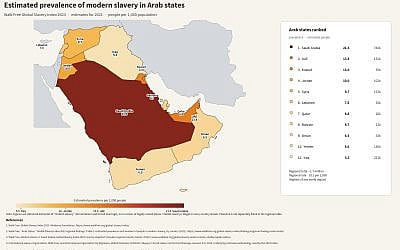
Under kafala, a migrant’s legal existence is tied to a sponsor. The Council on Foreign Relations describes a system that facilitates modern slavery. Human Rights Watch reports that abusive elements remain in Qatar after World Cup labor reforms. The Guardian documented domestic workers across the Gulf whose conditions meet UN trafficking indicators: passport seizure, no exit, violence, unpaid labor. Walk Free ranked Saudi Arabia first in the Arab region for estimated people in modern slavery. Rights groups continue to describe Gulf sponsorship rules as structurally exploitative. This is not ordinary wage bargaining. It is a legal architecture of control over foreign labor, including large African and Asian workforces.
Gaza: residue of the trade, trafficking, and one documented captive
Gaza is not running open desert caravans from the Maghreb. Claiming that would be false. What is documented is different, and still damning.
Afro-Palestinians—many descended from Africans owned by Negev and Gaza Bedouin, or brought through Egypt and the Red Sea—still live as a named minority in Gaza. Anthropologist Susan Beckerleg documented the genealogy in African and Asian Studies (2007): Bedouin families bought or kidnapped African children into the twentieth century; after 1948 some of those families became refugees in Gaza; descendants still reject the label abed (slave/Black). Her field notes from Gaza and the Negev are also archived in her interview material. Contemporary reporting still uses the inherited name: a Gaza neighborhood of African-origin residents called al-Abid / “the slaves’ quarter”, with unofficial estimates of about 1 percent of Gaza’s population. Al Jazeera has separately described Afro-Palestinian communities in Jerusalem, Jericho, and Gaza. The U.S. State Department reports sex and labor trafficking in the West Bank and Gaza, coerced commercial sex in some cases, and that Hamas reported no trafficking investigations.
The owners in that older Jerusalem and Palestinian system were not a Jewish planter class. They were, overwhelmingly, Arab Muslims: Ottoman officials, urban notables, and Bedouin sheikhs. In the 1860s William Hepworth Dixon walked Jaffa Gate and wrote that the man dozing by his mule was “a slave from the Upper Nile” who “belongs to an Arab bey who lets him out on hire”. In a Jerusalem coffee house the waiter was “commonly a negro slave” serving an Arab sheikh. In Jaffa, Dixon named Saïd: “a Nubian, a negro, and a slave… the property of an Arab gentleman.” Edward Robinson, visiting an Arab home in Jaffa in 1838, was washed by that household’s Nubian slave—the same Jerusalem Quarterly survey records these scenes. British officers later described African abid attached to Bedouin tribes and Arab notable families, not to Jewish colonies. The trade that stocked those houses ran through Arab and Ottoman markets from Sudan, Ethiopia, Egypt, and the Sahara.
Scholars who hunted for Jewish slaveholding in Ottoman Jerusalem found it rare enough to treat as news. Joseph Glass and Ruth Kark’s study of Sarah La Preta—an Ethiopian girl bought around 1880—records that the Sephardi banker Haim Aharon Valero purchased her from Arabs in the Old City market. Haaretz noted the paper as the first well-documented case of Jews owning a slave in Ottoman Palestine. Even that purchase was from Arab traders, of a girl already moving through the eastern trade. It does not convert Jerusalem slavery into a Jewish institution.
Gulf News interviewed Mohammad Obaid, a Gazan dabke dancer of Sudanese descent living in Al Jalla’a. He said at least 11,000 Black Palestinians lived in a neighborhood called “Al Abeed”—Arabic for slaves. He had to “prove myself twice as much as others.” Many Black Gazans, he said, were shut out of customer-facing jobs; police treatment had grown worse. That is current social fact inside Gaza, reported on the ground, not a historical footnote.
Current bondage in Gaza is not a public slave souk. It is narrower and still documented. In 2020 Fawzia Amin Sido, kidnapped as a child in Sinjar, was taken to Gaza, sold to a jihadist, forced to “marry,” and made to bear children while still a minor. She later told a UN side event she lived there “for years in slavery”. She was extracted in 2024. Hamas called the rescue story a “false narrative” and said her departure was voluntary. Readers can weigh a survivor’s account against a ruling faction’s press office. The New Arab reported the same path: Sinjar to Turkey, Egypt, then Gaza.
After October 7, 2023, the file widened. The U.S. State Department’s 2025 Trafficking in Persons report on Israel, the West Bank, and Gaza states that Hamas and other groups may have subjected hostages to conditions potentially amounting to sex trafficking and sexual slavery through repeated rape and sexual assault, and that released hostages also described conditions potentially amounting to labor trafficking. The same report records that Hamas identified no trafficking victims and ran no trafficking investigations. That is the current American government’s language, not a slogan.
What experts have been saying
This is not a newly invented talking point. In 1994 Charles Jacobs and the Mauritanian activist Mohamed Athié published “Bought and Sold” in The New York Times, arguing that chattel slavery in Mauritania and Sudan was still a living trade and that major human-rights groups treated Arab enslavement of Black Africans as too “sensitive” to confront. Jacobs co-founded the American Anti-Slavery Group. Three decades later he and Ben Poser wrote in The Jerusalem Post that in Algeria, Libya, Mauritania, and Sudan, Arab and Arabized populations still breed, buy, own, and trade Black Africans. Their point was specific: calling Israel “21st-century slavery” while ignoring actual slaveholders next door is not analysis. It is inversion.
Jacobs returned to Gaza by name. In “Arab enslavement and slaughter of black Africans must stop” (JNS, 2023) and again in “What would MLK do? Demand that Arabs free their black slaves” (JNS, 2026), he noted that a Gaza neighborhood of African-origin residents is called al-Abid, that abid means slave, and that Black Palestinians face job and marriage discrimination—the same pattern Gulf News recorded on the ground. In 2024 he and Poser asked why the human-rights industry fixates on Gaza while African chattel and sex trafficking remain a whisper. One may reject his politics. One cannot say the Gaza naming, the Mauritanian numbers, or the Libyan auctions are his invention. They predate him and survive him in government and press records.
The apartheid irony
Amnesty, Human Rights Watch, and a carousel of UN votes call Israel an “apartheid state.” Arab citizens of Israel vote, sit in the Knesset, serve on the Supreme Court, and hold passports. Critics of Israel can list real grievances—occupation, checkpoints, Gaza’s closure after Hamas’s rule and repeated wars. None of that is hereditary race slavery. None of it is a filmed auction of Black migrants. None of it is a sponsorship law that makes a worker the legal appendage of a citizen-sponsor. None of it is a quarter still named for slaves.
The selective outrage is the point. Mauritania’s Haratin, Libya’s auctioned migrants, Gulf domestics under kafala, a Yazidi girl held as a sex slave in Gaza, and hostages the State Department says may have been subjected to sexual slavery do not fit the preferred script, in which Israel is the unique racial villain of the Near East and Arab societies are only victims. The documents say otherwise. Read them.
Sources (live links)
- BBC: Mauritania last outlawed slavery in 1981; Walk Free 2023 estimate of 149,000
- Reuters: Mauritanian parliament criminalizes slavery, 2007
- The Guardian: “Slavery still shackles Mauritania, 31 years after its abolition”
- Global Human Rights Defence: hereditary slavery and the Haratin
- UN Watch statement on Mauritania, UN Human Rights Council, 2026
- S. State Department, 2025 Trafficking in Persons Report: Mauritania
- The Conversation: Libya migrant auctions and detention slavery
- UNSMIL / OHCHR: systematic abuses against migrants in Libya, 2024–2025
- S. State Department, 2025 Trafficking in Persons Report: Libya
- Frontiers in Political Science, 2025: “The new slave trade in Libya”
- Council on Foreign Relations: What Is the Kafala System?
- Human Rights Watch World Report 2025: Qatar (migrant workers)
- The Guardian: domestic workers under Gulf kafala, 2024
- Walk Free Global Slavery Index: Arab States findings
- Gulf Centre for Human Rights: kafala and migrant workers
- Susan Beckerleg, “African Bedouin in Palestine,” African and Asian Studies 6 (2007)
- Beckerleg field notes: African descendants in Gaza and the Negev (archived)
- Gulf News: “Black Palestinians face subtle racism in Gaza” (Al Abeed; Mohammad Obaid)
- TimesLIVE: Black Palestinians and Al Abeed in Gaza
- Middle East Monitor: unofficial estimate of Afro-Palestinians as about 1% of Gaza
- Al Jazeera: Afro-Palestinian communities in Jerusalem, Jericho, and Gaza
- Joseph B. Glass and Ruth Kark, “Sarah La Preta: A Slave in Jerusalem,” Jerusalem Quarterly 34 (Dixon: Arab bey / Arab gentleman as owners)
- Haaretz: Valero purchase of Sarah La Preta from Arab traders in the Old City market
- S. State Department, 2025 TIP Report: Israel, West Bank and Gaza (hostage sexual slavery language)
- iNews interview: Fawzia Amin Sido on ISIS-to-Gaza sexual slavery
- Fawzia Amin Sido testimony — UN Watch, June 2026
- Reuters: Hamas denies abduction claim, says departure was voluntary
- The New Arab: Yazidi survivor trafficked to Gaza
- Charles Jacobs and Mohamed Athié, “Bought and Sold,” The New York Times, July 13, 1994
- Charles Jacobs and Ben Poser, “Jews don’t own slaves, but some other people do,” Jerusalem Post, 2022
- Charles Jacobs and Ben Poser, “Arab enslavement and slaughter of black Africans must stop,” JNS, 2023
- Charles Jacobs, “What would MLK do? Demand that Arabs free their black slaves,” JNS, 2026
- JNS / Americans for Peace and Tolerance: Jacobs and Poser on Gaza vs. African slavery
Note: Hyperlinks point to the primary reports, news investigations, and reference pages cited in the essay. Legal abolition of slavery in a country does not, by itself, refute documented contemporary practice.