The soldier’s soul
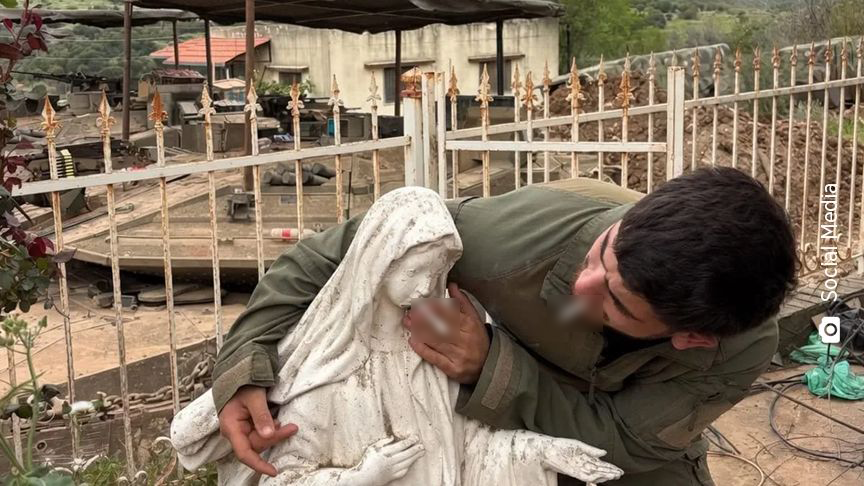
Two weeks ago it was a sledgehammer. Today it’s a cigarette. The same village in southern Lebanon, Debel. A different soldier, a different gesture, and the same question lingers.
A man in military uniform stood in front of a statue of the mother of Jesus and placed a cigarette between her stone lips. Someone with him took a picture. The picture was kept, then shared, then surfaced online weeks later. Each step was intentional.
The IDF says it views the incident gravely. The soldier will be disciplined. I am grateful for the quick response, and I trust it will be carried out. I want to write about something else. I want to write about what makes a soldier decide, even for a moment, that this is something worth doing.
Not all soldiers. Not most. Such acts shock the Israeli public as much as they shock the world, precisely because they violate the ethos the IDF teaches and most soldiers live by. And live by it they have. The men and women of the IDF have left their families and their children, sacrificed months of their lives, and gone back to the war again and again in defense of our land, our state, and our people.
The vast majority have remained moral and upright through all of it: bearing their arms with seriousness, their consciences heavier than their gear. I know them. They are my family and my friends. I have prayed with them and for them. They all carry the cost of what the country has asked of them. What I am thinking about is the few, and what the few tell us about what a long war does to a soldier’s soul.
The Torah is not naive about war. It is one of the most morally realistic documents on the impact of war on soldiers. In Deuteronomy, at the close of the laws of the military encampment, the Torah records a verse that has stayed with me through this whole period:
“For the Lord your God walks in the midst of your camp; therefore shall your camp be holy, that He see no unseemly thing in you and turn away from you” (Deuteronomy 23:15).
The plain reading is striking. The Torah does not say the camp must be holy because war is sacred. War is hell. The Torah says the camp must be holy because God is there, and God can be driven out. The presence of the Divine in the military camp is conditional. It depends on what soldiers do when they think no one is looking. The Torah, in other words, anticipates the cigarette: the casual cruelty of a soldier in someone else’s village, the joke made at someone else’s sacred object, the small contempts that distance from home seems to license. The Torah assumes that the moral pressure of war will produce gestures a soldier would not have made at home, and precisely there it commands an extraordinary vigilance.
Ramban, on this verse, is even more direct. War, he writes, draws soldiers toward violence, plunder, and cruelty. In war, even upright men lose their moral footing. For that reason, the Torah has to demand of the camp a holiness it does not demand of ordinary life. Ramban writes from the thirteenth century, but he could be describing this soldier.
The Sages saw the same thing. Lo dibrah Torah ela ke-neged yetzer ha-ra (Kiddushin 21b), they said: the Torah spoke against the evil inclination on the battlefield. It did not endorse the desire. It legislated for the soldier as the soldier actually is, knowing that some of what war stirs up must be contained. The Torah’s premise is that war puts moral judgment to sleep, and that the work of the military camp is to keep waking it up.
The Torah does not imagine that we will fight cleanly and come out unchanged. It assumes the opposite, and it asks us to act accordingly: to fight when we must, to do all we can to keep the camp holy while we fight, and to know in advance that something inside us will be tested every day and that on some days we will fail.
The cigarette is one of those failures. So was the sledgehammer. So were the songs sung over the rubble of cleared neighborhoods. I do not write to excuse the cigarette but to lament what a long war does to those who fight it, and to those of us who love them. I write to stand with them, not in judgment of them, and to ask what we owe the soldier who comes home with something heavier than his gear.
What the Torah names mahaneh kadosh, a holy camp, the modern literature calls moral injury. The psychiatrist Jonathan Shay, drawing on decades of work with Vietnam veterans, has argued that the deepest combat wounds are not the ones we usually call PTSD. They are wounds of conscience, the acts done that violate the soldier’s own sense of who he is. Shay reads Homer alongside the testimonies of men he treated; he could have read Deuteronomy. The Torah saw the same wound and gave the camp a way of life meant to prevent it.
The military response to the soldier in Debel is necessary, but it is not enough. Punishment comes after the act. The work of mahaneh kadosh is to prevent the act before it happens.
IDF Chief of Staff Lt. Gen. Eyal Zamir has been making the same point. Speaking to senior commanders last week, with the photograph of the smashed statue before them, he warned: “The unethical incidents we have seen are the product of a long and complex period, but that does not justify them. We must not compromise on our values. The erosion of norms could be no less dangerous than operational threats.”
We need to do a better job of teaching young people that the religious symbol of another faith, even in the home of an enemy, is not a target and is not a joke. We need to do a better job of noticing the small gestures, the photograph taken, the laugh at someone else’s sacred thing, and restraining them on the spot. We need to create a culture in the camp where the soldier who is poised to do something like this is stopped by the soldier next to him, with a hand on his shoulder and the words, this is not who we are.
We need to be willing to ask the question I am asking now and not flinch from it. What is the price of a long war, even one that is just and one we have no choice but to fight, on the morality of the people who fight it? We cannot fight and assume we come out unchanged. The Torah told us we would not.
Ve-haya mahanekha kadosh. And your camp shall be holy. The verse is a command, and a warning. Guard the camp so we do not lose the One Who walks in its midst.