


Stephen J Stern PhD
The Soul Killer and Capitalism’s Founder: Scottish Bad Boys Behind America
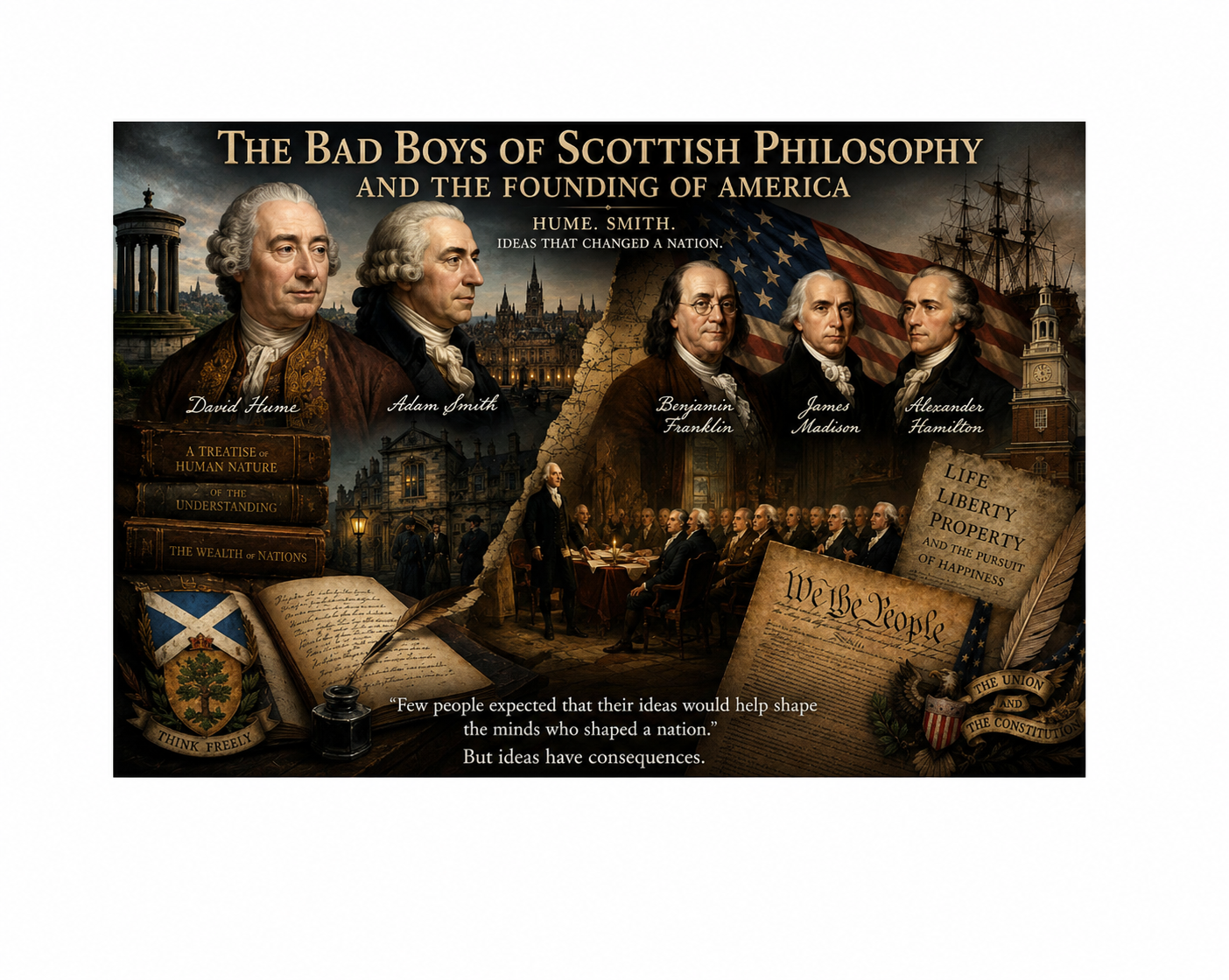
AI image created by author.
Adam Smith’s Oxford professors had a problem. Their promising student had become fascinated with David Hume. They had reason to worry. Hume’s philosophy terrified Europe, questioning everything civilization took for granted. Anything Hume touched changed the conversation. Traditional metaphysics did not stand a chance answering his questions. Religion loses its voice. Smith could not stop reading him.
Today, Adam Smith is remembered as the founder of capitalism. In his day, however, he was suspected of being influenced by David Hume, Scotland’s bad boy philosopher. The founder of capitalism was influenced by a perceived philosophical radical.
A friendship that rocked the world
I’m guessing few people knew that the friendship between Smith and Hume would become one of the most politically and socially consequential intellectual relationships of the past thousand years, let alone help shape the intellectual world of Benjamin Franklin, James Madison, Alexander Hamilton, and the American founding itself.
This July 4th we celebrate the 250th anniversary of the writing of the Declaration of Independence. The American experiment was informed by several intellectual currents. Founders read the Bible, ancient thinkers—Plato, Aristotle, Cicero… Yet they were perhaps most directly shaped by the philosophers of the Enlightenment.
John Locke supplied a language of rights. David Hume offered a psychology of politics. Adam Smith explored how moral life emerges through human sympathy. Montesquieu provided a constitutional architecture capable of restraining power, some of which he likely lifted from Locke’s writings. Together they helped shape the philosophical foundations of the American republic.
When Americans think about the philosophical influences behind the founding, they usually think of English philosopher John Locke. For good reason. The Declaration of Independence reflects Locke’s philosophy, basically plagiarizing him, whom the founders read in college. Ordinary colonists read his ideas, too. Samuel Adams, arguably the most hated revolutionary in the eyes of King George III and Parliament, published Locke’s writings in the Boston Gazette long before 1776, helping spread them throughout the colonies.
Yet Locke was not the only philosopher shaping the intellectual world of the founders. Another was Scottish philosopher David Hume, who was admired by Benjamin Franklin, James Madison, and Alexander Hamilton. Hume’s influence on the founding is often overshadowed, despite the fact that many concerns shaping the Constitution reflect Hume’s concerns and questions.
To understand Hume’s significance, it helps to begin with a debate that shaped Enlightenment thought. 17th century Philosopher Thomas Hobbes famously distrusted human beings. When left to their own devices, Hobbes believed people would create a war of all against all. Like lord of the flies. Human beings could not reliably govern themselves and therefore required strong authority, such as authoritarianism.
Locke disagreed. If human beings were truly incapable of cooperation, how could civilization exist at all? Society itself suggests that there is something within us that enables cooperation, trust, and mutual benefit, even while acknowledging humanity’s tendency toward self-interest and conflict.
In my course Capitalism vs. Marxism, we begin with Hobbes and then move to Locke. The contrast helps students understand one of the central questions of that time: can people be trusted to govern themselves? If Hobbes were completely right, would we even be here discussing Locke’s ideas? Locke’s answer was that we have the capacity to work together while remaining imperfect, self-interested and greedy.
Then Hume arrived and changed the terms of the debate
Locke privileges reason in human life. Human beings could use reason to understand the world, establish rights, and construct political institutions. Hume was skeptical, arguing that reason is not the master of human behavior. Years away from psychology emerging as a field, Hume redirected attention away from reason and toward the habits, emotions, and sentiments motivating people.
Hume terrified readers, leaders, and power brokers. He did not believe that reason sat on a throne governing human life. People were driven by passions, habits, customs, and social expectations. What we call reason, Hume notes, often arrives after the fact, explaining that our decisions are shaped by sentiment, emotions/psychology.
Hume ends the philosophical party
Unlike every philosopher before him, David Hume could not find the self, the essence of the self, so to speak. While looking, he crushed traditional hopes for a transcendent soul or fixed human essence. He instead found a bundle of perceptions flowing through one’s consciousness. For many of those around him, this was too much.
No one was more captivated by Hume than Adam Smith. While studying at Oxford, his professors worried about his fixation with Hume, who was viewed as a dangerous thinker. Smith’s devotion to his ideas raised concerns about Smith’s intellectual trajectory. Those concerns proved justified.
Smith became one of the most influential thinkers of the modern world. After accepting the chair of logic at Glasgow University, he soon moved into the prestigious chair of moral philosophy, a position previously occupied by Francis Hutcheson. Yet beneath the respectability of the position, Smith retained intellectual commitments shaped in large measure by David Hume.
The two men eventually became close friends. Although Hume was twelve years older, they found in one another philosophical companions. Smith admired Hume so much that he hoped Glasgow might hire him for the open Logic chair, though he understood how controversial hiring Hume would be. Hume’s reputation made any academic appointment politically difficult.
Smith loved it
There is an irony here. Today Adam Smith is often presented as the patron saint of markets and capitalism, a safe and familiar figure. In the eighteenth century he was anything but safe. The influence each had on the other can be seen in Smith’s The Theory of Moral Sentiments, 1759.
Link to the book: pdf:https://www.ibiblio.org/ml/libri/s/SmithA_MoralSentiments_p.pdf
Colonists knew Smith as the author of The Theory of Moral Sentiments. The book was widely popular in the American colonies, helping shape how Americans thought about morality, society, and human relations. Smith asked a question that is still contemporary: how do human beings create moral lives in a world where reason is not sovereign and traditions alone cannot do all the work?
The Theory of Moral Sentiments kind of anticipates existentialism, thinkers often exploring how human beings create meaning. Smith examined how persons construct moral lives through sympathy, social interaction, and self-reflection. He begins not with metaphysics or abstract reason, but with human beings encountering one another in everyday life. Before existentialism had a name, Smith was exploring how human beings create meaning.
Smith’s answers begin not with abstract principles but with lived experience. We encounter one another, imagining ourselves in another person’s situation. We seek approval, recognition, and mutual understanding. Morality emerges from human relationships rather than from philosophical or religious abstractions. That was a radical place to begin. Still is.
Even Smith’s economics rests upon this human foundation. If I want to trade with you, it is in my interest to understand your needs and concerns. Ignoring them works against my own interests. Cooperation and self-interest are not opposites. They often reinforce one another. The market, for Smith, was not simply an economic mechanism. It was a human activity embedded in social relationships directed by sympathy.
These ideas travel far beyond 18th century Scotland. Hume and Smith helped open the door to modern ways of thinking about psychology, society, and human behavior. Human beings were not primarily rational creatures applying universal truths. They were social beings shaped by habits, sentiments, customs, and shared expectations. Many founders absorbed these lessons.
The Declaration of Independence reflects Locke’s influence. The Constitution, however, reveals more Humean concerns. Madison, known as the architect of the constitution, and Hamilton, known as the architect of the federal government, worried about factionalism, religious wars, ambition, and the unreliability of human behavior. They were also influenced by French intellectuals, notably Montesquieu and his theory of separated powers, some of which he likely lifted from John Locke. The constitutional system they helped create reflects a recognition that human beings are not angels. Institutions must account for both cooperation and conflict.
Benjamin Franklin appreciated Hume as well. Franklin’s practical understanding of human affairs and his interest in the social dimensions of civic life easily fit within a world increasingly shaped by Humean questions about habit, character, and human behavior.
When students encounter the American founding, they often learn about Locke and Montesquieu. Hume’s role receives far less attention. Yet he was one of the most important philosophers of the eighteenth century, and his influence reached into many of the leading founders. Through his friendship with Adam Smith and his impact on Franklin, Madison, , and Hamilton, Hume’s writings on psychology, religion, government and more helped shape the intellectual world from which the United States emerged.
Two hundred and fifty years after the Declaration of Independence, Locke remains essential for understanding the language of rights and liberty found in the founding era. But Hume helps explain something equally important, why the founders worried so much about human behavior. And Smith helps explain how moral meaning emerges from human relationships.
Locke gave the founders a language of rights. Hume gave them a psychology of politics. Smith gave them a theory of moral life grounded in human sympathy as well as a free market of ideas resisting factions as analogized by Madison in federalist 10* from Smith’s free market economics in the Wealth of Nations. And Montesquieu gave them a constitutional architecture capable of restraining power.
That is not a bad philosophical foundation for a Republic that has lasted 250 years.
*Link for Federalist Paper Ten by James Madison: https://avalon.law.yale.edu/18th_century/fed10.asp