


Middle East Forum Fellow/North Africa Risk Consultant
The South Atlantic Siege: China’s Strategic Gambit to Break the Western Order
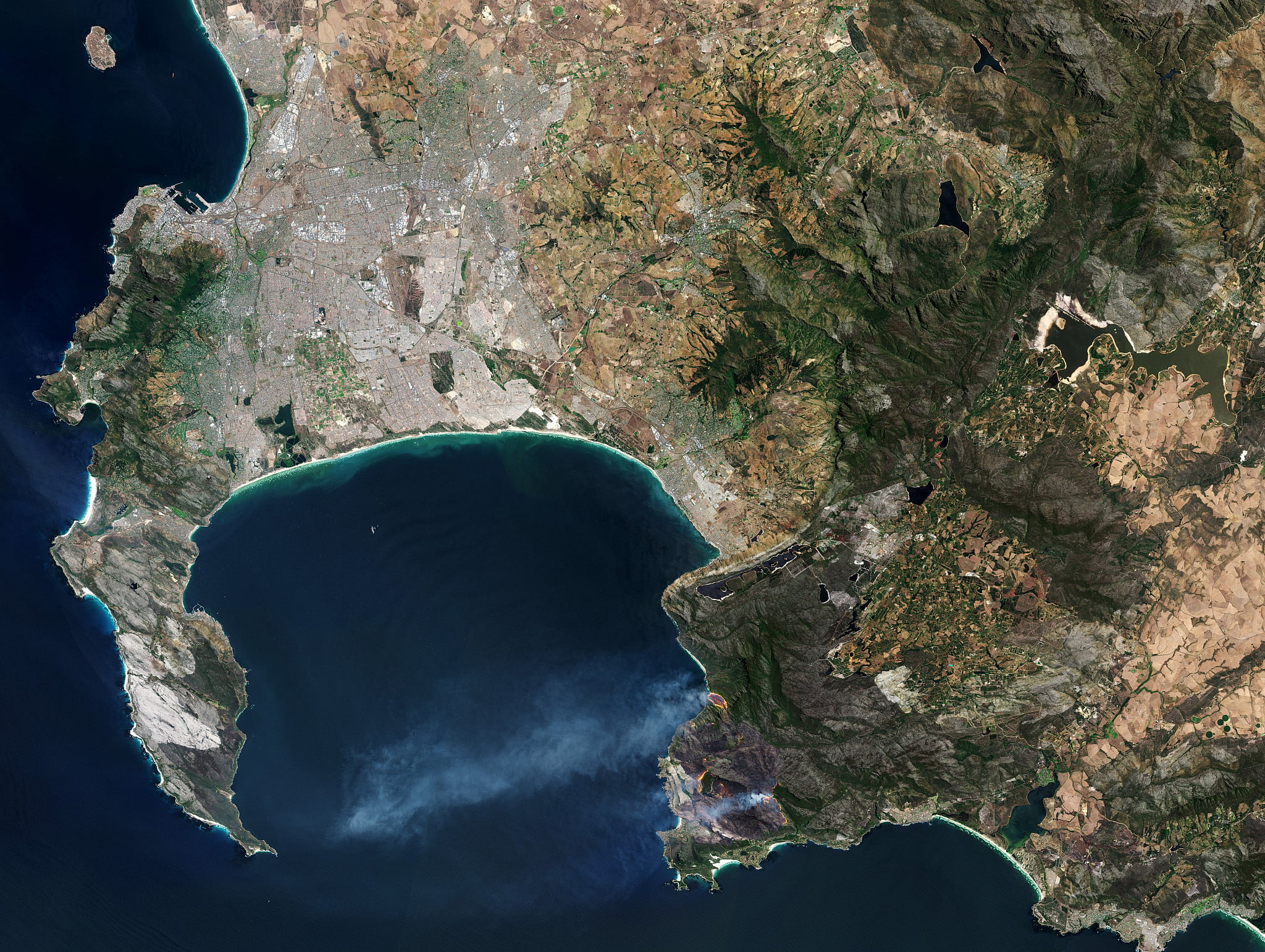
Satellite image of Cape Town showing the Cape Peninsula (left), Cape Flats and False Bay https://commons.wikimedia.org/w/index.php?curid=119296890
The arrival of the CNS Tangshan, a Chinese Type 052D guided-missile destroyer, at South Africa’s Simon’s Town Naval Base in January 2026 signaled a definitive rupture in the post-Cold War maritime security architecture.
As the Tangshan moored alongside the Iranian expeditionary sea base IRIS Makran and the Russian corvette RFS Stoikiy, the symbolic and tactical intent of the “Will for Peace 2026” exercise became irrefutable. Conducted under the BRICS Plus framework and led by the People’s Republic of China, these maneuvers represent far more than a routine exchange of maritime protocols. They signal the crystallization of a revisionist security coalition designed to challenge American naval primacy at the world’s most critical geographic chokepoint: the Cape of Good Hope.
The Orwellian Branding of a New Maritime Order
The strategic geography of the Cape Route has returned to its historical status as the primary artery for East-West commerce, driven by the persistent instability in the Red Sea and the Bab el-Mandeb Strait. The “Will for Peace 2026” exercise aims to demonstrate that a BRICS-aligned maritime presence can provide an alternative security guarantee—one that operates outside the US-led international rules-based order. The naming of the exercise itself is a study in Orwellian strategic messaging. The coalition includes a Russian Federation engaged in a war of attrition in Ukraine, an Iranian regime brutally suppressing its own citizens, and a Chinese Communist Party rehearsing the forced integration of Taiwan.
This nomenclature serves as a cynical linguistic shield intended to provide diplomatic cover for maneuvers that are fundamentally about power projection and the neutralization of Western economic coercion. By establishing a coordinated naval presence at the confluence of the Atlantic and Indian Oceans, the BRICS Plus coalition is positioning itself to monitor, and potentially disrupt, the “Cape Route” during periods of heightened global tension. The tactical integration of these assets—including the Russian Stoikiy, equipped with sophisticated electronic warfare systems—suggests a focus on “denial of access” scenarios that directly threaten Western supply chains.
South Africa: The Moral Hypocrisy of a “Neutral” Host
South Africa’s role as the host nation for these drills has triggered a profound domestic and international crisis of credibility. The Department of Defence has defended the exercise as a pragmatic necessity for a “neutral” nation. However, the inclusion of heavily sanctioned states like Iran and Russia has led opposition leaders to characterize the country as a “pawn” in a global power game. The Democratic Alliance has explicitly questioned China’s leadership, noting that the country conducts large-scale military exercises rehearsing an invasion of Taiwan.
The moral dimension of Pretoria’s foreign policy is under intense scrutiny. There is a jarring contrast between South Africa’s pursuit of a genocide case against Israel at the International Court of Justice and its warm welcome of Iranian security forces. While the South African government postures as a champion of international law, it welcomes the Islamic Revolutionary Guard Corps (IRGC)—an organization central to the violent repression of protests in Iran that began in late December 2025 and have reportedly left over 4,000 innocent civilians dead. Reports that President Cyril Ramaphosa initially instructed that Iran be limited to “observer status” to avoid antagonizing Washington suggest a loss of civilian control over the military, which proceeded with the full inclusion of Iranian vessels like the IRIS Shahid Mahdavi.
The Iranian Pivot and the “Axis of Evasion”
For the Iranian regime, “Will for Peace 2026” is a crucial component of its “Look to the East” policy to break out of strategic isolation. By deploying the 103rd and 104th flotillas to the South Atlantic, Tehran seeks to demonstrate that its naval capabilities are no longer confined to the Persian Gulf. This projection of power is intended to signal to both domestic and international audiences that the regime remains a potent global player despite internal fragility.
However, the maritime ambitions of the Iranian regime are inextricably linked to its internal instability. The “Will for Peace” exercise took place as the IRGC played a central role in internet blackouts and “medieval raids” against its own people. The Islamic Republic has entered a “point of no return,” where the protest movement continues to build despite a lethal response from security forces. The involvement of the IRGC in the Simon’s Town exercise also raises questions about corporate links to terror, such as the MTN Group’s investments alongside the Iranian Ministry of Defence in digital platforms allegedly weaponized for internal repression.
The American Response: Tariffs, Tankers, and Transactional Diplomacy
The Trump administration’s response to this revisionist bloc has been characterized by the weaponization of trade policy as a primary tool of national security. Just days before the exercise began, the United States seized a Venezuela-linked Russian oil tanker in the North Atlantic, citing violations of Western sanctions. This “Maximum Pressure 2.0” campaign was further escalated by a post on Truth Social, where President Trump declared that any country doing business with the Iranian regime would pay a 25% tariff on all transactions with the United States.
This threat of a 25% tariff had an immediate effect, forcing South Africa to request that Iran take observer status to mitigate the risk of devastating trade duties. This use of tariffs as a deterrent marks a significant evolution in international relations, where the national interest of the United States is asserted through the leverage of its massive consumer market.
Securing the Maritime Commons
The “Will for Peace 2026” exercise represents a strategic “Cape Gambit” by revisionist powers seeking to normalize their presence in distant oceans. By leveraging the ideological openness of South Africa and the economic shifts in global shipping, China, Russia, and Iran have established a military footprint in the South Atlantic that challenges Western primacy. Shipping companies like MSC have already recalibrated, introducing the “Western Cape Express” as the Cape Route becomes the permanent primary artery for global trade.
To protect American interests, Washington must ensure that this revisionist tide is met with a coherent strategy of containment and victory. This requires not only the military edge demonstrated by the redeployment of the USS Abraham Lincoln but also the aggressive use of economic leverage to prevent the consolidation of an “Axis of Evasion”. The maritime arteries of the world are the lifeblood of free civilization, and their defense is the defining challenge of 2026.