The Space Between the Labels
When I was in the fifth grade, I learned that identity can get you thrown against a fence. It happened during recess in the San Gabriel Valley, where basketballs bounced across cracked asphalt, and kids pretended not to study one another. Someone mentioned Christmas, and I said, without ceremony, “I don’t celebrate it.” The class bully turned toward me with the confidence of someone who had already decided the world’s categories were fixed. “What do you mean? Don’t you believe in Jesus? Aren’t you Latino?” I wasn’t startled by my own answer— even at ten, I knew who I was— but I was startled by how certain he was of who I should be. I tried to explain: “Jesus was Jewish. I’m Jewish. And yes, I’m Latino.” The logic didn’t matter. I was shoved toward the chain-link fence before friends pulled us apart. It wasn’t the almost-fight that stayed with me. It was the realization that some people genuinely cannot imagine Jews coming in more than one shade, and that even when you’re anchored in your own identity, others will insist on editing it. That was the first time I understood I lived in the space between labels.
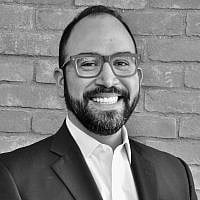
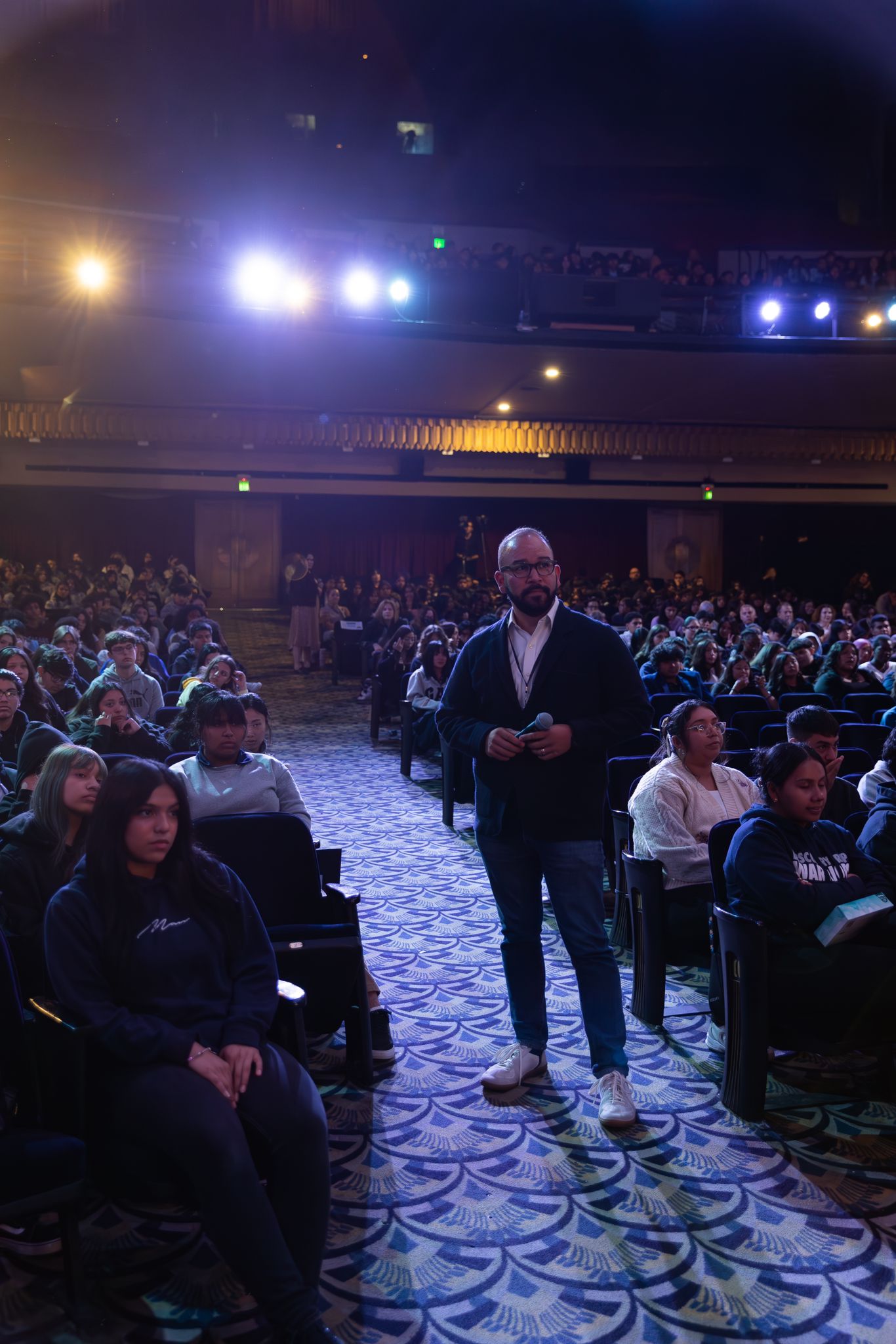
Decades later, the questions still come. The stakes are different now; the tone is kinder. But the underlying assumption hasn’t changed. Just yesterday, while facilitating an antisemitism workshop for a Jewish organization, I mentioned my background—Salvadorian and Spanish by birth, raised in an Ashkenazi Jewish home. Two adults, polite and earnest, immediately leaned in. “Oh wow,” one said. “So did your mother convert?” The other added, “Wait… were your parents Eastern European Jews who lived in Latin America?” Their curiosity was genuine. Their questions were fast, but warm. Yet the message beneath them was familiar: I see your answer, but show me your work. It was the same test from the playground, only now the shove was replaced with curiosity, and the demand for clarity came with a smile.
The truth is both straightforward and layered. I was adopted at six days old by Eastern European Jews who created a home that was unmistakably Ashkenazi and deeply, wonderfully hamish. There were mezuzot on the doorframes, Jewish music floating through the house, Shabbat candles each Friday. Passover meant renting out a catering hall because 120 relatives needed space to argue, sing, and pass plates down long tables. I grew up pulling on my father’s tallis the way my son pulls on mine now. I went to every funeral because my dad believed that showing up for others was the highest expression of community. Jewish life wasn’t abstract in our home—it was sound and smell and ritual and rhythm. So when someone tries to reverse-engineer my Jewish identity as a technical problem to solve, it reveals less about me and more about the limits of their imagination.
Growing up in the suburbs adjacent to East Los Angeles, my Latinidad was something I lived around as much as something I lived into. It was present in the landscape and language of the neighborhood, an identity that existed in the periphery but not always in the foreground. Only as an adult—and only because people kept asking who I was—did I begin to explore that part of myself with intention. Latinos generally accept me without complication. If I don’t speak Spanish, I get a smile, maybe encouragement, but rarely suspicion. Only once did someone tell me I wasn’t “really” Latino—more an awkward moment than an indictment. Among Jews, though, the questions come more regularly. Not maliciously. Often thoughtfully. But the curiosity itself reveals a cultural blind spot: the assumption that “Jewish” defaults to “white,” or “Ashkenazi,” or some predictable ancestry that aligns with a tidy narrative. Identity, of course, rarely follows anyone’s script.
For years, I resisted labels entirely. I didn’t want to be a “Jew of Color,” or a “Latino Jew,” or any identity modifier that reduced the complexity of my life into a single category. I wanted to be just a Jew—not Orthodox or Reform, not Ashkenazi or Mizrahi, not adopted or born into it. Just a Jew living his life. But labels have power. Not because they define us, but because the world uses them as gates. Eventually, I learned to use them strategically. If calling myself a Latino Jew opens a door, I’ll use the label to enter—and then, once inside, I can complicate it. I can show that identity is lived in layers, not boxes. That every person is a tapestry. That proximity does what labels never can. It’s not deception. It’s translation.
Belonging, for me, shows up in moments that echo my childhood. My wife playing mahjong with her friends, their mothers hovering nearby with commentary. Kids running through the house. The clatter of tiles, the warmth of food, the gentle chaos of community built from different backgrounds but shared rhythms. Those are the spaces where I feel most at ease. And I feel the opposite just as clearly. I’ve sat in conversations where people who know I’m Latino assume I must therefore hold a certain political stance on Israel, as though identity can predict ideology. As though one label dictates another. It’s the adult version of the playground assumption: if you’re Latino, you must be Christian; if you’re Christian, you must celebrate Christmas; if you’re Latino and Jewish, something must be explained.
In those moments, I don’t pull away. I lean in. I tell my story. I try to create the kind of proximity that breaks certainty apart. Because the real issue isn’t confusion—it’s the illusion that identity is supposed to be tidy.
If the world stopped asking me to justify who I am, I’d still be me. A Salvadorian-Spanish adoptee raised in a loud, loving Jewish home; a father now raising his own family in the same rhythm; a person shaped by the communities that held him and the questions that chased him. Identity, at its most honest, isn’t a label. It’s a story. And stories are rarely simple. The fifth-grade bully wanted a box to put me in. So did the well-meaning adults at my workshop. The labels were different. The certainty was the same. But life—my life, most lives—is lived in the space between the boxes. And that space, if we let it, can be wide enough for all of us.