Back in the early 1980s, while living on Kibbutz Ma’agan Michael in northern Israel, I received an invitation that seemed strangely simple.
One cold late-winter evening, Racheli—the head of the overseas kibbutz volunteers—told us to meet at the front gate with sleeping bags and warm clothing.
No explanation. No destination. Just trust.
We drove deep into the night with no idea where we were headed. By the time the bus finally stopped, darkness still blanketed the countryside around us, and we fell asleep beneath the open sky.
When morning came, we awoke to rolling hills flooded with white and soft pink almond blossoms stretching endlessly across the landscape.
Our rucksacks returned full of almonds, and with some of the harvest Racheli later baked an almond pie none of us ever forgot.
Only years later did I begin to understand why that landscape remained so deeply etched in my memory.
Parashat Korach opens with one of the Torah’s most devastating rebellions. Korach, a man of stature and privilege, rises against Moshe and Aharon in a rebellion that fractures the spiritual unity of the nation. Though already entrusted with greatness, he seeks more—more honor, more prominence, more control.
The consequences are catastrophic: fire, plague, division, and a nation left spiritually shaken to its core. Yet even after the rebellion is crushed, unrest still lingers among the people.
And then the Torah introduces one of its quietest and most profound miracles.
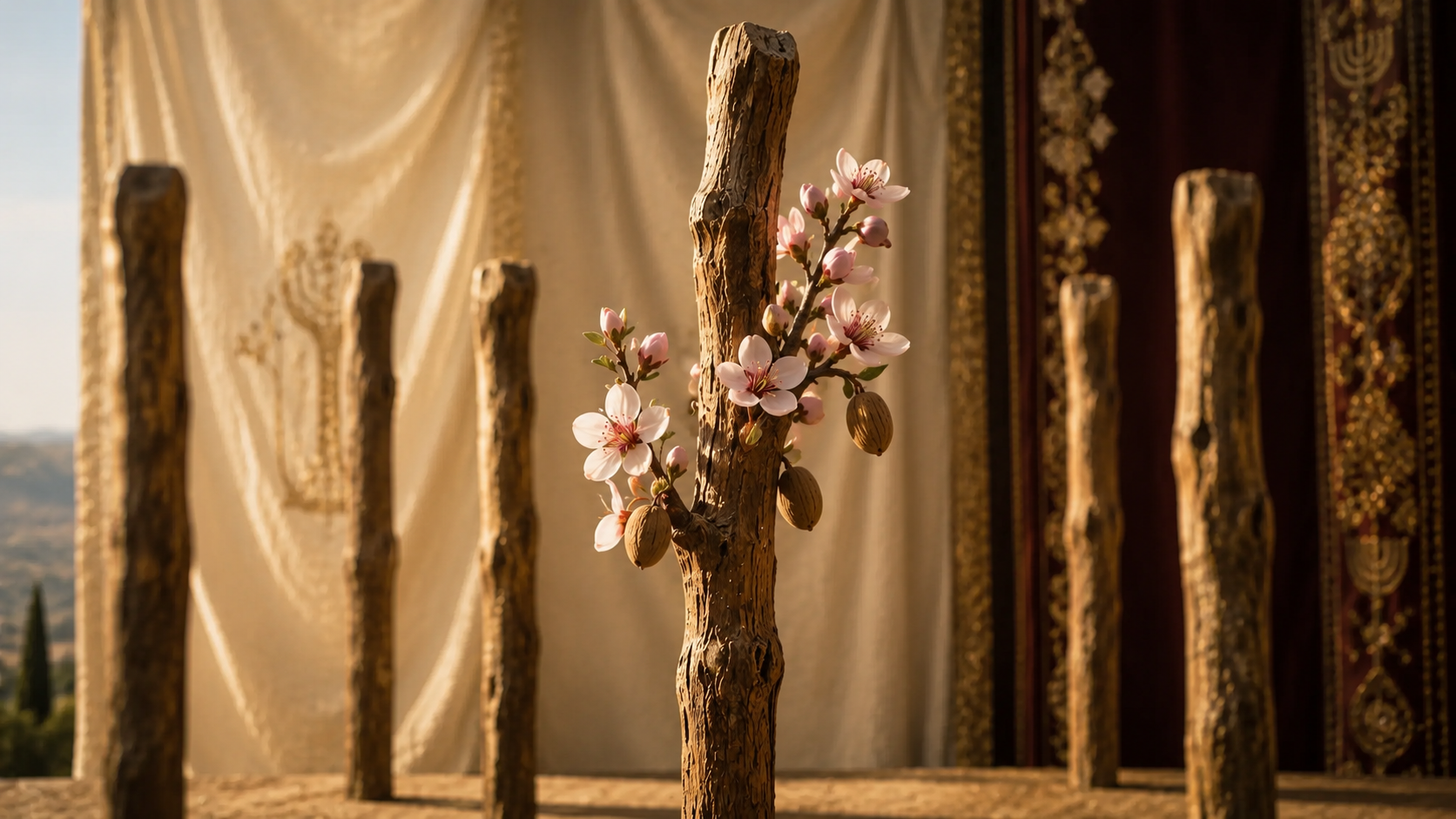
Hashem commands Moshe to collect a staff from each tribe and place them within the Tent of Meeting. By morning, only one has changed:
וְהִנֵּה פָרַח מַטֵּה־אַהֲרֹן… וַיָּצֵץ צִיץ וַיִּגְמֹל שְׁקֵדִים “Behold, the staff of Aharon… had blossomed, sprouted buds, bloomed flowers, and borne ripe almonds.” (Bamidbar 17:23)
Remarkably, neither the earth swallowing Korach nor the heavenly fire fully ended the unrest. Only the sight of dead wood bearing life finally quieted the nation’s complaints.
After all the fear, upheaval, and destruction, it was not another display of power that restored order, but the sight of lifeless wood suddenly flowering with life.
This was far more than proof of chosen leadership. It revealed the nature of holiness itself.
True spiritual authority does not sustain itself through force, spectacle, or self-importance. The kohen does not seize power over the people; he stands as a vessel through which blessing flows. Like barren wood suddenly blossoming, authentic holiness quietly restores what conflict leaves exhausted and fractured.
Rabbeinu Bachya sees within Aharon’s staff one of Torah’s deepest truths: even what appears dry and lifeless can still become a vessel for Hashem’s blessing.
And of all symbols, why almonds?
Because the almond tree—shaked (שקד)—is the first tree in the Land of Israel to awaken after winter’s dormancy. While much of creation still lies silent and bare, the almond blossoms early, quietly announcing that renewal has already begun. Long before spring fully arrives, the almond tree bears witness that life is returning.
Centuries later, the prophet Yirmiyahu is shown the branch of an almond tree—the first vision of his prophetic calling. Hashem then declares:
כִּי־שֹׁקֵד אֲנִי עַל־דְּבָרִי לַעֲשֹׂתוֹ “For I am watchful (shoked) over My word to perform it.” (Yirmiyahu 1:12)
The almond thus becomes a symbol of Hashem’s constant watchfulness over history itself—His quiet guiding hand even when the world appears dormant and uncertain.
Even the Torah’s language hints at this deeper connection, for the word tzitz—“blossom”—also recalls the sacred golden tzitz worn upon Aharon’s forehead, engraved with the words קֹדֶשׁ לַה׳—“Holy to Hashem.” The letters of shaked seem to echo kodesh, as though the almond points toward awakened holiness.
This same imagery appears within the Menorah of the Mishkan, whose branches were formed with almond blossoms:
מְשֻׁקָּדִים
The Menorah itself became a tree of awakened light within sacred space. And significantly, it is Aharon who is entrusted with kindling it.
Both the Menorah and Aharon’s staff reveal the same enduring truth: holiness does not emerge through grasping for power, but through becoming a vessel capable of carrying Hashem’s light into the world.
Not all sacred things reveal themselves through fire.
Some arrive quietly, like almond blossoms before spring.
שבת שלום שמואל
About the Author
Sam writes on faith, Jewish identity, geopolitics, and the enduring covenant between the Jewish people and the Land of Israel. Living between the UK and Israel, he explores renewal, sovereignty, and the forces shaping the journey home.