The Star Inside the Atom
On the Magen David, the nucleus of matter, and the six directions of Sefer Yetzirah
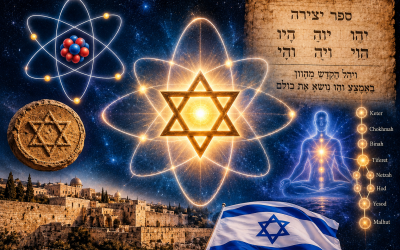
I was looking at a drawing of an atom. A nucleus in the middle, and around it three ellipses crossing one another. Where the three ellipses overlapped, six points appeared around the nucleus, and in the middle of those six points I saw a Magen David. It is a likeness in a drawing, nothing more. There is no star in the actual structure of an atom. I knew that, and I kept looking anyway, because what drew me was never the lines. It was the center.
The Magen David is more than a shape made of six lines. It is an ancient drawing of how a person stands in the universe, of the place where what comes down from above meets what rises from below. One triangle reaches toward the sky and points to unseen support, to inspiration, to direction. The other descends toward the earth and speaks of human responsibility, of labor, of the mark we leave. The space held between these two movements is a person’s true center, the one place where we can stand unshaken even when the world outside is in turmoil.
When I set out to learn about the center of the atom, the first thing that surprised me was how small it is. In 1911 Ernest Rutherford showed that nearly all of an atom’s mass is gathered in a nucleus at its heart. The figures vary from atom to atom, yet the radius of the nucleus is roughly between one ten thousandth and one hundred thousandth of the atom’s radius, and more than 99.9 percent of the atom’s mass sits there. The rest is almost entirely empty. The second thing that surprised me was what happens inside the nucleus. Every proton carries a positive charge, and positive charges push each other away. What holds them together is the strong nuclear interaction acting among protons and neutrons. When I read that, my mind went straight to the two triangles of the star, facing in opposite directions. One up, one down.
Then there is the matter of the orbits we all remember from school textbooks. In 1913 Niels Bohr placed electrons on fixed paths around the nucleus. After Erwin Schrödinger in 1926, physics stopped describing the electron as a little ball circling along a line and began describing it through a wave function, as the probability of where around the nucleus it might be found. So the lines in which I saw the Magen David do not really exist. The center is still there.
Next I went looking for where the center stands in Jewish texts, and I arrived at Sefer Yetzirah. In the version edited by the Gra, in the thirteenth mishnah of the first chapter, HaShem seals above and below, east and west, south and north, each with a different arrangement of the three letters of the Name, Yud, Heh and Vav. Three letters can be arranged in exactly six ways, יהו, יוה, היו, הוי, ויה and והי. Which arrangement belongs to which direction differs from one manuscript to another, yet every version agrees that six directions are sealed with six arrangements. In the fourth chapter the six directions are counted again and completed with this line. Veheichal hakodesh mechuvan ba’emtza vehu nose et kulan. The holy palace stands precisely in the middle, and it carries them all.
I stopped at that sentence. Sefer Yetzirah says nothing about a star, and nothing about an atom. I had simply read it right after reading about the nucleus, and I could not keep the two apart. Six directions and a palace that carries them all. An atom that is almost empty and a tiny nucleus that carries all its weight. And in the Magen David, six points with a hexagon at the heart.
The same chapter speaks of seven letters, Bet, Gimel, Dalet, Kaf, Peh, Resh and Tav, and links them to the seven gates of the human face. Two eyes, two ears, two nostrils and a mouth. Six come in pairs, one stands alone. Rabbi Naftali Silberberg of Chabad describes the Magen David as a shape with seven compartments and ties them to the seven attributes through which HaShem created the world. In his reading the upper point is Tiferet, the upper wings are Chesed and Gevurah, the lower wings are Netzach and Hod, the point that descends below is Malchut, and the center of the star is Yesod. Malchut receives the flow of the six attributes above it and carries it into the world. This is one interpretation and not the shared view of the whole Kabbalistic tradition. When I think about those seven gates of the face, I see a distinction. Six gates take the world in, and the single mouth sends words and prayer out.
The name Magen David itself belonged to HaShem long before it belonged to a shape. In the Babylonian Talmud, Pesachim 117b, Rav Yosef explains HaShem’s promise to give David a great name with these very words, and the blessing recited after the haftarah on Shabbat morning still closes with Baruch Atah HaShem Magen David. The shape is far older, and in the beginning it was not Jewish at all. According to the entry Gershom Scholem wrote for the Encyclopaedia Judaica, one of the earliest known examples is a seal from the seventh century BCE, found in Sidon and belonging to a man named Yehoshua ben Asayahu. Scholem identifies the kabbalistic Sefer haGevul, written in the early fourteenth century, as the oldest known witness to the six pointed star being called Magen David. In 1354 Emperor Charles IV granted the Jewish community of Prague the right to carry its own flag. That flag, later known as King David’s flag, bore the six pointed star, and Scholem writes that this is how the star became the community’s official emblem in Prague. He also stresses that the shape did not originate in Judaism and only became a Jewish symbol over time.
The detail in Scholem’s entry that stayed with me most was a different one. He writes that from around 1500 the name Shaddai was often written inside the six pointed star. A Name of HaShem came to rest within it. Shaddai, שדי, is written with Shin, Dalet and Yud. The Talmud in Chagigah 12a explains the name this way. When HaShem created the world, it kept expanding and expanding, until HaShem said to it dai, enough, and it stopped. The edges did not stretch on forever, because a voice from the middle told them enough. Rashi, at the end of Toldot, where Yitzhak blesses Yaakov in the name of El Shaddai, reads the same word from another side and explains Shaddai as the One whose blessings are enough, abundant enough to suffice. The name in the middle sets a limit to the points, and it also gives them what will be enough. In Sefer Yetzirah the six directions lean on the palace at the center. In these stars, too, the six points stand around the Name that told the world enough.
In Kabbalah, Shaddai belongs to Yesod. Rabbi Yosef Gikatilla, in the second gate of Shaarei Orah, describes Yesod through the names El Chai and Shaddai. Yesod is the channel through which the flow from Tiferet reaches the Shechinah. In Rabbi Silberberg’s reading as well, the center of the star is Yesod. So the Name that was written inside the star for centuries and the sefirah Silberberg places at its heart fall on the same spot. The same Name is written on the outside of the mezuzah, and tradition also reads it as Shomer Daltot Yisrael, Guardian of the doors of Israel. Inside, the Shema. Outside, Shaddai. As we enter a home, we place our hand on that Name.
The Magen David was carried like a shield for centuries because what protected was never the lines themselves but what the lines brought to mind. It reminded a person who returns to their own center not to be lost in the storm outside. The symbol was a quiet wisdom that said, gather yourself, do not scatter.
During the Holocaust, this same star was cut from yellow cloth and sewn onto the chests of Jews. On October 28 1948, the flag with blue stripes and a Magen David at its center was adopted as the flag of Israel. Today some see this symbol only as the mark of a flag and trample it underfoot. What is being trampled is often not understood to be a meaning that a people has carried for centuries in its prayers, on its doorposts and on its gravestones. The Magen David reaches far beyond a political label. It is a heritage that reminds us of our power to hold on to our own essence.
 Sources
- Rutherford’s nuclear model, 1911. https://www.britannica.com/science/atom/Rutherfords-nuclear-model
- Size and mass of the atomic nucleus and the strong nuclear interaction. https://www.chemistryexplained.com/Ar-Bo/Atomic-Nucleus.html
- Sefer Yetzirah 1:13, Gra version, the six directions sealed with arrangements of Yud Heh Vav. https://voices.sefaria.org/sheets/698853
- Sefer Yetzirah, chapter 4, in the Westcott translation 4:2 on the six directions and the holy palace at the center, and 4:3 and 4:4 on the seven double letters, the seven days and the seven gates of the face. https://neonvagabond.xyz/mirrors/sacred-texts/jud/yetzirah.htm
- Rabbi Naftali Silberberg, the seven compartments of the Magen David and the seven attributes. https://www.chabad.org/788679
- Babylonian Talmud, Pesachim 117b, the Magen David blessing. https://hadran.org.il/daf/pesachim-117/
- Gershom Scholem, Encyclopaedia Judaica, entry Magen David. The Sidon seal, Sefer haGevul, Prague 1354, and the name Shaddai written inside the star. https://www.jewishvirtuallibrary.org/magen-david
- Babylonian Talmud, Chagigah 12a, Shaddai and dai. https://dafaleph.com/home/2016/1/7/a-divine-name-the-unlikeliness-of-the-universe
- Bereshit 28:3 and Rashi, El Shaddai and blessings that suffice. https://widetorah.com/genesis/28/3/
- Yesod as the channel between Tiferet and the Shechinah. https://jewishvirtuallibrary.org/ten-sefirot-yesod
- Rabbi Yosef Gikatilla, Shaarei Orah, second gate, Yesod, El Chai and Shaddai. https://satyori.com/source-texts/shaarei-orah/
- The mezuzah and Shomer Daltot Yisrael. https://en.wikipedia.org/wiki/Mezuzah
- National Library of Israel, Gershom Scholem’s view. https://blog.nli.org.il/en/?p=98034
- The flag of Israel, October 28, 1948. https://www.jewishvirtuallibrary.org/the-israeli-flag