


Research Scientist | Data Analyst | Policy Commentator
The Star of David Beside the Lion and Sun
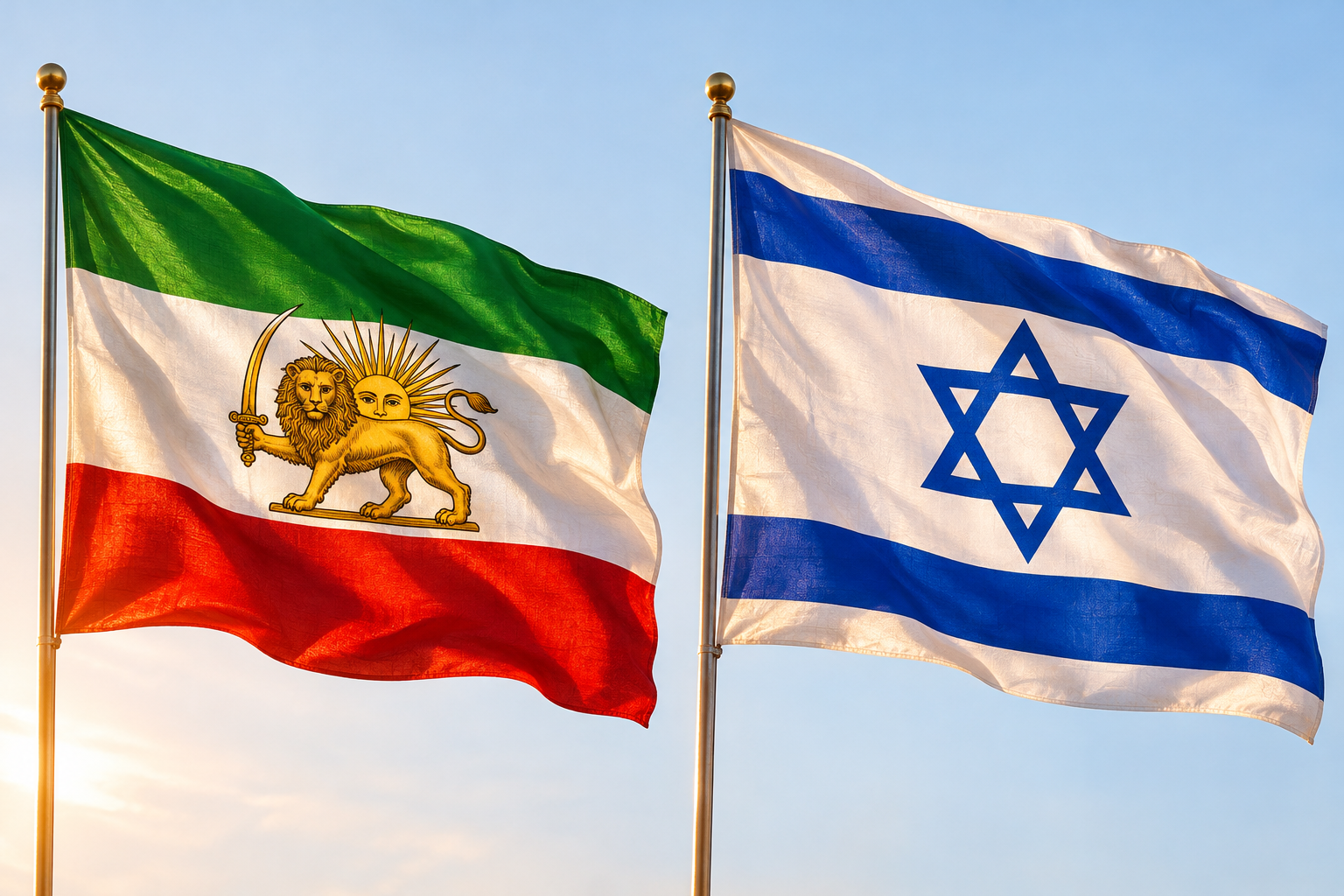
The Lion and Sun beside the Star of David: symbols that together point toward a more prosperous future for both nations and the wider region.
Documented demonstrations reveal an opening for Iranian-Israeli friendship that deserves attention beyond the photographs.
An Israeli flag at an Iranian demonstration complicates a familiar story.
For decades, the Islamic Republic has presented hostility toward Israel as one of its defining commitments. Yet outside Iran, Iranian opposition demonstrators have repeatedly appeared carrying the Israeli flag beside Iran’s Lion and Sun.
The government insists these symbols belong on opposite sides. The people holding them appear to have made other arrangements.
The photographs are striking. Their significance, however, deserves more than an enthusiastic caption. How often has this happened? What do the demonstrators represent? And what could Israel gain by taking their friendship seriously?
The available evidence establishes a recurring public gesture across several years. Within those limits, it reveals a political opening worth examining.
More than an isolated photograph:
On April 14, 2024, following the Islamic Republic’s direct attack on Israel, more than 100 Iranians and Israelis gathered outside the Iranian embassy in London. Jewish News documented Iranian and Israeli flags displayed together, alongside pictures of Crown Prince Reza Pahlavi and messages supporting the release of Israeli hostages.
The location gave the gathering particular meaning. Outside the embassy representing the regime’s government, participants visibly rejected the assumption that its confrontation with Israel expressed their own national identity.
In June 2025, The Jerusalem Post reported another London gathering involving several hundred Iranian and Israeli counter-demonstrators, with Israeli and Iranian opposition flags appearing together once again.
Reuters footage documents further examples:
| Date | Location | Documented activity |
|---|---|---|
| February 28, 2026 | London | Anti-government demonstrators carrying Lion and Sun, Israeli, and American flags. |
| March 1, 2026 | London | Marchers displaying Iranian and Israeli flags; interviewed participants expressed support for American and Israeli action against the Islamic Republic. |
| March 8, 2026 | London | Iranian royalist opposition supporters carrying Israeli and Lion and Sun flags during a procession toward the Israeli embassy. |
| April 26, 2026 | Toronto | Demonstrators displaying Israeli and Lion and Sun flags, with participants seeking outside support against the Islamic Republic. |
Sources: Reuters footage from February 28, March 1, March 8, and April 26.
The pattern did not end in London or Toronto. On November 7, 2026, thousands of Iranians gathered in Frankfurt as Crown Prince Reza Pahlavi accepted the Freedom Prize awarded to the Iranian people by the Friedrich Naumann Foundation. Public reporting described large crowds carrying pre-revolutionary Iranian flags, and images and videos circulated from the event showing Iranian opposition supporters displaying Israeli and Lion and Sun flags together. The symbolism was particularly striking because it appeared at a time when many European cities had recently witnessed large pro-Palestinian and anti-Israel demonstrations. The Frankfurt gathering suggested that at least some opponents of the Islamic Republic were willing to express friendship with Israel publicly rather than merely criticize the regime.
Together, these reports document recurring gatherings across several cities between April 2024 and November 2026, with Iranian opposition supporters publicly displaying Israeli flags, sometimes alongside Israeli and Jewish participants.
The wider protest landscape:
These gatherings occurred against a much larger wave of international mobilization.
A study using Crowd Counting Consortium data recorded nearly 12,400 pro-Palestinian protest events in the United States between October 7, 2023, and June 7, 2024.
Those figures count events, not individual participants. Someone attending ten demonstrations may contribute to ten event records. They also cannot be compared numerically with several selectively documented Iranian gatherings across different periods and countries.
Nevertheless, the figures show the scale of sustained public mobilization surrounding Israel. Within that environment, Iranian opposition supporters displaying Israeli flags provide a noteworthy counterpoint: people associated with a country whose government promotes hostility toward Israel are publicly proposing another relationship.
Their significance extends beyond their numbers.
What two flags communicate:
The Lion and Sun beside the Star of David conveys something that a general statement of solidarity may not: friendship with Israel can coexist with an explicitly Iranian national identity.
For some participants, the gesture expresses support for particular military actions. For others, it may convey opposition to the Islamic Republic, solidarity with Israeli civilians, or hope for future relations. Those motivations should be investigated rather than assumed.
A Reuters report on the North American Iranian diaspora documented disagreement over foreign intervention. Opposition to the Islamic Republic does not produce a single position on war.
That diversity does not make public friendship meaningless. It makes careful engagement necessary.
Crown Prince Reza Pahlavi offers an important connection between these public gestures and a political vision. His image appeared at several documented gatherings, including events associated with the Freedom Prize ceremony in Frankfurt, and his April 2023 visit to Israel combined Holocaust remembrance with interest in civilian cooperation, including water technology.
His emphasis on Iran’s territorial integrity also addresses a foundational concern: Iranians should be able to pursue friendship without fearing that their country’s fragmentation is the intended destination.
In my view, sustained Israeli engagement with Pahlavi, alongside an explicit commitment to Iranian sovereignty and territorial integrity, could help turn that opening into greater trust.
A friendship worth developing
There is historical substance behind the possibility. Cyrus the Great’s place in Jewish history supplies a shared reference older than contemporary hostility. More recently, Israeli experts participated in reconstruction and planning after Iran’s 1962 Qazvin earthquake.
Neither example guarantees future cooperation. Both demonstrate that confrontation is not the only relationship available.
For Israel, the opportunity includes potential scientific partners, professional networks, and a future regional relationship supported by interests extending beyond a common adversary. For Iranians, it includes access to cooperation that strengthens domestic capability and respects national independence.
Universities, professional associations, cultural institutions, and civil-society organizations can begin developing those connections. Reciprocity should include concern for Jewish security and Israeli civilian lives, alongside Iranian freedom and civilian safety.
Demonstrations cannot substitute for representative political institutions. But they can reveal constituencies willing to imagine a different future.
The people carrying these flags have already challenged one of the Islamic Republic’s most enduring assumptions: that hostility toward Israel speaks for the Iranian nation.
From London to Toronto, and from Frankfurt’s public squares to events honoring Crown Prince Reza Pahlavi, they have made that challenge visible. The question now is whether the friendship they symbolize can be translated into relationships that endure beyond the demonstrations themselves.