


Practical Spirituality - Slow and Steady
The Star of David Is a Map, Not Just a Symbol
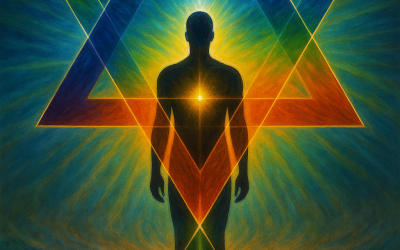 (Image Created by Chatgpt)
We wear it on necklaces, wave it on flags, and carve it into our memories. But the Magen David was never meant to be just a badge of identity. It’s a map — a diagram of consciousness.
Its two triangles aren’t decoration. They are directions: one rising from earth, the other descending from heaven. Their meeting point — that quiet hexagon in the center — is the human soul saying perhaps the most important human response in the Torah:
Hineni — I am here.
The Upward Triangle: Becoming
The upward triangle is the climb — our human struggle to grow, to love, to understand. Psychologist Abraham Maslow called this self-actualization: the drive to become everything we are capable of being.
Judaism calls it tikkun, repair. Every mitzvah, every act of kindness, is another step upward — another piece of the soul restored. The upward triangle is humanity reaching for God.
The Downward Triangle: Receiving
The downward triangle is the opposite movement — meaning descending from above. Psychiatrist Viktor Frankl, a survivor of Auschwitz, taught that human beings can endure almost anything if their lives have meaning.
Meaning, he said, is not invented — it’s received. It descends like light. That’s the downward triangle: God reaching toward humanity.
When these two forces meet — our ascent and God’s descent — the Star of David comes alive. The human soul stands at the intersection of striving and grace.
The Six Points: Directions of Awareness
In Kabbalah, every object in our world exists within six directions: up, down, left, right, forward, and back. These are the boundaries of physical space — and the outer points of the Magen David mirror them perfectly.
When Jews wave the lulav during Sukkot in all six directions, it’s not choreography — it’s theology. It declares that the Divine Presence fills every corner of creation.
But those six points don’t only mark space. They also define awareness.
The Six Constant Mitzvot: Anchoring the Mind
Jewish tradition teaches that there are Six Constant Mitzvot — commandments that apply in every moment of life:
-
To believe in God.
-
Not to believe in other gods.
-
To know that God is One.
-
To love God.
-
To revere God.
-
Not to follow one’s heart and eyes astray.
These aren’t rituals. They’re mindsets. They orient the soul like a compass.
Each point of the star becomes a direction of consciousness — six reminders to stay awake to the presence of the Divine in every moment.
The Center: Hineni
At the center of the star is not a commandment, but a space — the stillness where heaven and earth touch. That’s where the human being stands, aware, balanced, and alive.
It’s the space of Hineni — the word Abraham, Moses, and Samuel each speak when called by God. It doesn’t mean “yes.” It means: I am fully here.
The Star as a Living Map
Seen this way, the Star of David unites psychology, philosophy, and Torah:
-
Maslow gives us the upward motion — human potential.
-
Frankl gives us the downward motion — meaning and purpose.
-
Kabbalah gives us the six directions — divine presence in all space.
-
The mitzvot give us the ethical compass.
-
And Hineni gives it life.
The Magen David isn’t a static emblem. It’s a living map of the soul — a reminder that to be Jewish is to live consciously, with presence in every direction.
We don’t wear the Star just to show who we are.
We wear it to remember how to be.