
The State Of Jeremiah Will Bring Everlasting Peace
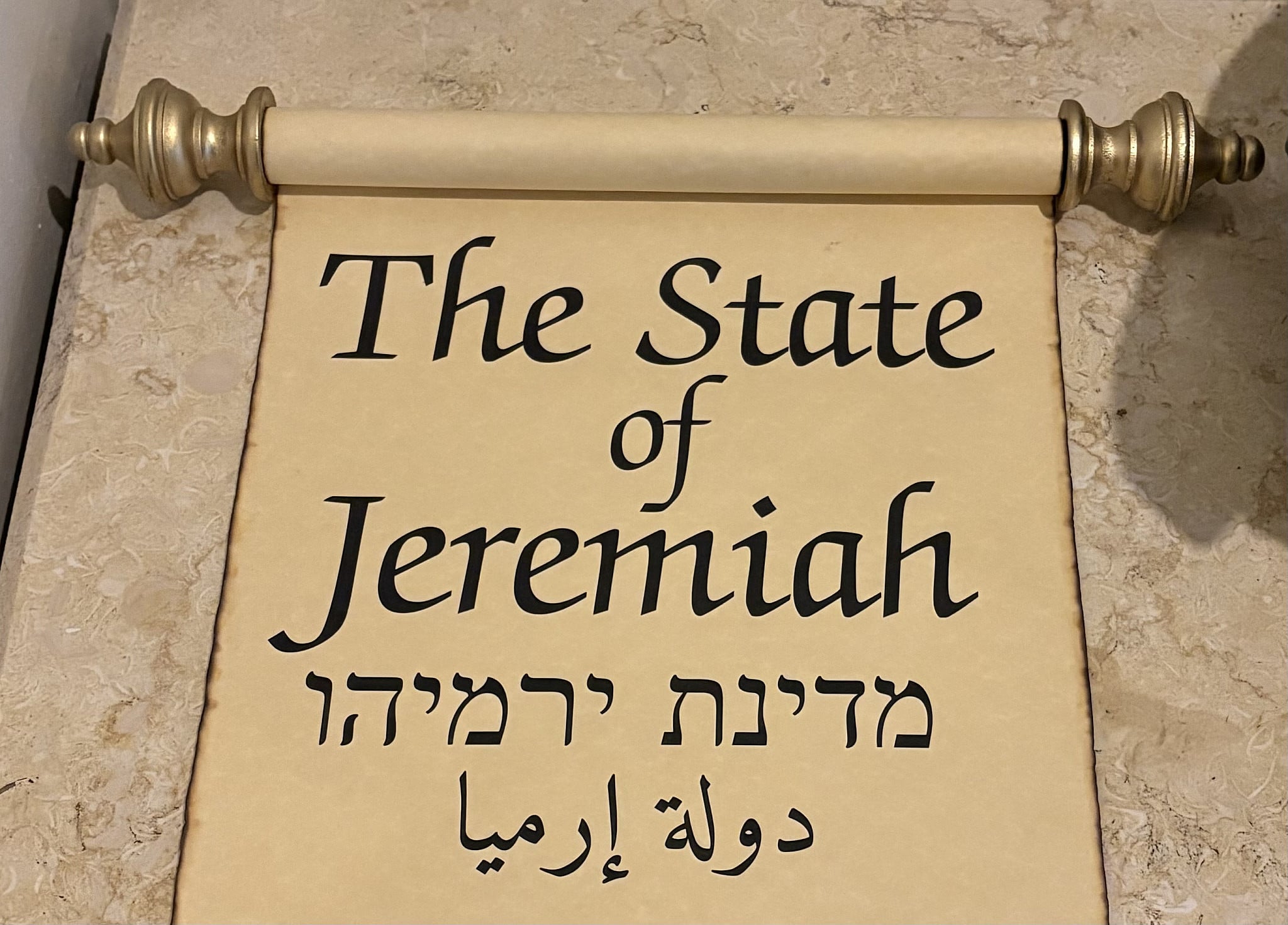
Forget the One-State, Two-State Debate
The State of Jeremiah Is the Peace Blueprint the Middle East Has Been Waiting For
Why has every prior blueprint for Middle East peace collapsed?
Each one treated Gaza as a border problem instead of a human famine: a famine of dignity, purpose, and soil.
The human famine, a deep wound that requires deep treatment, has been treated instead with the bandaid of ceasefires, which have become a kind of mirage in the Middle East over the past few decades. They appear briefly in the heat of diplomacy, only to dissolve in the next exchange of fire. The latest pause in fighting has continued to see hundreds of civilians injured and killed in Gaza, months after the Trump-brokered peace deal. This shows how fragile political peace has become when the earth beneath both peoples is still poisoned by fear, trauma, and neglect.
In a prior Reuters interview, Hamas official Mohammed Nazzal said, “Disarming us is absolutely out of the question.”
I didn’t hear madness. I heard trauma.
He identified the deepest blockage in every Gaza negotiation. For many radicalized fighters, the weapon is identity. Laying it down feels like public humiliation, the final stripping of dignity after years of loss. That’s why top-down peace plans fail: they demand humiliation before healing.
The Core Truth
Nazzal also said, “The weapons of the resistance are directly linked to the establishment of a fully sovereign Palestinian state.”
Translation: “We’ll stop fighting when someone gives us the garden we never had.”
Trauma blinds both sides. No one can imagine that garden until someone begins to plant it.
Reframing Resistance
True, permanent peace must be planted, literally, as a new covenant between land and life: a vision where Israelis and Palestinians restore what war has stripped from them—the soil’s fertility, the dignity of work, and the spiritual calm of shared cultivation.
The Middle East needs to boldly reimagine how everlasting peace can take root in practice.
The State of Jeremiah is a peace framework that replaces coercion with transformation, where the heartbeat of the land is revived.
It begins where the Biblical prophets left off: “They shall beat their swords into pruning hooks.” Isaiah shared the vision, while Jeremiah gave the instructions: “Build houses and live in them; plant gardens and eat their produce.”
What if we took their words to heart?
Instead of demanding men to hand over their rifles, invite them to use those same hands to plant olive seedlings. Resistance doesn’t vanish; it evolves. The instinct to defend life can shift from fire to fertility. Call it Resistance-to-Regeneration, a movement that keeps pride but changes its battlefield from rubble to roots.
I’m a farmer who has helped work the land in Israel alongside Israeli farmers during the recent 2-year war, and have also spoken with families in Gaza. I’ve seen how quickly the soil responds when electricity, water, and will align. The land doesn’t care who plants it, only that someone does, with sincerity.
The Famine of Our Time
Today’s famine is moral as well as material: people are starved of purpose and agency. When Gazan hands plant rather than fire, peace stops being theory. Demilitarization becomes sovereignty through cultivation.
Nazzal rejected the idea of handing weapons to Egypt or any foreign force. External control feels like death to honor cultures. Only internal transformation, freely chosen and not imposed, can endure.
The State of Jeremiah offers that third path, dignity through co-creation. It says, “No one strips your pride; you can choose to trade the rifle for the plow.”
For Israelis, it reframes security too. Aid is channeled into shared livelihoods and cooperative land stewardship, making radicalization economically irrational.
Learning from Trump’s 20-Point Gaza Plan
The Trump administration’s 20-point Gaza peace plan envisioned Gaza rebuilt as a “deradicalized, terror-free zone, amnesty for militants who disarm and commit to coexistence, safe passage for those who leave, and an interfaith dialogue process (grounded in tolerance and mutual respect) to reshape current narratives.
Those provisions echo the logic of The State of Jeremiah, yet with one key difference. The Trump plan treats disarmament as a precondition. The State of Jeremiah treats soil regeneration as the vehicle by which disarmament occurs voluntarily.
Imagine a former fighter offered steady work on a community farm, land shares, and the dignity of building his children’s future. The same hand that once held a rifle now holds a seedling. Instead of surrendering, identity evolves.
From Rubble to Roots
Farmers know something politicians often overlook: coexistence begins where seeds touch the same ground. A tree planted by two hands cannot distinguish which one was Jewish, Muslim, or Christian, it only grows toward the light. From coexistence, we move to co-creation, the shared act of renewing life itself.
The question before the region, and before the international community, is not whether another truce can hold. It’s whether we can build ecosystems of peace resilient enough to endure through uncertainty.
Imagine aid convoys not as symbols of crisis, but as caravans of renewal: engineers, agronomists, and youth from both sides re-greening the borderlands once called wastelands. Imagine a generation which no longer inherits rubble, but roots that bear abundant fruit in its season.
The State of Jeremiah does not seek to redraw lines on a map. It is an energetic state of mind, a frequency of peace that grows through restoration, rather than revenge. The current ceasefire’s cracks are visible, but within them, soil waits for rain.
If we truly wish to rebuild Gaza, we must stop negotiating over rubble and start planting in truth. The soil remembers blood, but it also remembers mercy. And mercy, once rooted, grows fast.
Why Now
A ceasefire buys time for silence, but peace is never guaranteed. Silence can be fertile ground if we plant wisely. Between diplomatic fatigue and international paralysis lies a vacuum of imagination and opportunity to heal the land.
If Washington and Jerusalem want lasting peace, they must stop chasing disarmament as a precondition and start funding agricultural sovereignty. What does this look like in practice? Community farms co-owned and managed by Israelis and Palestinians who live within walking distance of each other. Local land stewardship that also strengthens national food security and aligns with Israel’s emerging National Food Security Plan 2050, which aims to secure reliable local supply through 2050.
When weapons finally rust from disuse, not decree, we’ll know that The State of Jeremiah worked. Peace imposed through force dies fast. Peace planted with loving hands endures.
When the resistance says, “Weapons = Sovereignty,”
The State of Jeremiah replies, “Seeds = Sovereignty.”
Both protect life; only one extends it for everlasting peace.
Perhaps Jeremiah’s prophecy wasn’t poetry after all. It was the forgotten instruction manual for our time. If we dare to nurture the land together, this time, the ground might hold. Then, everlasting peace will finally be within our reach.