


Examining Extremism, Identity, and Influence
The Story Behind India’s Viral ‘Cockroach’ Controversy
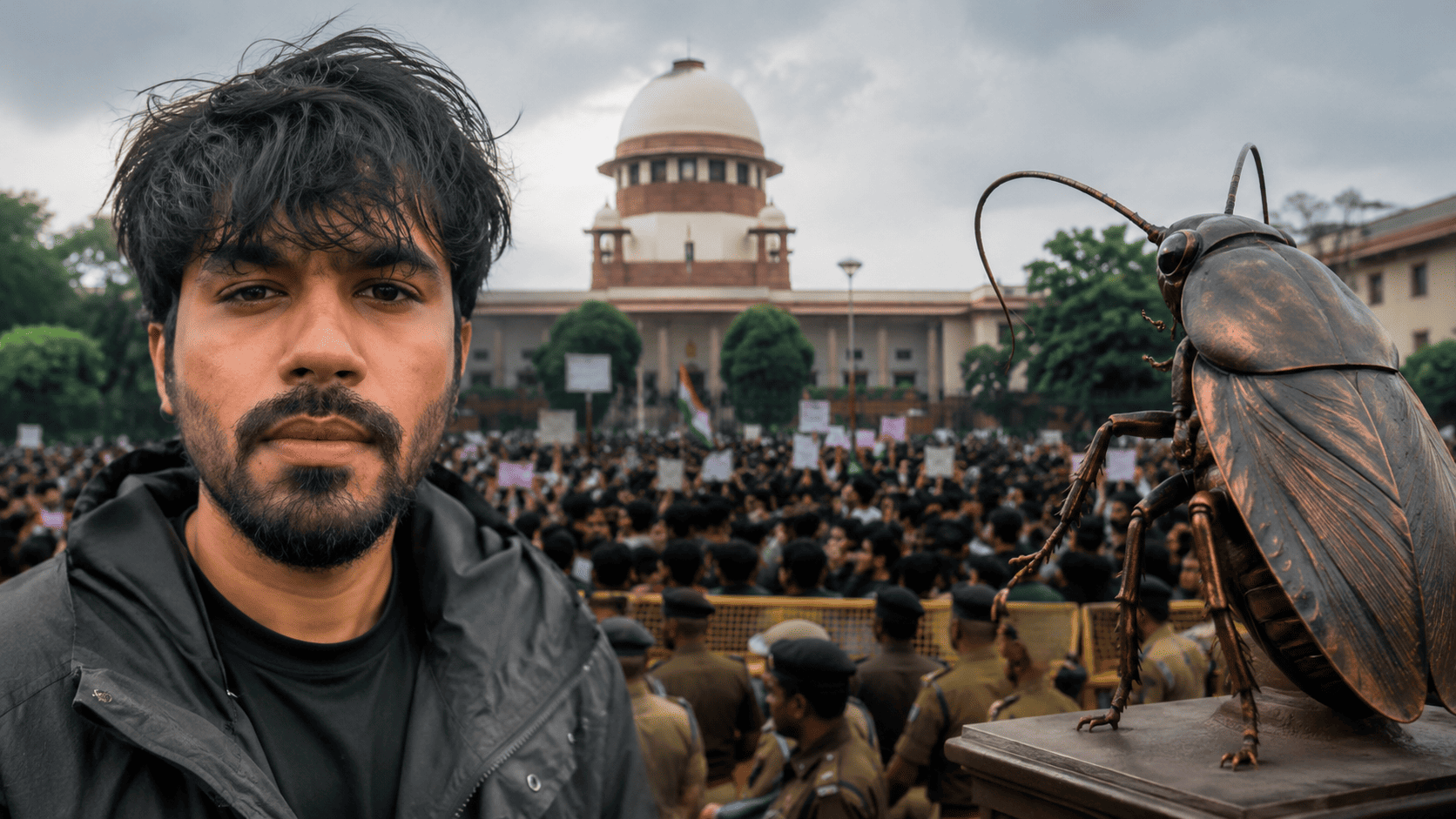
Photo illustration: Courtesy of Author
Twenty million followers in six days. A US-based founder. Western press on speed dial. And a founding story that doesn’t hold up to thirty seconds of scrutiny.
There’s a moment in every political scandal when the story hardens — when a version of events becomes so widely repeated that questioning it feels almost rude. The Cockroach Janta Party (CJP) reached that moment faster than almost any movement in recent Indian political memory.
In less than a week, it had 20 million Instagram followers, headlines in Al Jazeera and the Associated Press, and a founding grievance that had been accepted, without much examination, as straightforward fact: that India’s Chief Justice had compared unemployed young Indians to cockroaches and parasites in open court.
The problem is that this isn’t quite what happened. And the gap between what happened and what the movement says happened is not a rounding error. It’s the whole story.
The Remark, The Room, and What Was Actually Being Discussed
To understand why the CJP’s founding narrative falls apart, you need to understand what Indian Supreme Court hearings actually look like — and what was being argued on 15 May 2026.
India’s Supreme Court is not a quiet appellate chamber. It is a chaotic, crowded institution that handles everything from constitutional crises to disputes over individual property.
On that day, Chief Justice Surya Kant was presiding over a contempt petition — a formal legal complaint — specifically about the designation of senior advocates, and the problem of lawyers using fake and bogus degrees to gain professional standing.
This is a real and documented problem in the Indian legal system. The Chief Justice, in the middle of this hearing, made a remark about youngsters who, failing to get employment or a foothold in the profession, became media activists, social media commentators, and RTI filers who then “attacked everyone.” He used the word cockroaches.
It was a bad comparison. No one serious is defending it. The Chief Justice of India should not be using insect metaphors for frustrated young people, regardless of context. But the context matters enormously, because the context tells you who he was actually talking about — people gaming entry into the legal profession through fraudulent credentials, not the 300-odd million young Indians navigating a difficult job market.
Within twenty-four hours, Justice Kant issued a public clarification. His words, he said, had been directed at those who had entered the legal profession through fake degrees — not at Indian youth broadly. He called the country’s young people the pillars of a developed India. The clarification was unambiguous. The episode, by every reasonable measure, was over.
How a Clarification Becomes a Weapon
This is where Abhijeet Dipke — the CJP’s founder, operating out of the United States — made a move that deserves much more scrutiny than it has received.
Rather than acknowledging the clarification, Dipke recast it. The Chief Justice’s specific reference to people with fake and bogus degrees was reframed, in CJP messaging, as a veiled attack on Prime Minister Narendra Modi’s famously contested academic credentials.
For readers outside India: Modi’s university degree has been a low-level political controversy for years, with opposition figures periodically questioning its authenticity. It is a well-worn battlefield in Indian political discourse.
The Chief Justice said nothing about Modi. His clarification was about lawyers with fraudulent qualifications — a completely separate matter from prime ministerial educational records. But the CJP needed the grievance to survive the correction.
So the correction was surgically reinterpreted to feed a pre-existing political fight that the movement’s likely supporters already cared about. The founding remark — already partially misrepresented — was now attached to an entirely unrelated controversy.
This is not political spin, which is normal and expected in any democracy. This is the manufacturing of meaning from words that did not carry it. And it happened in the movement’s first forty-eight hours.
South Asia Has Seen This Before
Anyone who has watched the region’s politics over the past few years will find something familiar in this sequence of events.
Sri Lanka in 2022 saw a genuine, spontaneous uprising against economic collapse — the Aragalaya — that began with real suffering and ended with a president fleeing by boat in the middle of the night.
Bangladesh in 2024 produced a student movement that ousted Sheikh Hasina after fifteen years in power. Nepal in 2025 saw its own version of youth-led institutional disruption. Each of these began with legitimate grievances.
Each also, at various points, became something harder to defend — Bangladesh most visibly, where the post-movement period saw documented violence against Hindu minorities that the original movement’s architects struggled to either prevent or adequately condemn.
The pattern is not that youth movements are inherently dangerous. The pattern is that movements which compress genuine anger with manufactured narrative — which need the story to be bigger and simpler than the facts support — tend to outrun their own capacity for accountability. They become very good at identifying enemies and very bad at governing the morning after.
The CJP has several features that don’t appear in genuinely organic movements. A founder based in the United States, insulated from the consequences of what unfolds on the ground. A follower count that reached twenty million in six days — a number that requires either extraordinary resonance or significant coordination, and possibly both.
Synchronized coverage in major Western outlets that reported the founding grievance without examining whether it was accurate. These are not the fingerprints of a street-level uprising. They suggest something more deliberate.
The Part Where the Victimhood Never Stops
Once a movement’s identity is built on persecution, everything becomes evidence of persecution. The CJP demonstrated this with some efficiency.
When its website went offline, the movement announced that the Indian government had taken it down — state censorship, digital suppression, the usual vocabulary.
Technical analysis by OpIndia found that the domain cockroachjantaparty.org was in a “clientHold” status, meaning the domain registrar had deactivated it, not the government. No correction followed from the CJP. The censorship narrative continued.
When Dipke claimed his personal Instagram account had been hacked, no supporting evidence appeared publicly. The claim circulated anyway. Meanwhile, the CJP’s X account was genuinely withheld under Section 69(A) of India’s Information Technology Act — a real, verifiable state action. That one real instance of government intervention then served as the anchor for every unsubstantiated claim around it. It’s a technique with a long history: establish one genuine grievance, then use it to lend credibility to grievances you cannot prove.
Why This Matters Beyond the Drama
India has real problems that deserve real movements. Unemployment among educated youth is genuinely high. Courts are genuinely overburdened and sometimes careless in the language they use. Institutions sometimes behave in ways that warrant fierce public scrutiny. None of that justifies a movement that, in its first breath, chose to misrepresent a sitting judge’s clarified remarks — and has not corrected the record since.
A democracy’s public discourse depends on a basic shared commitment: when a public figure says something wrong and then corrects it, you acknowledge the correction. You can still criticize the original statement.
You can argue the clarification was inadequate. But you cannot simply pretend the correction didn’t happen, or reinterpret it to mean something it doesn’t, and then claim to be speaking in the name of accountability.
The CJP will likely keep growing. The international coverage will probably continue. The follower count will climb. None of that changes the nature of the foundation. The movement chose, in its first forty-eight hours, to build on a distortion it had the information to avoid. That was a choice — not an error, not a misunderstanding. A choice.
And every time it invokes truth, accountability, or institutional integrity after that, it’s asking to be judged by standards it declined to apply to itself at the very beginning.