Documentary filmmaker
The Story They Missed Already Exists
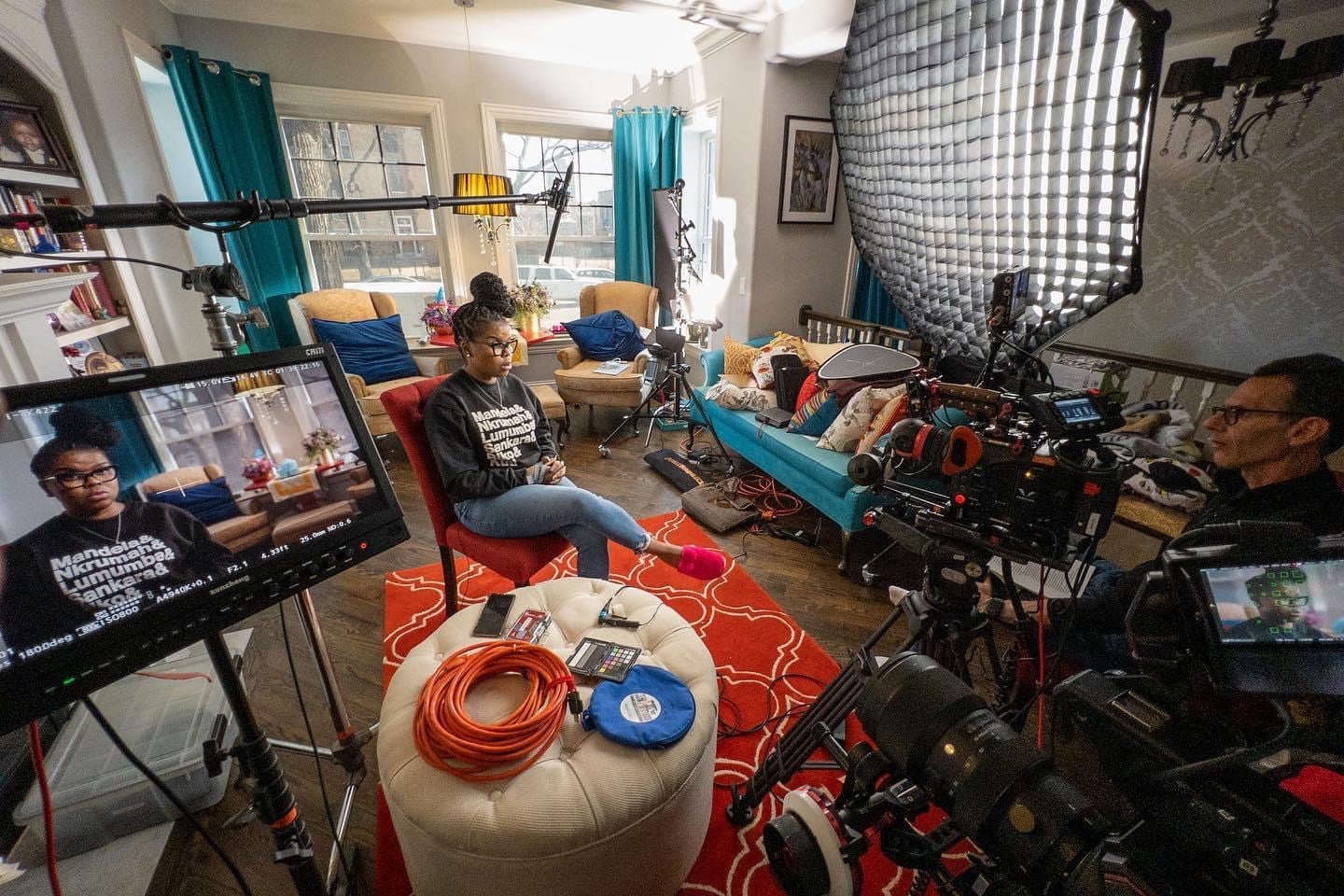
Tamar Manasseh being interviewed for Rabbi on the Block (image courtesy of author)
I read with great interest Robin Washington’s recent piece in The Forward, The PBS series ‘Black and Jewish America’ gets it right — except the Black and Jewish part. Washington argues that Black Jews are too often erased from conversations about relations between the African American and the (white) Jewish community. In the Henry Louis Gates documentary series, he writes, Black Jews “didn’t get the chance” to tell their story.
I couldn’t agree more.
If only there were a documentary film that tells the story of Black Jews and highlights the role that they can play as a bridge between these two communities that are so often depicted as being at odds with one another.
There is one, and I made it.
The film is called “Rabbi on the Block,” and it tells the story of Rabbi Tamar Manasseh, the charismatic anti-gun violence activist and community leader from the south side of Chicago.
Tamar’s work is grounded in both Jewish ethics and Black communal tradition. She feeds the hungry, hosts Yom Kippur services in the middle of a Black neighborhood, and delivers toys to children on Christmas Day. On a block that has known more than its share of hardship, she has made Judaism synonymous with generosity, care, and presence.
For nearly a decade Tamar has been doing this work, and because of her there is a neighborhood of poor Black residents who associate Judaism not with distance or suspicion, but with charity, generosity, and kindness. For years, she has been bringing white Jewish groups to the block, creating human connections that have developed into deep and lasting friendships.
Rabbi Manasseh is by far the best public relations that Judaism can have on the south side of Chicago.
Her success offers a practical model for improving Black-Jewish relations: start at the grassroots, not in conference rooms.
My experience filming Rabbi Manasseh convinced me that relationship-building fails when it’s imposed from the top down. It works when people meet as neighbors first and representatives second. White Jews and African Americans need more shared spaces where they can see one another as human beings, not abstractions.
The tragedy is that even efforts like Rabbi Manasseh’’s often struggle to find institutional support. Over the past several years, we have tried to push forward various initiatives to bring people together, only to be rebuffed for one reason or another. Too often, it feels like much lip service is paid to the importance of bridging the gaps that exist, but when the time comes to take action, willing partners are difficult to find.
And then came October 7th.
If the relationship between white Jews and African Americans was fragile before, the situation has definitely reached a crisis point since that awful day over two years ago.
Israel, long a source of tension between our communities, has become the third rail – touch it at your own risk.
Rabbi Manasseh saw it firsthand last year when she tried to organize a unity Passover Seder. One group refused to attend a “Zionist Seder.” Another said they wouldn’t participate unless Israel was explicitly discussed.
When we talk about the need to have uncomfortable conversations, this is the uncomfortable conversation that has to be had. If we can’t find a way to address this elephant in the room, there will be no reconciliation.
Washington notes that Rabbi Capers Funnye of Chicago’s Beth Shalom B’nai Zaken Ethiopian Hebrew Congregation is included in the PBS series, but more as a talking head commenting on general historical events, and not talking about his own congregation’s unique place in the Jewish world.
Rabbi Mansseh grew up in Rabbi Funnye’s congregation and Rabbi Funnye is the one who ordained her. When I interviewed him for Rabbi on the Block, he provided me with some of the most thoughtful insights about the struggles that Black Jews face in finding acceptance in mainstream American Judaism.
“When you pray, and when I pray, the sounds may be a little different, but the prayers are exactly the same. And so, when we pray, we can pray together. Although we have different tempos, different cadences, we can still pray together,” Rabbi Funnye told me. “As an African American Jew, I’m sorry that you have problems with me when I come into your house, you will never have a problem when you come into my house.”
That generosity is not theoretical. It is practiced daily by Black Jews like Tamar Manesseh who move between communities that too often misunderstand them and, in doing so, misunderstand each other.
The story Robin Washington is calling for is not missing. It is unfolding right now. Black Jews are telling it every day through the work they do, the spaces they create, and the bridges they build whether institutions acknowledge them or not.
More people need to see that story.
That’s why Rabbi on the Block exists.
Related Topics