


The strategic recomposition of the Mediterranean
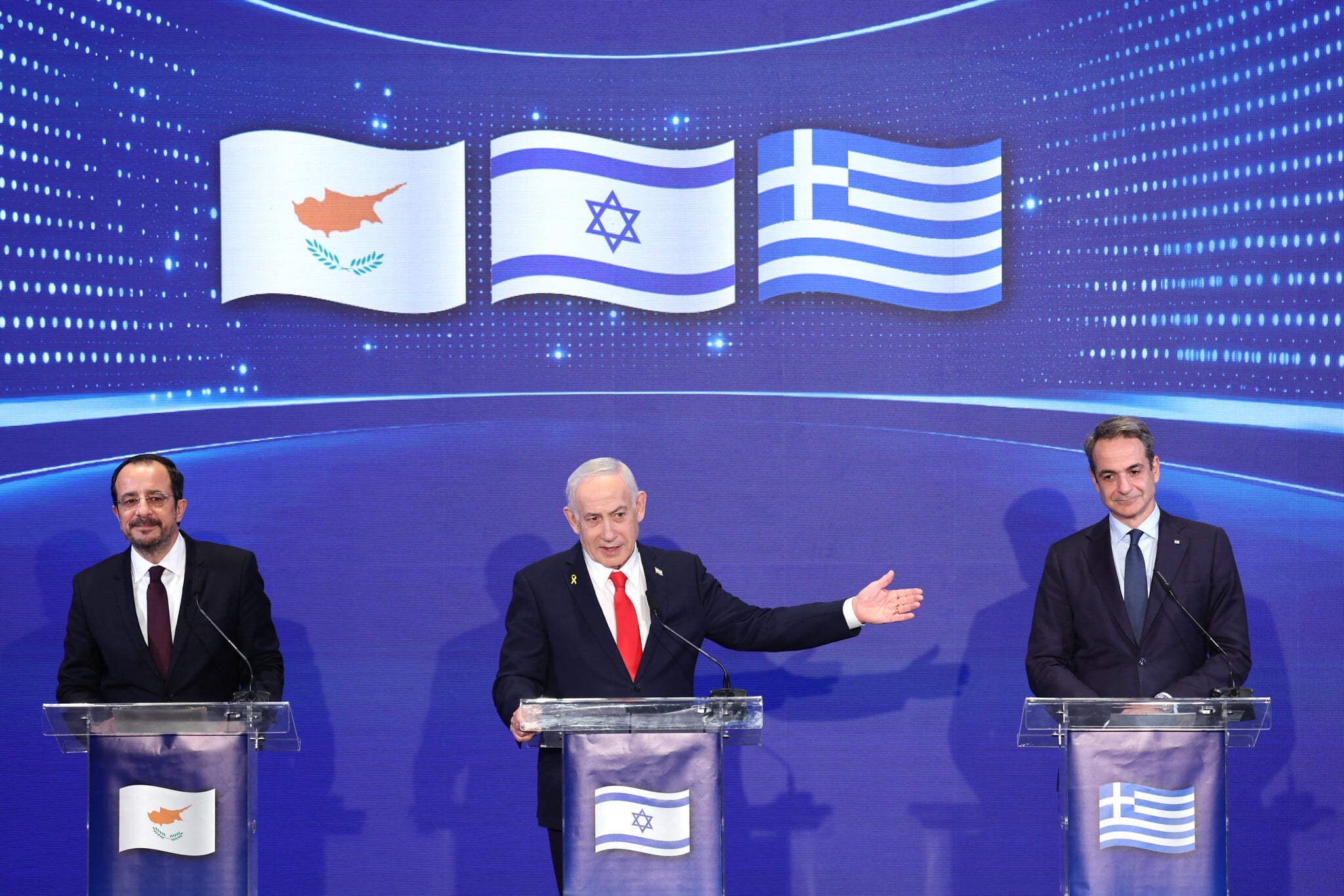
Since October 7, 2023, and for several years, the eastern Mediterranean has been experiencing a profound strategic realignment. The strengthened military and security collaboration among Israel, Greece, and Cyprus is no longer just a matter of technical coordination or joint exercises: it reflects a regional restructuring in which Turkey appears to be the main loser, marginalized at the same time on the security, energy, and diplomatic levels.This dynamic is part of the context of strong regional turbulence. The Gaza war, Lebanon and Syria’s tensions, the eastern Mediterranean bloc competition, and the polarization of alliances are pushing states to look for partners deemed reliable, predictable, and strategically compatible. The triangle of Israel, Greece, and Cyprus has gradually established itself based on these criteria.
For Israel, getting along with Athens and Nicosia is important for several reasons. On the security front, military cooperation with two members of the European Union and NATO (for Greece) offers strategic depth and a diversification of its partnerships at a time when its relations with Ankara have deteriorated significantly. Joint exercises, intelligence sharing, and naval and air cooperation strengthen offers strategic depth in a maritime space that has become central.
For Greece and Cyprus, this partnership brings a level of protection and projection. In response to Turkey’s perceived assertiveness and revisionism, particularly in the eastern Mediterranean, the Israeli anchorage provides additional military credibility. It also allows Athens and Nicosia to be more integrated into the security architectures supported by Washington and, more broadly, by Western capitals.
But beyond security, this cooperation extends to the energy and strategic field. Coordination projects around gas resources, electricity interconnections, and maritime infrastructure structure a regional space where Turkey is no longer indispensable. In other words, an alternative axis has formed, capable of getting around Ankara both on the energy and diplomatic levels.
It is here that the Turkish question becomes central. Erdogan’s Turkey wanted to be a pivotal power: a member of NATO, a major player in the Middle East, a regional mediator, and a leader of the Muslim world. However, this ambition is today confronted with an accumulation of contradictions. His avowed political support for Hamas, his extremely harsh rhetoric against the Netanyahu government, his refusal to make a clear break with Russia, and the maintenance of the S-400 system continue to fuel Western distrust.
In this context, the marginalization of Ankara in certain regional formats is not the result of a diplomatic plot but of a logic of strategic selection. Israel, supported by its Greek and Cypriot partners, favors states with which it shares a security convergence and minimal strategic compatibility. Turkey, on the other hand, is perceived as an unpredictable actor, whose regional agenda often clashes with that of its Western partners.
The issue of Gaza illustrates this sidelining. Ankara has expressed its willingness to play a role in the post-war period or even to participate in an international force. However, Israel firmly opposes it, considering that a Turkish commitment would compromise its security interests. Result: Turkey finds itself excluded from key discussions on the future of Gaza, even as it seeks to position itself as an essential player in the Palestinian file.
More broadly, this dynamic reveals a recomposition of the Middle East where Turkey is no longer automatically at the center of the game. Regional formats multiply without it: trilateral, 3+1 partnerships, and ad hoc coalitions. The Eastern Mediterranean thus becomes a laboratory for a new equilibrium, in which Ankara must choose between a pragmatic normalization strategy or a posture of protest that would further accentuate its isolation.
For Turkey, the problem is “serious.” A real rapprochement with Washington and its allies would involve costly concessions on the political and symbolic level. On the other hand, continuing with a strategy of double playing may lead to a shift from relative marginalization to a more permanent strategic decline.
The military cooperation between Israel, Greece, and Cyprus is therefore not only an alliance of circumstance. It is the symptom of a broader regional shift, where strategic credibility, coherence of alliances, and readability of positions now take precedence over declared ambitions for power. In this new chessboard, Turkey remains an important player, but less and less indispensable.