

The Street and the Home, Part II
3: Becoming Viennese
To understand what surfaced in me, I must describe, with some care, what my father’s world offered — and what it cost.
The story begins, formally, with the Toleranzpatent of 1782, Joseph II’s Edict of Toleration, which opened certain professions, certain schools, and certain forms of civic participation to Jews in the Habsburg lands in exchange for a gradual loosening of communal autonomy and traditional dress and language.(6) Over the following century, and especially after full legal emancipation in 1867, Vienna’s Jewish population grew rapidly — from a small, tightly regulated community to, by the eve of the First World War, roughly ten percent of the city’s population, one of the largest and most consequential Jewish communities in Europe.(7) Marsha Rozenblit’s demographic and social history of this community describes the identity that resulted as tripartite: Austrian by political loyalty, German by culture and language, and Jewish by religion and ethnic descent — a formula that, crucially, its adherents did not experience as three competing loyalties but as a single coherent self, so long as each element stayed within its proper sphere.(7)
That last clause matters enormously, and it is the heart of what I want to call, following one thread of my own thinking about this material, the camouflage thesis. Animals camouflage to survive predators. Minorities camouflage to survive majorities. Camouflage, understood this way, is not cowardice — it is adaptation, a rational and often creative response to a genuinely dangerous environment. Vienna rewarded a specific kind of Jewish camouflage: the cultivated physician, the lawyer, the professor, the operagoer, the reserve officer, the gentleman of the coffee house. Steven Beller’s study of Vienna’s Jews documents just how successful this adaptation was by any external measure — Jews were represented, by the early twentieth century, at levels vastly disproportionate to their share of the population in medicine, law, journalism, and the professions generally, and Jewish patronage and participation were central to the city’s celebrated musical and artistic life. (6)
There is a darker way to describe this success, and I have come to think it is the more accurate one. In 1922 the Viennese journalist Hugo Bettauer — himself a Jew who had been baptized into the Lutheran church at eighteen — published a satirical novel, Die Stadt ohne Juden, subtitled “a novel of the day after tomorrow,” in which Vienna expels its Jews by legislation and then, within months, regrets it. (8) What is instructive is the shape the regret takes. The city does not repent morally. It grows dull. The theatres, forbidden their Jewish playwrights, sink into provincial mediocrity; the cafés empty; the operettas are hissed off the stage; and, most tellingly of all, the demagogues find themselves without anyone left to blame. Benjamin Balint identifies this as belonging to an old European genre of mercantile remorse — expulsion followed by an accounting of losses, in which readmission is imagined as a favour the expellers graciously extend. (9) Bettauer deploys the genre as satire, but, as Balint observes, he does not entirely escape it, since his case for the Jews rests substantially on the functions they perform: the financiers, the physicians, the musicians, the patrons, the suppliers of urban brilliance.
I dwell on this because it names something the camouflage thesis, as I first formulated it, was too gentle to say. The Viennese Jewish persona was not only a mask against danger. It was a value proposition, denominated in the majority’s own currency. Bildung, the professions, the mastery of German prose and German music — these were not merely the means of becoming inconspicuous. They were evidence submitted in an ongoing argument about whether Jews were worth having. Which means the persona had already conceded the terms of that argument. It accepted that Jewish belonging was contingent on Jewish usefulness and so internalized the very accounting it was meant to defuse. This is not a criticism of the people who wore the mask, who were doing what one does under conditions one has not chosen. It is a description of what the mask cost, and of why it could not, in the end, protect anyone. A case for one’s own existence built on contribution is a case that can be reopened at any moment by anyone willing to dispute the ledger.
None of this was false. This is where Jung’s concept of the persona becomes indispensable, and I want to introduce it carefully rather than as an accusation. For Jung, the persona is not a lie; it is the necessary interface between the inner self and the social world, the mask every civilized person wears to function among others. (10) Every civilization requires masks. Vienna simply offered its Jews an unusually elaborate, unusually rewarding mask — Bildung, cultivation, the mastery of German prose and German music and German law — and many of them wore it brilliantly, without ever believing, in their own minds, that they had abandoned anything essential. My father’s generation inherited precisely this belief: that one could be, without contradiction, a Jew in the home and a gentleman on the street.
Jung’s caution, however, is the one that matters most for this essay: the danger is not the persona itself, which is unavoidable and often admirable, but the moment when persona is mistaken for identity — when the mask forgets that it is a mask, and the person wearing it forgets there is a face underneath. My father’s Vienna, I now believe, lived close to that line without, for the most part, crossing it entirely. But the pressure to approach that line — the pressure toward invisibility as the price of belonging — is precisely what produced the reaction I felt on meeting a stranger who had refused to make the same bargain.
4: The Ostjuden
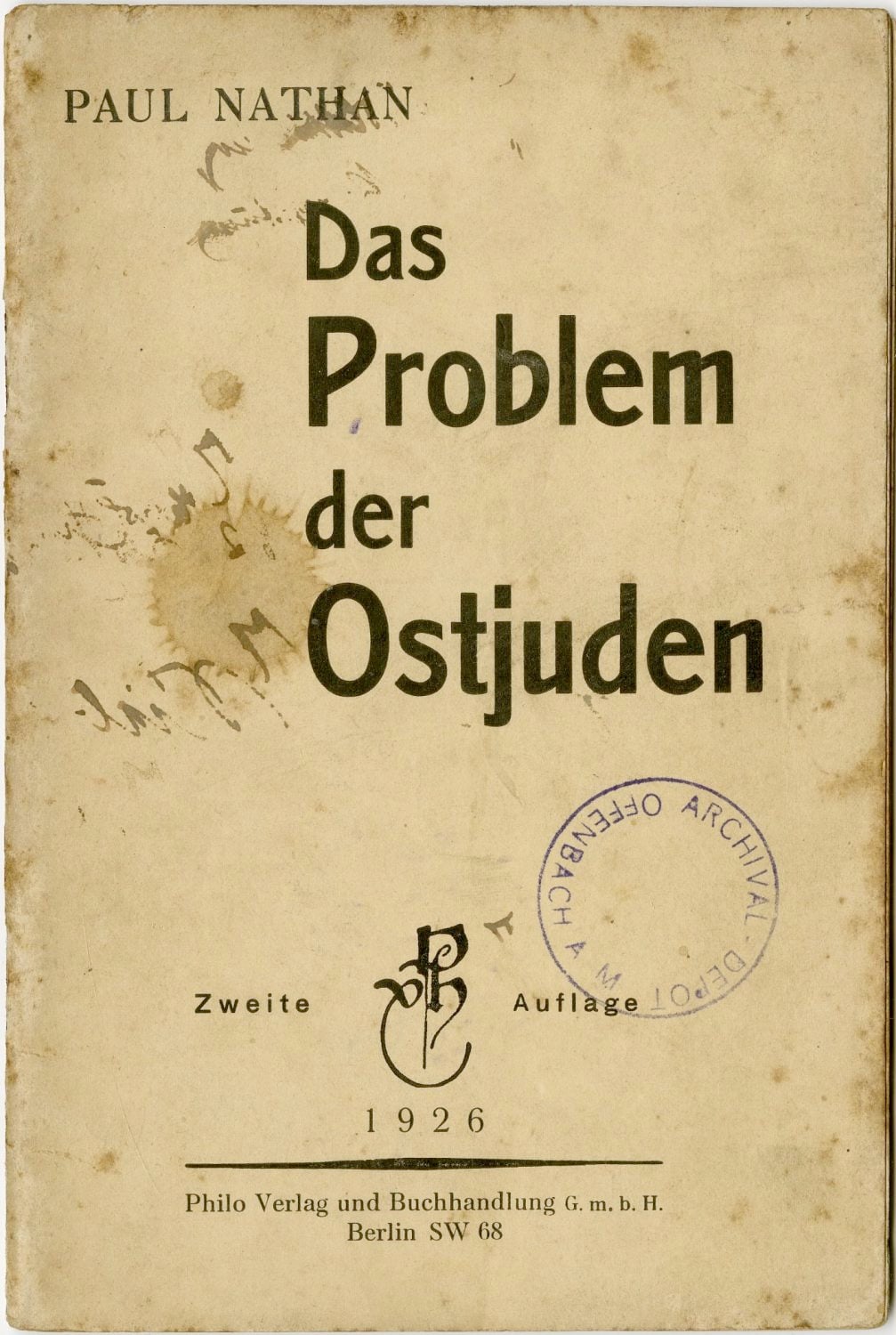
This movement is, necessarily, largely historical, because the tension I am describing did not originate as psychology. It originated as a real, documented, often painful encounter between two Jewish worlds that had developed on opposite sides of an internal European frontier.
Beginning in the 1880s and accelerating catastrophically with the First World War and its aftermath, waves of Jewish refugees and migrants arrived in Vienna from Galicia, Bukovina, Hungary, Lithuania, and the Russian Pale of Settlement — regions where Jewish life had remained overwhelmingly traditional, Yiddish-speaking, and, especially after 1914, subject to devastating violence and displacement as competing armies swept across the eastern front.(11) They arrived, in large numbers, in caftans rather than frock coats, speaking Yiddish rather than cultivated German, wearing payot, and practicing a public, unapologetic piety that had little in common with the discreet, privatized religion of the Viennese Jewish bourgeoisie.
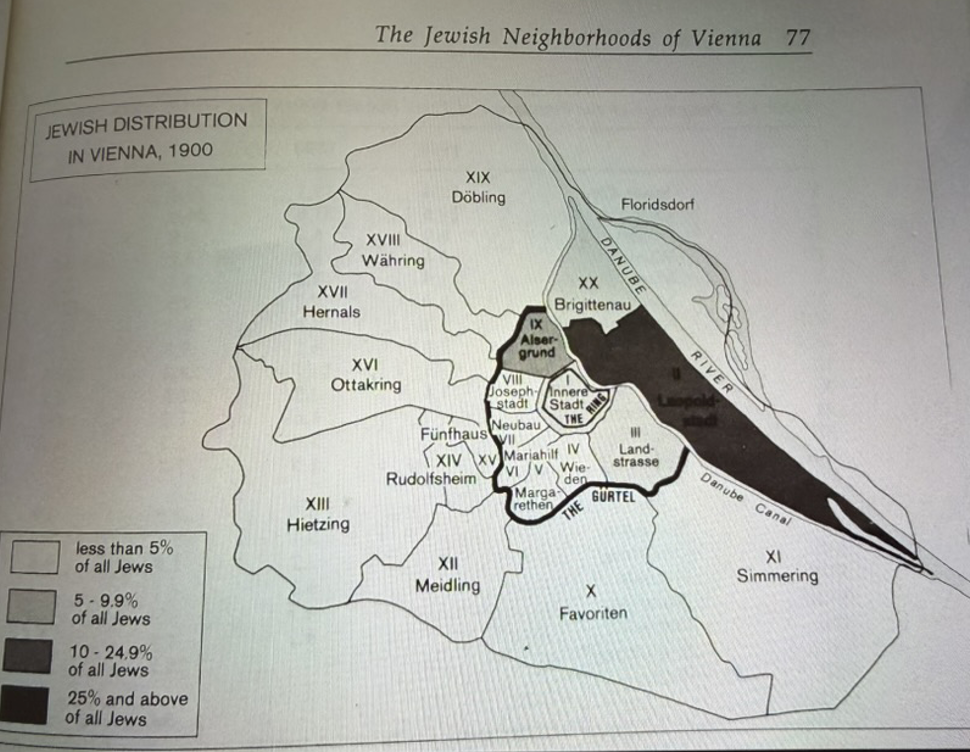
The numbers alone convey something of the scale of what Vienna absorbed. Rozenblit’s demographic reconstruction shows the city’s Jewish population rising from roughly 6,000 in 1857 to over 175,000 by 1910, with the sharpest surges tied directly to crises in the east — the pogrom waves following the 1881 assassination of Alexander II, the failed 1905 revolution and its accompanying violence, and then, most dramatically, the mass flight of Galician Jewry before the advancing Russian army in 1914 and 1915, which brought an estimated 77,000 refugees into Vienna within a matter of months, a great many of them destitute, traumatized, and entirely dependent on a communal infrastructure unprepared for their arrival.(11) They settled overwhelmingly in the Leopoldstadt, Vienna’s Second District, which by the war years had become so densely identified with Eastern European Jewish life that Viennese slang had already begun calling it “Mazzesinsel” — the matzah island — a term that could carry either affectionate familiarity or contemptuous distance depending entirely on who was using it and in what tone.(6)
The organized Jewish community’s response to this influx was neither uniformly generous nor uniformly hostile, and the historical record complicates any simple story. The Israelitische Kultusgemeinde, Vienna’s official Jewish communal body, together with organizations such as the Wiener Israelitische Allianz, did mobilize substantial relief — soup kitchens, temporary housing, medical care, and eventually schooling — for the refugee population, and prominent assimilated Jews sat on the boards that organized this aid.(11) At the same time, internal communal correspondence and the Jewish press of the period reveal persistent anxiety that the refugees’ visible poverty, their Yiddish, and their public piety were furnishing precisely the material antisemitic agitators needed. Christian Social politicians, most notoriously Mayor Karl Lueger and his successors, seized on the refugee presence to argue that Vienna was being “overrun” by an alien element, collapsing the careful distinctions between assimilated and unassimilated Jews that the Kultusgemeinde’s own leadership had spent decades constructing.(1) The bitter irony, evident already before 1918, was that the antisemitic right refused to honor exactly the distinction the assimilated community most needed it to honor.
For many assimilated Viennese Jews, these newcomers represented, uncomfortably, several things at once: their own grandparents, one or two generations removed — Beller notes that a substantial proportion of the city’s most acculturated Jewish families had themselves arrived from Bohemia, Moravia, or Hungary within living memory, making the social distance from the Ostjuden considerably narrower, genealogically, than it felt psychologically; a source of social embarrassment before a Gentile society already primed by antisemitic caricature to see all Jews as foreign and unassimilable; a living reminder of the provincial origins many had worked hard to leave behind; and, not least, a feared vision of what their own children might become should the project of assimilation ever falter.(6) Karl Kraus, himself a Jew of exactly this acculturated background, directed some of his most cutting satire at the Ostjuden, and Jewish-owned newspapers of the period were not above caricaturing the new arrivals in terms uncomfortably close to the antisemitic press they otherwise opposed.(12) Jacques Le Rider and George Mosse have both documented this anxious pattern of internal Jewish self-differentiation, in which the acculturated Jew, already vulnerable to the charge of alien unassimilability, sought to draw a hard line between himself and the visibly, unmistakably “unassimilated” Jew arriving at the Nordbahnhof.(13) Sander Gilman’s account of what he terms Jewish self-hatred locates the deeper mechanism here: contempt absorbed from the dominant culture, redirected inward, away from the actual source of danger and toward the members of one’s own community who most resembled the stereotype.(14)
Yet the response was never monolithic, and it is worth naming the countercurrent directly. Zionist youth movements, gaining strength in Vienna precisely during these years, often celebrated the Ostjuden as bearers of an authentic Jewish national culture that assimilated Vienna had lost — Martin Buber’s lectures on Hasidism, delivered in Vienna to enthusiastic young Jewish audiences beginning in 1909, explicitly inverted the prevailing hierarchy, presenting Hasidic spirituality as a wellspring the West needed to rediscover rather than a backwardness to be escaped.(15) Buber’s own turn toward Hasidic sources, culminating in his retellings of Hasidic tales, gave an entire generation of acculturated young Viennese Jews permission to feel something other than embarrassment when they encountered a Galician rebbe’s court — permission, in effect, to feel what Hillman would later ask me to feel: not shame, but wonder at an unfamiliar image. That this countercurrent existed alongside the more common pattern of anxious distancing is itself evidence that the reaction I am examining in myself was never inevitable, never simply “how Viennese Jews felt,” but one pole of a live and unresolved argument within the community itself — an argument I now recognize I am still, unknowingly, a participant in.
It is important, and I want to insist on this, that the historical record not be flattened into caricature in either direction. The tension between Western and Eastern European Jewry was real, and it was often unkind, but it was not uniform contempt. Many assimilated Viennese Jews were active in refugee relief for the Ostjuden arriving during and after the war; many Eastern European Jewish immigrants themselves embraced modernity, Zionism, socialism, or secular Yiddish culture in ways that resist any simple “traditional versus modern” binary; and there were, throughout this period, countless intermediaries — families that were simultaneously observant and professionally assimilated, communities that blended German and Yiddish, individuals who moved fluidly between these supposedly opposed worlds.(6) Preserving that complexity matters, because it prevents this essay from becoming a judgment on entire communities and keeps it what I want it to be: a meditation on inherited images and projections, not a verdict on the people who carried them.
Part II of a five-part series. Notes and references appear at the end of Part V.