

The Street and the Home, Part V
Vienna, the Ostjude, and the Jewish Shadow
9: Jerusalem Answers Vienna
One further turn of the mirror is worth including, because it complicates any simple resolution and, I think, ultimately points the way toward one.
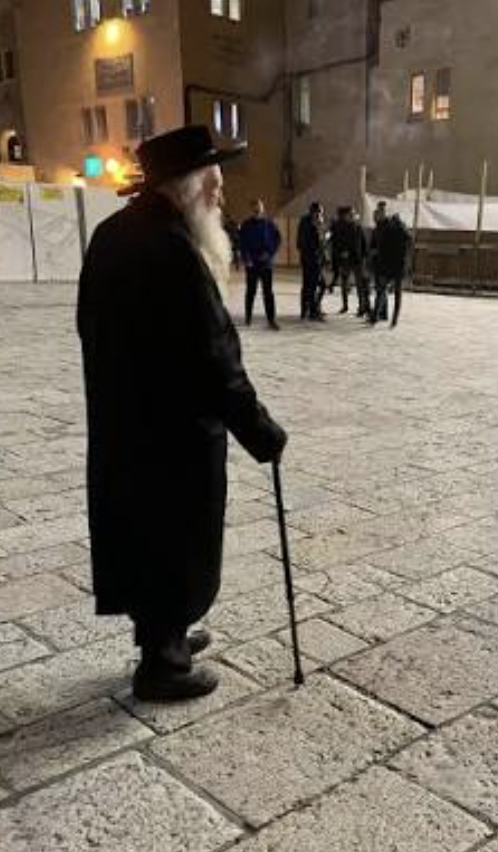
I have walked the streets of Jerusalem many times over the course of my life — Meah Shearim, Geula, the crowded lanes near the Machane Yehuda market where Hasidic, secular, Sephardi, and tourist traffic all move through the same narrow space without any of it registering, to anyone, as remarkable. In Jerusalem, a man in a kapote crossing in front of my car at a red light is not an image that asks anything of me at all; it barely rises to the level of noticing. It was only in retrospect, thinking back on the Vienna encounter, that I understood how strange this asymmetry was. The same visual fact — a Hasidic man walking a city street — had provoked nothing in Jerusalem and provoked a great deal in Vienna. The man himself had not changed. The street had.
In Vienna, the Hasid appeared, to my inherited eye, as the visibly foreign figure against a backdrop of cultivated European assimilation. In Jerusalem, the symbolism inverts almost completely. There, the black kapote is not an intrusion but simply one expression, among many, of ordinary Jewish public life. It is very often the secular, cosmopolitan, European-inflected Jew — the descendant, in cultural style if not literal genealogy, of my father’s Vienna — who can appear, within a different set of communal norms, as the outsider, the one whose Jewishness has been diluted by contact with the very culture that once demanded its concealment. I have felt this reversal directed at myself, more than once, in more traditional neighborhoods of Jerusalem — a fleeting sense of being the less legible Jew in the room, despite a lifetime of Orthodox observance, simply because my dress and my manner still carry, unmistakably, the marks of a Western professional life. That feeling, I now recognize, is the precise mirror image of what I felt in Vienna, and noticing the symmetry has done more to dissolve my Viennese discomfort than any amount of direct argument with it could have.
There is a fourth city in this argument, and I have been avoiding it, because including it costs me the comfortable position of observer.
I wear a yarmulke. I have worn one, uncovered, on the streets of New York for decades without a single moment’s hesitation; it has never once risen to the level of a thought. In Jerusalem, less than that. In London, as a boy, I was not permitted to. And in Vienna, on those same elegant boulevards where I watched a Hasidic family cross the street, I was conscious of it. Not frightened. Conscious — aware of my own head in a way I am never aware of it in Manhattan, performing small unnecessary calculations about which streets, which hours, which glances.
Which means the scene I have been describing for nine movements was never quite what I said it was. I was not a bare eye observing a visible Jew. There were two visible Jews on that street, and I was the second. The recoil I felt was not simply directed outward at a stranger in a kapote; it was, at least in part, the recoil of a man wearing the very thing his mother had once replaced with a cap, in the city that had taught her generation why. He was not carrying my Shadow instead of me. He was carrying it alongside me, more competently, without apparent effort — and it was the ease that stung. What I took for discomfort at his visibility was substantially discomfort at my own, arriving by the only route available to it, deflected onto someone better at bearing it.
This also explains the gradient, and the explanation is not the one I would have offered before writing this essay. It is not observance that varies across the four cities; my practice is identical in all of them. It is the local memory of danger. New York holds none that touches me. Jerusalem holds a great deal, but not of this kind and not aimed at the kapote. London held enough, a generation ago, to put a cap on a boy’s head. Vienna holds the archive of the thing itself, and to walk through an archive with a marked head is a different act from walking through a city.
The archetype does not disappear when it crosses a border. It moves. The center of gravity — who counts as the authentic Jew, who counts as the one who has compromised — relocates depending on where one stands, and this alone should be evidence enough that no fixed hierarchy of Jewish authenticity can be sustained across geography. If the same figure can be coded as foreign in one city and as normative in another, then the discomfort I felt cannot be mistaken for a stable judgment about who is more genuinely a Jew. It is, instead, a symptom of location — geographic, historical, and psychological all at once. That the rabbinic tradition names God Makom, Place, is not incidental here; I have argued elsewhere that place in Jewish thought is never neutral background but an active constituent of what can be perceived within it. (28) Geography reshapes archetype. My father looked into the mirror of Vienna and asked, in effect, how can I become sufficiently Austrian that my Judaism will no longer be an obstacle? I looked into that same mirror eighty years later and asked, instead, what part of my Judaism did Vienna ask my father to hide? The mirror had not changed. The observer had.
10: Integration — Joseph, Judah, Benjamin, and Adam I and Adam II
I do not want this essay to end in Jungian terms alone, however useful they have been in getting me here, because the deepest resources for integration available to me are not Swiss or German but Hebrew, and I want to close within my own tradition rather than borrowing its resolution from outside.
The Talmudic principle elu v’elu divrei Elohim ḥayyim — “these and these are the words of the living God” — offers a first frame. (29) Applied to competing halakhic opinions in dispute, the principle refuses to declare one side simply false and the other simply true; it holds both within a single, larger legitimacy, without erasing the real disagreement between them. I want to borrow that structure here, not to dissolve the difference between assimilationist and Hasidic Jewish life into false equivalence, but to insist that both are genuine, if radically different, expressions of covenantal existence — expressions that need not be reconciled by declaring a winner, only recognized as belonging to one unfinished family.
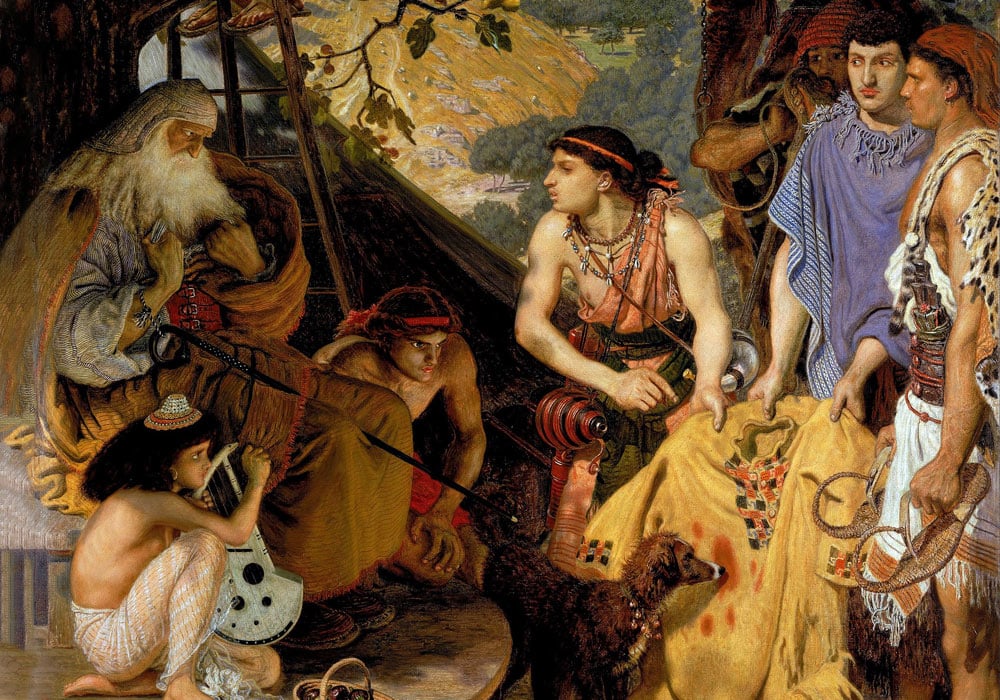
The deeper archetype, though, I think is biblical rather than rabbinic, and it is the one that has stayed with me longest: Joseph and his brothers. Joseph is Egyptian in dress, language, administrative sophistication, and political mastery. He succeeds precisely because he masters the dominant civilization without — this is the crucial claim of the narrative — abandoning his covenant; when tested, at the height of his power, he does not deny who he is. Judah remains recognizably Hebrew throughout, tied to the land, the family, the flock. The brothers, encountering one another in Egypt, at first fail to recognize each other at all. Only through suffering, confession, and a long, halting process of testing do they become reconciled. I have read this narrative before as a clinical paradigm for fraternal rupture and its somatic consequences, and what strikes me now is how exactly the diagnostic structure transfers: estrangement between brothers who share everything is more corrosive, and slower to heal, than enmity between strangers who share nothing.(30) That structure is remarkably close to the history I have been tracing: the assimilated Viennese Jew is, archetypally, Joseph — mastering Bildung, the professions, the German sentence, without, in his own understanding, abandoning the covenant beneath the persona. The Hasid from Galicia is Judah — recognizably, unmistakably Hebrew, tied to a visible and public form of Jewish life. Hitler became a grotesque anti-Joseph, refusing every distinction Joseph had worked so carefully to construct, insisting there was only ever “Jew.”
But it is not Judah I find myself thinking of most, at the end of this. It is Benjamin. Joseph weeps most, in the narrative, not over Judah, who confronts him directly and eloquently, but over Benjamin, who says nothing at all — the one brother who never left home, who remained in Canaan while Joseph became Egyptian. Perhaps Joseph weeps over Benjamin because Benjamin represents the life Joseph never lived, the self he might have become had history taken a different turn. I wonder now whether the Hasid I saw on that Viennese street represents, for me, something closer to Benjamin than to an accusing Judah: not what the assimilated strand of my inheritance despises, but what it mourns — a form of visible, undivided Jewish life that circumstance, ambition, and history diverted my family away from, without ever fully erasing the pull toward it.
Rabbi Joseph B. Soloveitchik’s distinction, in The Lonely Man of Faith, between Adam I and Adam II offers a final, theological frame for the same tension. (31) Adam I is the Adam of mastery, culture, achievement, dominion over the earth — the Adam commanded to “fill the earth and subdue it.” Adam II is the Adam of covenant, obedience, humility, communion — the Adam formed from dust and commanded to till and to keep. Soloveitchik’s argument is that authentic religious existence requires both, held in permanent, unresolved tension, and that a life collapsed entirely into either Adam alone becomes distorted. The assimilated Viennese Jew, I think, largely perfected Adam I. The Hasid, in his public, embodied piety, often appears to represent Adam II almost undiluted. Both, without the other, risk incompleteness. Neither is the whole of what covenantal Jewish life asks of a person. Revisiting Soloveitchik’s essay at sixty years’ distance, I argued that the dialectic has too often been domesticated into a manageable balance, when its actual demand is that the tension remain unresolved and painful. (32) Vienna is where I learned what that costs.
Epilogue: Walking Behind the Kapote
I see a Hasidic family crossing a Viennese street.
Years earlier, I might have crossed to the other side.
Now, after standing at my ancestors’ graves, I follow them instead — not because I have become (post) Hasidic, and not because I have resolved, in some tidy way, everything this essay has tried to examine, but because I recognize, finally, that they are carrying part of my own history. Not carrying it for me, and not carrying it as me — but carrying, unasked and unaware, a fragment of the inheritance my own family once believed it had to set down to survive.
I arrived in Vienna believing I was searching for my father. I left realizing I had also been searching for the brother my father had been taught not to resemble. The black kapote that once seemed out of place on Vienna’s elegant streets no longer appeared to me as an intrusion but as a question. It asked whether a people could survive by becoming invisible, or whether every generation must decide anew how visibly it will bear its covenant. Hitler answered that question with racial hatred, declaring every Jew the same. Judaism answers differently. It insists that Joseph and Benjamin, the professor and the Hasid, the salon and the shtibl, the German sentence and the Yiddish niggun, all belong to one unfinished family. Standing beside my great-grandfather’s solitary grave, I realized that history had not asked me to choose between them. It had asked me to recognize them both within myself.
My mother sent me out with a cap where the yarmulke should have been. I have spent a lifetime taking that cap off, and Vienna is where I discovered I was still holding it.
Vienna taught my father that survival required becoming invisible. Jerusalem taught me that survival sometimes requires becoming visible. Between those two cities walks the Jew I am still trying to become.
Part V of a five-part series.
References
- Schorske CE. Fin-de-Siècle Vienna: Politics and Culture. New York: Alfred A. Knopf; 1980.
- Maidenbaum A, Martin SA, editors. Lingering Shadows: Jungians, Freudians, and Anti-Semitism. Boston: Shambhala; 1991.
- Neumann E. Depth Psychology and a New Ethic. Rolfe E, translator. Boston: Shambhala; 1990.
- Ungar J. The Agony of the “Yarmulka” — A “Confession.” Judaism. 1985;34 (August 1985). Available from: https://www.jyungar.com/s/agony_of_yarmulka.pdf
- Sacks J. Remarks on Jewish pride: address to Chabad Lubavitch of Greenwich (video). The Rabbi Sacks Legacy. Available from: https://rabbisacks.org/videos/addressing-greenwich-chabad-on-jewish-pride/ (accessed August 7, 2026).
- Beller S. Vienna and the Jews, 1867–1938: A Cultural History. Cambridge: Cambridge University Press; 1989.
- Rozenblit ML. The Jews of Vienna, 1867–1914: Assimilation and Identity. Albany: State University of New York Press; 1983.
- Bettauer H. Die Stadt ohne Juden: Ein Roman von Übermorgen. Vienna: Gloriette-Verlag; 1922.
- Balint B. The city without Jews: the first time Vienna expelled its Jews was in an eerily prescient novel. Jewish Review of Books. Summer 2026; published online 2026 Aug 4. Available from: https://jewishreviewofbooks.substack.com/p/the-city-without-jews
- Jung CG. Aion: Research into the Phenomenology of the Self. Hull RFC, translator. Princeton: Princeton University Press; 1959.
- Rozenblit ML. Reconstructing a National Identity: The Jews of Habsburg Austria during World War I. Oxford: Oxford University Press; 2001.
- Le Rider J. Modernity and Crises of Identity: Culture and Society in Fin-de-Siècle Vienna. New York: Continuum; 1993.
- Mosse GL. German Jews Beyond Judaism. Bloomington: Indiana University Press; 1985.
- Gilman SL. Jewish Self-Hatred: Anti-Semitism and the Hidden Language of the Jews. Baltimore: Johns Hopkins University Press; 1986.
- Mendes-Flohr P. Martin Buber: A Life of Faith and Dissent. New Haven: Yale University Press; 2019.
- Lewin K. Self-hatred among Jews. In: Resolving Social Conflicts. New York: Harper & Brothers; 1948. (Originally published 1941.)
- Jewish Book Council. On the Origins of Jewish Self-Hatred (on the book by Paul Reitter; Princeton: Princeton University Press, 2012). Available from: https://www.jewishbookcouncil.org/book/on-the-origins-of-jewish-self-hatred (accessed August 7, 2026).
- Finlay WML. Pathologizing dissent: identity politics, Zionism and the “self-hating Jew.” British Journal of Social Psychology. 2005;44(2):201–222.
- My Jewish Learning. Self-Hating Jews. Available from: https://www.myjewishlearning.com/article/self-hating-jews/ (accessed August 7, 2026).
- Ungar-Sargon J. The Sacred Paradox of Healing: Integrating Shadow and Light in Medicine, Politics, and Spirituality through Jungian and Kabbalistic Wisdom. Journal of Psychology and Neuroscience. 2025;7(3):1–16.
- Jung CG. Psychology and Religion: West and East. Hull RFC, translator. Princeton: Princeton University Press; 1958.
- Neumann E. The Origins and History of Consciousness. Hull RFC, translator. Princeton: Princeton University Press; 1954.
- Hillman J. Re-Visioning Psychology. New York: Harper & Row; 1975.
- Ungar-Sargon J. The Absent Divine and the Problem of Evil in Mental Therapeutic Encounters: Insights from Jung, Hillman, and Drob. EC Neurology. 2025;17(5):1–15.
- Ungar-Sargon J. The Wound as Altar: An Anti-Theodicy of the Shoah. Journal of Religion and Theology. 2026;8(2):6–28.
- Ungar-Sargon J. The Covering of Blood from Sinai to the Crematoria on a Silent Thread and the Twentieth-Century Inversion of the Covered Ground. Journal of Religion and Theology. 2026;8(2):28–46.
- Ungar-Sargon J. Blackstar: Symbol, Withdrawal, and the Refusal of Consolation. Journal of Psychology and Neuroscience. 2026;8(1):1–10.
- Ungar-Sargon J. Makom, Tzimtzum, and the Collapse of the Horse-and-Rider Parable/Mashal. American Journal of Medical and Clinical Research & Reviews. 2026;5(6):1–23.
- Babylonian Talmud, Eruvin 13b.
- Ungar-Sargon JY. Fraternal Rupture and Somatic Pathology: The Joseph Narrative as Clinical Paradigm for Family and Communal Conflict. Advance Medical & Clinical Research. 2025;6(2):238–242.
- Soloveitchik JB. The Lonely Man of Faith. New York: Doubleday; 1965/2006.
- Ungar-Sargon J. The Lonely Man of Faith at Sixty: Dialectic, Evolution, Critiques, and an Embodied Resistance. Journal of Religion and Theology. 2025;7(4):95–105.
Additional works consulted: Hillman J. The Dream and the Underworld. New York: Harper & Row; 1979.