


The Street Is Also Mine

Reading Parashat Mishpatim as an Ecological Revelation
Parashat Mishpatim is often read as a catalogue of civil regulations: damages, liabilities, custodianship, bodily harm. Yet beneath its legal texture lies one of the most radical ethical insights in the Torah: there is no meaningful separation between what is “mine” and what is “ours” when harm is involved. Private action is never morally private if its consequences spill into shared space. The Torah’s civil law assumes a simple but unsettling premise: ownership does not grant moral isolation.
This premise is crystallized in a striking Talmudic passage:
A person may not throw stones from his private domain into the public domain.”
(Bava Kamma 50b)
The Talmud then narrates:
There was once a man who was clearing stones from his property into the public domain. A certain pious man encountered him and said: ‘Fool! Why are you throwing stones from a domain that is not yours into a domain that is yours?”
(Bava Kamma 50b)
The protest sounds absurd. The man is moving stones from his land to public space. Surely the public domain is not his. The Talmud completes the story with quiet irony:
In time, he was forced to sell his field. One day, walking in that same public domain, he stumbled over the very stones he had thrown there. He said: ‘How well that pious man spoke
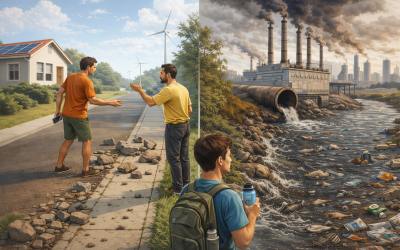
The rebuke becomes intelligible only retrospectively. The public domain was always his, not in the sense of legal title, but in the deeper sense of existential belonging. He was not removing debris from his world; he was merely relocating it within it. The brilliance of the Talmudic insight lies precisely in its inversion of property logic. The category of “public” is not outside the self. It is simply the extended field of one’s own future vulnerability. We tend to imagine public space as morally diluted space- everyone’s and therefore no one’s. The Talmud refuses that fiction. The street you dirty is the street you will walk. The air you pollute is the air you will breathe. The water you contaminate is the water that will circulate back into your body. Throwing harm “away” is a conceptual error; there is no metaphysical “away.”
 Parashat Mishpatim’s civil framework anticipates this ecological truth. The Torah does not treat damage as a technical matter of compensation alone; it treats it as an ethical breach of relational space. The same logic that governs oxen, pits, and property boundaries governs shared existence. This insight reaches back even further, to Genesis: humanity is placed in the garden- “to work it and to guard it” (Genesis 2:15). We are empowered to cultivate, but equally commanded to preserve. The earth is not raw material for extraction alone; it is a sphere of mutual dependency. What changes when we internalize the Talmud’s reversal- that the public domain is, in a profound sense, also ours? Rabbinic tradition sharpens this further. In Kohelet Rabbah (7:13), we read:
When the Holy One created the first human, He took him and showed him all the trees of the Garden of Eden and said: ‘See My works, how beautiful and praiseworthy they are. All that I have created, I created for you. Take care that you do not corrupt and destroy My world – for if you corrupt it, there will be no one after you to repair it.
This is not merely an ecological warning; it is a theological claim about responsibility. “There will be no one after you to repair it” is not apocalyptic drama; it is a sober recognition of irreversibility. Damage accumulates. Systems collapse. Some thresholds, once crossed, cannot simply be undone. Placed alongside the Talmudic story of the stones, the message becomes clearer: the public sphere is not an expendable margin of existence. It is the extended body of our shared life. The illusion that there is somewhere “else” for consequences to land is precisely what the Torah refuse to grant.
Environmental responsibility ceases to be abstract activism and becomes enlightened self-recognition. Discarding trash from a car window is not exporting waste; it is moving it from one room of the house to another. Dumping toxins into rivers is not externalizing cost; it is postponing consequence. Industrial pollution is not the problem of an anonymous collective; it is the displacement of stones that will eventually lie in our own path. The Talmudic man understood this only after he lost his field. Only when he no longer possessed private ownership did he realize that the broader domain had always been implicated in his fate.
Perhaps our environmental moment is a similar awakening. We have behaved as though the planet were a set of detachable compartments: here private comfort, there public cost. But the Torah’s legal imagination insists on a different metaphysics. There is one domain. There is one shared ground. And here lies the dizzying insight- not that we “owe” something to the public sphere, but that the public sphere is already part of our own extended self. The street, the shoreline, the forest, the atmosphere are not sentimental abstractions. They are the expanded perimeter of our home. The question the Torah quietly places before us is not whether we own the world. It is whether we recognize that we already belong to it.
If you have read this far- Step outside. Breathe. Look. The world is not “away.” It is already yours.
Shabbat Shalom.