The Stretcher Doesn’t Move Without Everyone
Israel has no shortage of slogans. Every war, every election, every crisis produces another one, loudly proclaimed and quickly forgotten.
“Get under the stretcher” is not one of them.
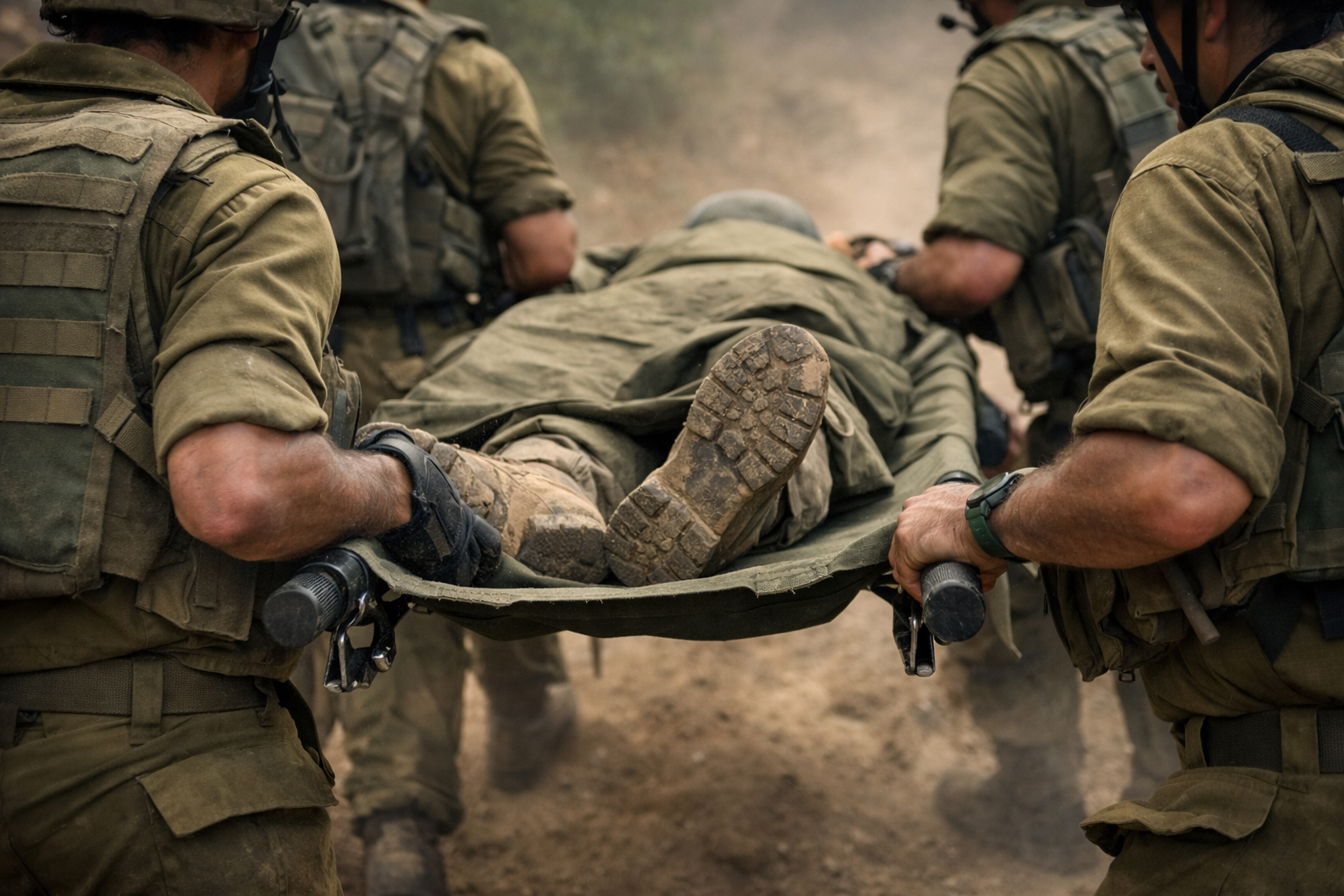
In Hebrew, להיכנס מתחת לאלונקה, it is not rhetoric. It is instruction. It is operational, not aspirational. When someone falls in the field, when the weight becomes unbearable, you do not debate, defer, or delegate. You rotate in. The stretcher does not move unless everyone understands that carrying it is mandatory, not symbolic.
That ethic has carried Israel through wars, terror waves, and moments when the country had no margin for error. It is the quiet rule beneath the noise, the reason a small, fractured, argumentative society has managed to survive anyway. When things get heavy, survival is not a spectator sport.
Which is why the growing and permanent exemption of Haredi men from military service is no longer a narrow policy dispute. It is a direct contradiction of one of the state’s most basic civic assumptions.
Israel has faced existential threats on multiple fronts since October 7. But this exemption, this sanctioned step out from under the stretcher, has the potential to do what many external enemies cannot: corrode the shared burden that turns a population into a people.
The exemption did not begin in bad faith. At the state’s founding, the number of full-time yeshiva students was small. Israel was young, fragile, and determined to preserve what remained of European Torah scholarship after the Holocaust. An exemption affecting a few hundred men was understood as symbolic, provisional, and limited.
But provisional arrangements have a way of hardening into permanent structures. As the Haredi population grew, the exemption grew with it. What began as a narrow accommodation became a mass deferral. Committees were appointed. Laws were passed, struck down, reworked, and struck down again. Each iteration tried to reconcile universal obligation in theory with permanent exemption in practice.
For years, the issue was managed rather than resolved. The IDF adjusted. The economy absorbed the distortion. Secular and national-religious Israelis complained, then carried on.
October 7 ended that equilibrium.
The war exposed the strain on Israel’s reserve forces, its families, and its workforce. Tens of thousands of Israelis rotated under the stretcher for months at a time. Lives were paused. Careers stalled. Trauma accumulated. As the burden intensified, the exemption stopped looking like a compromise and started looking like a breach of trust.
To engage this issue honestly, the Haredi position deserves to be stated at its strongest. Haredi leaders argue that Torah study is not avoidance of service but a different form of service. That spiritual preservation is as vital to Jewish survival as physical defense. That the IDF, built around secular norms, poses a genuine threat to Haredi religious life and continuity. And that once young men are drawn into military or secular frameworks, the community risks losing them altogether.
This argument is not frivolous. Jewish history is filled with communities that did not survive exposure to dominant cultures. The fear is real.
But it is no longer sufficient.
A modern state cannot function on metaphysics alone. An army cannot operate on belief while others supply the manpower. And a society cannot demand prolonged sacrifice from some while sanctifying exemption for others, especially when the exempt population is no longer marginal.
More importantly, a community that expresses such confidence in the power of Torah should not fear contact with the broader society as an existential threat. A way of life that is strong survives engagement. A way of life that is fragile will not be saved by insulation.
Judaism has never survived by hiding from reality. It has survived by wrestling with it.
This debate is often framed as religious versus secular. That framing is both inaccurate and dangerous. The real divide is between those who accept shared obligation and those who are structurally excused from it.
The exemption does more than strain the IDF. It distorts Israel’s economy, weakens workforce participation, and deepens resentment between communities that must continue living together long after this war ends. It teaches young secular Israelis that commitment is optional. It teaches young Haredim that citizenship comes without responsibility.
No society survives that lesson for long.
The solution does not require erasing Haredi identity or forcing every young man into a combat unit. But it does require getting under the stretcher.
National service must become the norm, not the exception. That service can take multiple forms: military frameworks compatible with Haredi life, as well as large-scale civil service in healthcare, emergency response, welfare systems, education, and disaster relief. These are not symbolic roles. They are areas where Israel urgently needs manpower, particularly in a prolonged national emergency.
At the same time, Torah study should be respected, but defined honestly. A small, clearly delineated cohort of exceptional scholars can be supported as a national asset. Blanket exemption cannot.
This is not punishment. It is an invitation into full partnership.
Israel has survived wars, terror, and isolation because it understood a basic truth: when the stretcher gets heavy, everyone rotates in.
The Haredi community is part of that story, not exempt from it. Shared destiny demands shared burden, and national service in one form or another is now the unavoidable expression of that bond. Not as coercion. As citizenship.
If Torah is strong enough to sustain a people for two thousand years in exile, it is strong enough to survive responsibility in a Jewish state.
Because a country that allows permanent exemption from sacrifice will eventually discover that what collapses is not the stretcher, but the society carrying it.