Rabbi of Tamid Palm Beach
The Success of a Minor Holiday
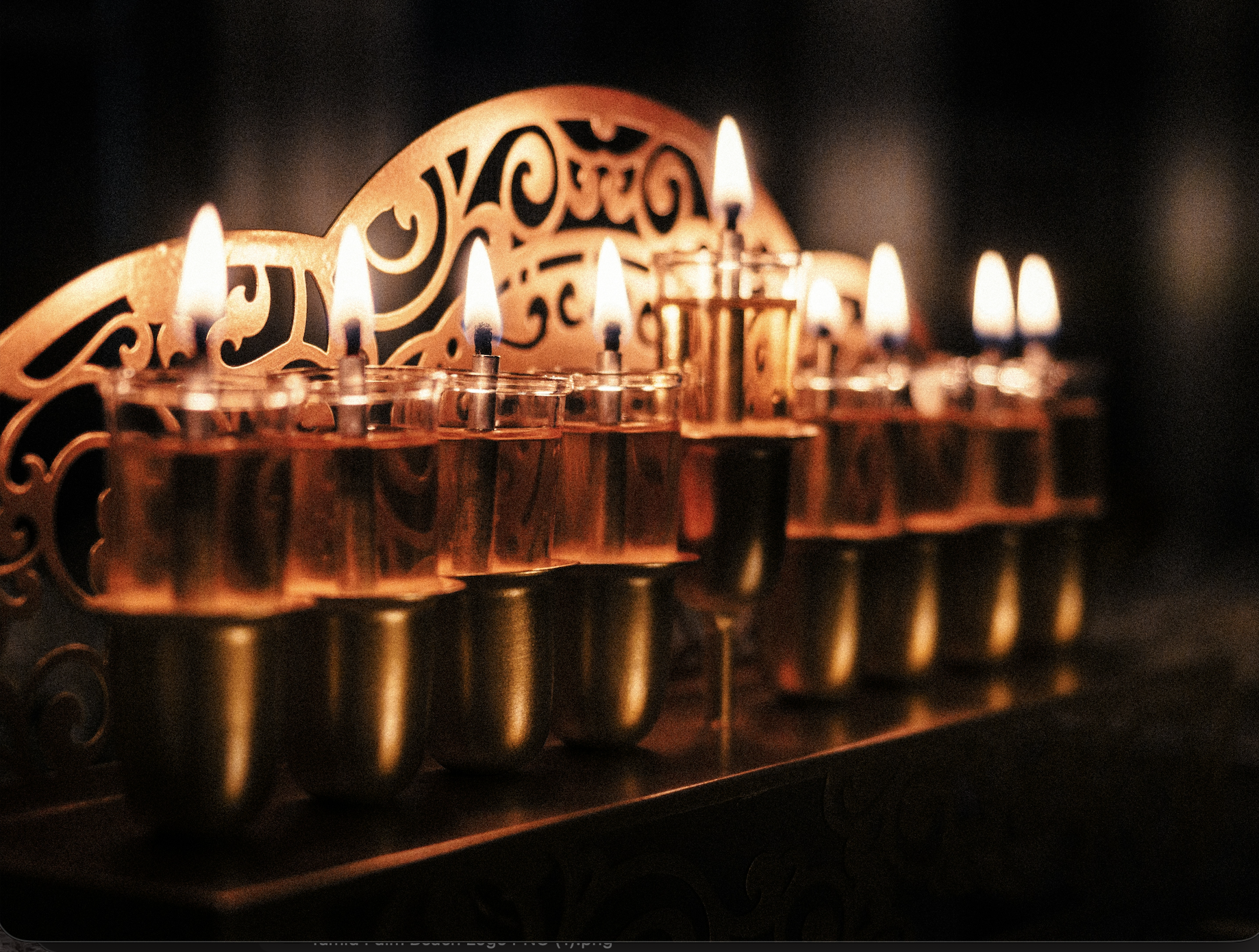
Hanukkah may be a minor holiday, but its enduring appeal reveals something profound about how Jews make Judaism their own. Photo by Eliezer Muller on Unsplash.
Every December, rabbis find themselves in the peculiar position of explaining to Jews that one of their favorite Jewish holidays is actually a minor one. Hanukkah is not mentioned in the Hebrew Bible, carries no general prohibition against work and requires no synagogue attendance. Its prominence in American Jewish life owes considerable credit to Christmas.
Yet according to Pew Research Center’s 2020 survey, 81 percent of American Jews own a menorah, including 57 percent of those who identify as Jews of no religion. Among the Jewish ritual objects surveyed, the menorah was the most widely owned.
At a time when Jewish institutions devote considerable energy to encouraging Jewish participation, perhaps we should spend less time explaining Hanukkah’s minor status and more time investigating its major success.
The influence of Christmas is well documented. A 2010 study by economists Ran Abramitzky, Liran Einav and Oren Rigbi found that American Jews with young children were more likely to celebrate Hanukkah and that Hanukkah-related spending was higher in areas with smaller Jewish populations.
There is considerable irony in a holiday associated with resistance to assimilation gaining prominence through its encounter with the surrounding culture. But Christmas helps explain the demand for Hanukkah without necessarily explaining what made Hanukkah so well suited to meet that demand.
For that, we might turn to the Talmud.
In Shabbat 21b, the rabbis describe three levels of Hanukkah observance. The basic obligation is remarkably modest: one light per household each night. An enhanced observance provides a light for each member of the household. A further enhancement varies the number of lights according to the night of the festival.
It is this last form of observance, following the ascending count of Beit Hillel, that became the familiar practice.
A Jew who rarely observes Shabbat, does not keep kosher and seldom attends synagogue may nevertheless light eight candles on the final night of Hanukkah, practicing what the Talmud considers an enhancement upon an enhancement: mehadrin min hamehadrin.
Most Jews who do so are simply following custom. But how interesting that the enhanced practice became the custom in the first place.
Imagine Hanukkah without the accumulating candles. Lighting one candle every evening would be easier, but much of the anticipation and visual beauty of the holiday would disappear. The additional ritual is part of its appeal.
We tend to assume that greater religious participation requires fewer religious demands. Hanukkah suggests that we ought to distinguish between effort and barriers to participation. People may welcome additional religious effort when that effort enriches the experience.
There is another peculiarity about Hanukkah. It commemorates the restoration of the Temple in Jerusalem, yet its enduring ritual requires neither a Temple nor a priesthood. The rabbis placed the obligation in the hands of the household: ner ish uveito, a light for a person and their home.
But they did not envision an exclusively private celebration. The Talmud instructs Jews, under ordinary circumstances, to place their lights at the entrance to their homes or in a window facing the public domain. Individual households, performing their own religious obligations, collectively create a Jewish public presence.
Hanukkah achieves something Jewish institutions often struggle to accomplish: meaningful individual participation that simultaneously strengthens a collective identity.
Passover, another widely observed Jewish holiday, shares some of these characteristics. Preparing a Seder can be considerably more demanding than attending a synagogue service. Yet the preparations, storytelling, questions and family customs are integral to its appeal. The participants inherit a tradition but also assume responsibility for its expression.
Both holidays complicate the conventional relationship between religious commitment and religious practice. We often assume that Jews must first develop a stronger attachment to Judaism before they will participate more fully in Jewish life. But the relationship can also work in reverse. Attachment can emerge through the experience of practicing Judaism.
A child lighting the menorah need not first understand the significance of the Maccabean revolt. An adult hosting a Hanukkah gathering need not first resolve questions of theology or religious observance. Participation does not require a prior declaration of commitment.
For Jewish institutions, this raises an interesting question. There is a difference between providing people with Jewish experiences and equipping them to create their own. Perhaps one measure of an institution’s success is the Jewish life that takes place in its absence.
Hanukkah began as a celebration of the restoration of a sacred institution. It endured through the centuries by entrusting its central ritual to ordinary Jews. Its enhanced form of observance became its familiar practice, and its encounter with another culture helped renew its relevance.
Perhaps what makes Hanukkah so successful is not how little Judaism it asks of Jews, but how much Judaism it enables Jews to make their own.
Related Topics