*The Sufganiyah and the Dreidel: How to Look at Life*
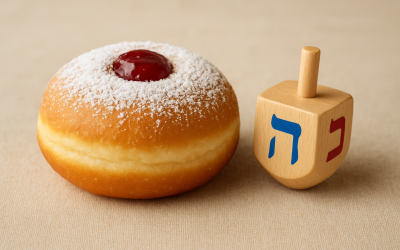
Hanukkah teaches us to look beyond what is on the outside and to focus on what is inside. Two familiar symbols—the sufganiyah and the dreidel—offer a clear lesson about life, guided by HaKadosh Baruch Hu.
The Sufganiyah
By way of derash, the word sufganiyah can be read as sof–gan–Yah—“the end of the Garden of G-d.” After Adam and Chava left Gan Eden, they entered a world that is no longer perfect. The sufganiyah helps us reflect on that world.
Like the sufganiyah, the world is round and complete. It has an outside and an inside. If we do not handle it carefully, it can become messy. But the most important part is not the outside—it is what is inside.
Life works the same way. The outside consists of work, responsibilities, stress, and daily worries. We cannot avoid it. But beneath it lies something far more important: our neshama, the spark of HaKadosh Baruch Hu within us. This inner spark is a reminder that everything is guided by HaKadosh Baruch Hu, and nothing happens by chance. One can live only on the outside, focusing on duties and tasks, or one can reach inward and connect with Hashem’s guidance, discovering the true purpose and value of life. The sufganiyah, with its hidden filling, demonstrates this clearly: the sweetness is always there, just as Hashem’s plan is always present, even if it is not immediately visible.
The Dreidel
The dreidel teaches a connected lesson. While it spins, nothing can be read. The letters are there, but motion hides them. Only when the dreidel comes to rest do the words appear: Nes Gadol Hayah Po—a great miracle happened here.
Life is similar. When we are constantly spinning—busy with work, family, health, and daily pressures—we cannot see clearly. Everything seems random or confusing. But when we pause and reflect, even briefly, clarity comes. What once seemed ordinary can be recognized as meaningful. What appeared random can be seen as guided and purposeful. Guided by the Kaddosh Boruch Hu within us, we recognize that everything is under His control. Nothing happens by chance.
The Ramban, at the end of Parashat Bo, writes that recognizing miracles, even hidden ones, trains a person to see that everything is a miracle. That is why, when we stop and look, we can truly say: nes gadol hayah po.
The Message of Hanukkah
Hanukkah does not ask us to ignore the outside world. We must manage our responsibilities and act in the world. But we should not confuse the outside with the inside. The challenge is to handle the outside while finding and nurturing the inner, the neshama, and remembering that everything is guided by HaKadosh Baruch Hu.
If we do this, life is seen differently. We understand that life itself is a miracle—not because it is always exciting, but because when we pause and reflect, we see that it is ordered, purposeful, and fully guided by Hashem.
Today, the lesson is clear. Even when life feels busy, messy, or confusing, we should take a moment to pause, look inward, and discover the sweetness and Hashem’s guidance hidden in the world around us. That is how both the sufganiyah and the dreidel remind us that life is controlled by HaKadosh Baruch Hu and that Hanukkah remains alive and meaningful for us today.