

The Suicide of the Open Mind: Has the West Auctioned Its Own Future?
To survey the institutional landscape of the modern West is to confront a spectacle at once tragic and grotesque: an imperium of unprecedented military and economic power quietly auctioning off its civilizational inheritance for cash.
Over the preceding four dispatches of this series, we have traced the precise anatomy of a long-range strategic conquest.
It began in the mid-1990s with the establishment of Al Jazeera, an outbound broadcast megaphone designed to break Western news dominance across the Middle East. It evolved through AJ+, an algorithmic micro-targeting engine engineered to exploit domestic cultural fractures and radicalize young American social media feeds. It moved upstream into Academia, where over six billion dollars in sovereign wealth quietly purchased satellite campuses, endowed faculty chairs, and reshaped K-12 curricula. And finally, it reached its operational zenith in the halls of Congress, where foreign-backed advocacy networks built a bulletproof shield of political innocence around Capitol Hill lawmakers.
Now, as the full architecture stands exposed, the inevitable, agonizing question emerges:
Have we already lost? Is it too late? Should we simply give up?
The impulse toward defeatism is understandable. When a small Gulf autocracy—possessing a native population smaller than the city of Wichita, Kansas—can successfully embed its strategic interests into the Ivy League, control youth digital algorithms, and leverage members of the United States House of Representatives, one is tempted to declare the American experiment in self-governance compromised beyond repair.
To yield to that defeatism, however, is to misunderstand both the nature of our vulnerability and the fundamental character of Western power.
I. The Pathology of Complacency
The State of Qatar did not conquer the American mind through military genius or irresistible ideological fervor. It accomplished its institutional capture through a far simpler mechanism: it exploited a profound, self-inflicted paralysis of Western civilizational confidence.
For half a century following the end of the Cold War, the Western policy establishment convinced itself of a comforting delusion—that free markets, open borders, and absolute institutional neutrality were self-sustaining virtues that no foreign adversary could weaponize. We built a world where our elite universities treated sovereign wealth grants as politically neutral philanthropy, where tech platforms prioritized engagement algorithms over national security, and where political parties prioritized primary voting blocs over the integrity of federal counterterrorism investigations.
In his landmark work The Open Society and Its Enemies, Karl Popper warned of the fundamental vulnerability of liberal democracy: an open society that tolerates everything, including the forces working actively to dismantle its openness, will ultimately be destroyed.
What we have witnessed over the last quarter-century is the commercialization of that paradox. We did not merely tolerate the enemies of openness; we put our premier research universities, our media networks, and our congressional corridors up for bid to the highest sovereign bidder.
The supreme irony of the post-Cold War era is that our adversaries understood the strategic value of Western institutions far better than the custodians who inherited them. While Western academics derided their own heritage as colonial and obsolete, foreign strategists in Doha recognized that control over Georgetown, Northwestern, and Cornell was worth billions of dollars in natural gas revenue. They did not buy our institutions to destroy them; they bought them to pilot them.
II. The Myth of Inevitability
Why does it appear that we have lost? Because the battle was fought entirely asymmetric.
For thirty years, Western democracies treated foreign influence as a simple matter of espionage—spies stealing blueprints or diplomats buying access. We were looking for saboteurs with wire cutters while our adversaries were walking through the front door with endowment checks and Super PAC contributions.
While federal agencies monitored military hardware, Qatar built a multi-layered hybrid engine that operated entirely within the legal boundaries of the Western open system:
- The Media Layer (Al Jazeera/AJ+): Neutralized critical public scrutiny and softened Western youth demographics toward anti-Western narratives.
- The Academic Layer (Education City): Captured future diplomatic, journalistic, and policy elites before they ever entered government service.
- The Legislative Layer (CAIR/Capitol Hill): Used domestic civil-rights shields and primary election machinery to ensure that lawmakers would defend the proxy network against law enforcement scrutiny.
When all three layers operate simultaneously, the system creates the illusion of total victory. The university administrator protects the grant, the journalist protects the narrative, and the congresswoman protects the constituency—each acting in complete, sincere defense of their institutional interests, while the foreign sovereign collects the dividend.
III. The Verdict: Is It Too Late?
Is it too late? The cold, analytical answer is no.
A total totalitarian regime cannot self-correct; when its ideological core rots, it collapses under its own weight, as the Soviet Union did in 1991. A liberal democracy, however, possesses a unique, almost miraculous capacity for self-correction—if and only if its citizens force a moment of total, unvarnished moral clarity.
The strength of the foreign influence architecture was never its military power; its strength was its invisibility. For decades, this infrastructure operated in the shadows of technical tax codes, undisclosed university grants, and backroom political bundling. The moment the light of forensic exposure shines upon the machinery, the illusion of inevitability shatters.
Consider what happens when an open society decides to defend itself:
- In Academia: A single statutory enforcement action enforcing mandatory transparency under Section 117 of the Higher Education Act—backed by the immediate forfeiture of federal research grants for non-compliant universities—dismantles billions of dollars in foreign leverage overnight. The moment elite universities are forced to choose between Qatari sovereign wealth and U.S. taxpayer research funding, the foreign contracts will be canceled in an afternoon.
- In the Digital Sphere: Simple legislative insistence on algorithmic transparency and foreign-ownership divestment strips platforms like AJ+ of their ability to manipulate domestic youth demographics without disclosure.
- On Capitol Hill: The enforcement of the Foreign Agents Registration Act (FARA) and strict federal audits of pass-through PAC funding strip front organizations of their ability to hide behind the “civil rights” mantle, leaving politicians exposed to the raw electoral cost of serving as proxy shields.
The foreign capture of American institutions appears permanent only because we have not yet chosen to exercise the sovereign power of democratic self-defense.
IV. The Refusal to Surrender
Do we give up?
To surrender is to accept that the greatest experiment in human liberty—a nation founded on constitutional governance, free inquiry, and individual liberty—can be quietly acquired by a petro-monarchy with a checkbook. It is to concede that our universities are merely commercial enterprises, our media outlets merely advertising platforms, and our representatives merely political commodities.
Despair is an intellectual luxury we cannot afford. It is the refuge of the weary and the comfortable who prefer solemn resignation to the brutal, necessary work of institutional reclamation.
The conflict before us is not a military confrontation; it is a battle for civilizational spine. The State of Qatar bought what we willingly put up for sale. The fault lies not in Doha’s ambition, but in Washington’s, Cambridge’s, and Silicon Valley’s moral decay.
The hour is dangerously late. The pipeline is laid, the funds are cleared, and the political shields are in place. But the story of the West is not a eulogy—it is an ongoing argument.
The time for polite accommodation, transparent excuses, and institutional cowardice is over. It is time to enforce our laws, audit our institutions, reclaim our classrooms, and rebuild the sovereign integrity of the American republic.
An open mind was designed as an instrument for the pursuit of truth—not an open vault for foreign acquisition. The hour is late. Close the accounts, sever the pipelines, and reclaim the republic.
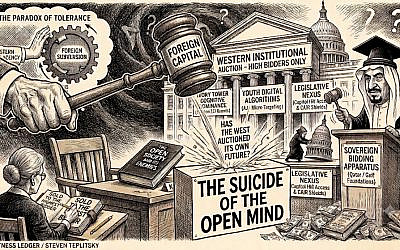
-image courtesy of and with permission of The Witness Ledger
-for more in depth analysis go to https://substack.com/@steventeplitsky