


Writing Where Intelligence Meets Strategy
The Suwałki Gap
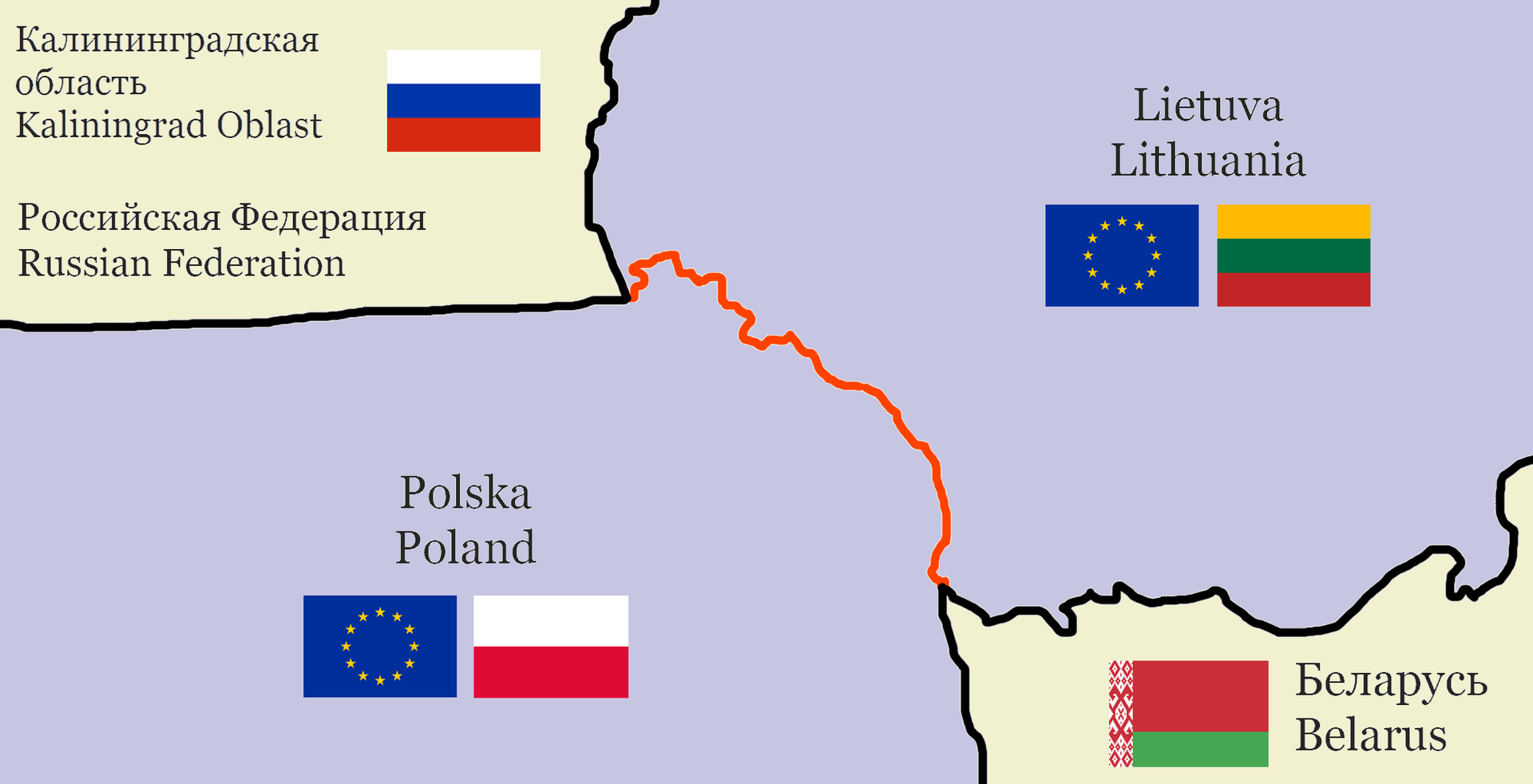
Map: Jakub Łuczak / Wikimedia Commons / Public Domain
A narrow strip of land between Poland and Lithuania has become one of Europe’s most sensitive security flashpoints. Wedged between Russia’s Kaliningrad exclave and Belarus, it forms the principal land link connecting the Baltic states to the rest of NATO. There is no public evidence that a Russian attack is imminent. Still, geography, military exercises and hybrid pressure have ensured that the alliance continues to treat the area as a critical strategic vulnerability.
The Suwałki Gap runs along the Polish-Lithuanian border, between the Russian exclave of Kaliningrad to the west and Belarus to the east. Its importance lies not in its size, but in its location. It is the land corridor connecting Poland to Lithuania, and from there to Latvia and Estonia.
NATO regards the area as strategically important, and a U.S.-led multinational force based in Poland trains, among other missions, to defend the region and reinforce the alliance’s northeastern flank in the event of a crisis.
In a broader confrontation between Russia and NATO, disruption or closure of the corridor could complicate the movement of troops, armour, ammunition and fuel from Poland into the Baltic states. Its geography adds to the challenge: Russia maintains significant military capabilities in Kaliningrad, while Belarus, Moscow’s closest military ally, sits on the opposite side of the corridor.
The pressure does not require an invasion to have strategic effect.
In September 2026, Belarus conducted military exercises near its borders with Poland and Lithuania, including areas close to the Suwałki Gap. Mechanised units and armoured forces trained in border defence, counter-sabotage operations and responses to drones and light aircraft. Minsk described the exercises as defensive and said their scale remained below the threshold requiring prior notification under the Vienna Document.
Their location, however, ensured close scrutiny from NATO. Military activity in an area where Russian and Belarusian forces could potentially exert pressure from opposite directions inevitably carries strategic significance.
Another incident days earlier illustrated the level of alertness across the region. On September 14, an Italian fighter jet operating under NATO command shot down an unmanned aircraft that entered Lithuanian airspace from Belarus. Two days later, Lithuanian President Gitanas Nausėda said the drone was most likely Russian-made, had probably been intended for Ukraine, and may have been diverted by electronic warfare.
The incident did not establish that Russia had deliberately targeted Lithuania. It did, however, demonstrate how the war in Ukraine can generate security incidents inside NATO territory, where decisions sometimes have to be made before the origin or intent of an intrusion is fully understood.
According to NATO, recent years have also seen increasing airspace violations, cyberattacks and acts of sabotage attributed to Russia. In response, the alliance has significantly strengthened its eastern flank.
By 2026, nine multinational land formations were positioned from Finland in the north to Bulgaria and Romania in the south. They are supported by reinforcement plans, pre-positioned equipment and integrated command structures designed to enable a faster response in the event of a crisis.
Preparations for the defence of the Suwałki region are not theoretical. In spring 2026, Lithuania, Poland and Portugal conducted Brave Griffin 26/II near the Polish-Lithuanian border. The exercise rehearsed rapid and coordinated responses to threats in the area, reflecting the corridor’s established place in NATO operational planning.
The strategic map has also changed considerably.
The accession of Finland and Sweden to NATO expanded the alliance’s military position in Northern Europe and improved its ability to operate across the Baltic region. In June 2026, a new Swedish-led multinational NATO force became operational in Finland, increasing the alliance’s military presence across its eastern and northern approaches.
These changes do not make the Suwałki Gap irrelevant. They make any attempt to seize or isolate it more difficult and considerably more dangerous.
A deliberate attack in the area would require striking Polish or Lithuanian territory. Both are NATO members. Under Article 5 of the North Atlantic Treaty, an armed attack against one member is considered an attack against all, with each ally committed to providing assistance it deems necessary.
As of September 2026, there is no public evidence that Russia is preparing to seize the corridor. Analysis published by the Royal United Services Institute in July cautioned against confusing military contingency planning with evidence of political intent, noting the lack of credible indications that Moscow is preparing a limited invasion of Poland designed to test NATO resolve.
The more immediate risk lies in the grey zone between peace and open conflict: drones, navigation interference, cyber activity, airspace incursions, military exercises and incidents whose origin may initially be unclear.
On September 19, for example, Poland scrambled fighter aircraft and placed air-defence systems on alert during a major Russian attack on Ukraine. The Polish military later reported that no violation of its airspace had occurred. The episode illustrated the new security reality along NATO’s eastern frontier: high readiness, rapid military responses and constant concern that developments across the border could spill into alliance territory.
The Suwałki Gap is therefore less a sign of an approaching war than a continuing test of NATO deterrence.
For the alliance, the objective is to ensure that Moscow never concludes it could quickly sever the Baltic states from the rest of NATO and create a military fait accompli before the alliance could respond.
The significance of Suwałki is not that a war must begin there. It is that its geography makes it one of the places where a failure of deterrence could acquire strategic consequences with extraordinary speed.