


The Tale of the Hollow Kings and the Stone Golem
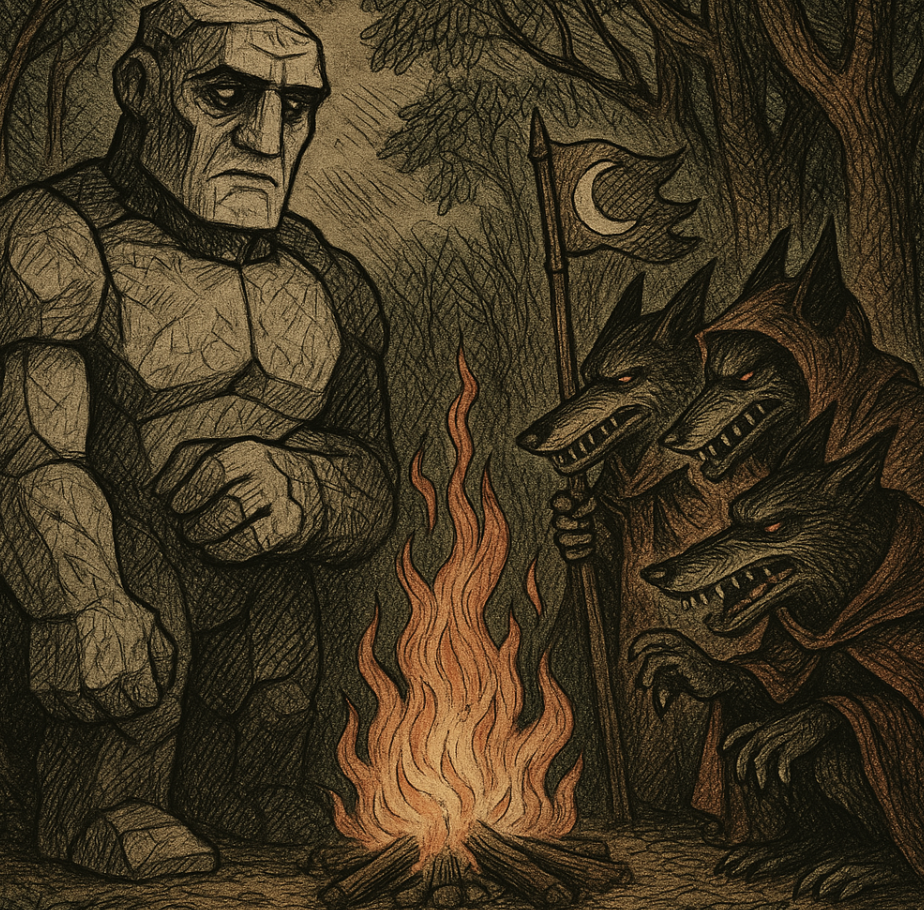
Once upon a time, in a barren land of dust and fire, there stood two kingdoms. One was young and small, no larger than a patch of moss upon a great forest floor, but it was clever and steadfast. The other, which called itself the Kingdom of the Crescent Banner, was old, proud, and full of grievances that weighed upon its people like a chain of iron.
The young kingdom was guarded by a Stone Golem, a creature forged from the tears and ashes of its ancestors. This Golem was not born of war but of survival; every scar on its body told of fire endured, every crack in its stone skin a memory of exiles, massacres, and a world that had once vowed never to save them again. The Golem sought not conquest but life — a small place to stand, a breath of peace.
But the Kingdom of the Crescent Banner saw the Golem and screamed that it was a monster. “It has stolen our fields! It has built its houses on our graves!” cried the kingdom’s rulers, though their own hands were soaked in the blood of their people, whom they beat into obedience and used as shields. To keep their power, they conjured a tale of eternal victimhood. They taught their children to curse the Golem, to dream of its destruction, and to see their suffering as noble, even holy.
And oh, how the wolves came.
For this kingdom was ruled not by princes but by wolves cloaked in shepherd’s garb. These wolves spoke of freedom and justice, but behind closed doors, they sharpened their teeth and devoured the very people they claimed to lead. They took every loaf of bread given by far-off lands, every coin and sack of grain, and turned them into spears, bombs, and underground lairs. They howled at the moon and called it resistance, even as their people starved.
Far away, atop a glittering mountain of glass and gold, there stood a mighty fortress known as the Tower of Nations. Within this tower sat the Hollow Kings — lords and emissaries from every corner of the world. Once, they were said to guard justice, but in truth, their thrones were made of whispers and cowardice. They feared the wolves, for the wolves were many, and they feared the mob that cheered for the wolves. And so, whenever the wolves cried, “The Golem is cruel! The Golem must fall!” the Hollow Kings raised their hands and decreed, “Yes, the Golem is the villain.”
Not once did they ask why the wolves sent their own children to fight while they feasted in their lairs. Not once did they ask why the Golem, though accused of savagery, built hospitals, orchards, and sanctuaries even for those who cursed its name. The Hollow Kings found it easier — and far more pleasing to the crowd — to point at the Golem and say, “There is the beast. There is the cause of all ills.”
In the towns and villages beyond the tower, the storytellers took up this tale. The scribes, the bards, the magicians of moving pictures — all wove the same dark fable. They painted the wolves as noble heroes and the Golem as a tyrant, never telling of the nights when wolves crept into villages and tore throats for sport. With each telling, the tale grew sharper, and soon, even the children who had never seen the Golem believed it to be a monster of shadow and steel.
And so the poison spread.
The Kingdom of the Crescent Banner marched through the markets of the world, waving its banners of grief. It cried of hunger, though its rulers hoarded food. It cried of chains, though its own people were bound by fear. And everywhere, kind-hearted folk — who could not see through the enchantments of the storytellers — wept for the wolves and cursed the Golem.
But the Golem stood firm. It had seen too much to believe in the pity of the Hollow Kings. It knew that if it faltered, if it ever laid down its shield, the wolves would not stop at its gates but would consume every brick, every orchard, every child who called the Golem protector. The Golem’s heart — if stone can have a heart — beat with a single truth: survival is not cruelty. And yet, the Golem was alone.
One day, a wanderer came to the lands of the Crescent Banner. This wanderer saw the truth: the wolves were not saviours but jailers, and the people they claimed to fight for were pawns in their bloody games. The wanderer cried out, “Why do you bow to these wolves? Why do you curse the Golem that only defends its home?” But the crowd, lulled by years of tales, turned on the wanderer and called him a heretic. For in this cursed kingdom, truth was the greatest crime.
The Hollow Kings heard of this and smiled thinly. Better to silence the wanderer, they thought, than risk angering the wolves. Better to keep the tale alive — that comforting lie of heroes and villains — than to face the messy, difficult truth.
Yet, as all fairy tales must, this one too trembles toward its ending. For even the strongest enchantments fray when tested by reality. The people of the Crescent Banner, worn and weary, begin to whisper that perhaps the wolves are not their saviours. Some dream — quietly, dangerously — of a day when they might live without fear, when they might trade their banners of grief for gardens of peace. And the Golem, though battered and scarred, watches and waits, knowing that if the curse of lies can ever be broken, both kingdoms might yet share the land.
But for now, the wolves howl, the Hollow Kings nod, and the storytellers sharpen their quills. It is a dark tale, a cruel tale, but all tales — even the darkest — must end. And when this one does, the truth will outlast the wolves’ howling, for truth, though beaten and buried, is harder than stone.