
The Talk You’re Not Having with Your Kids—and Why It Can’t Wait
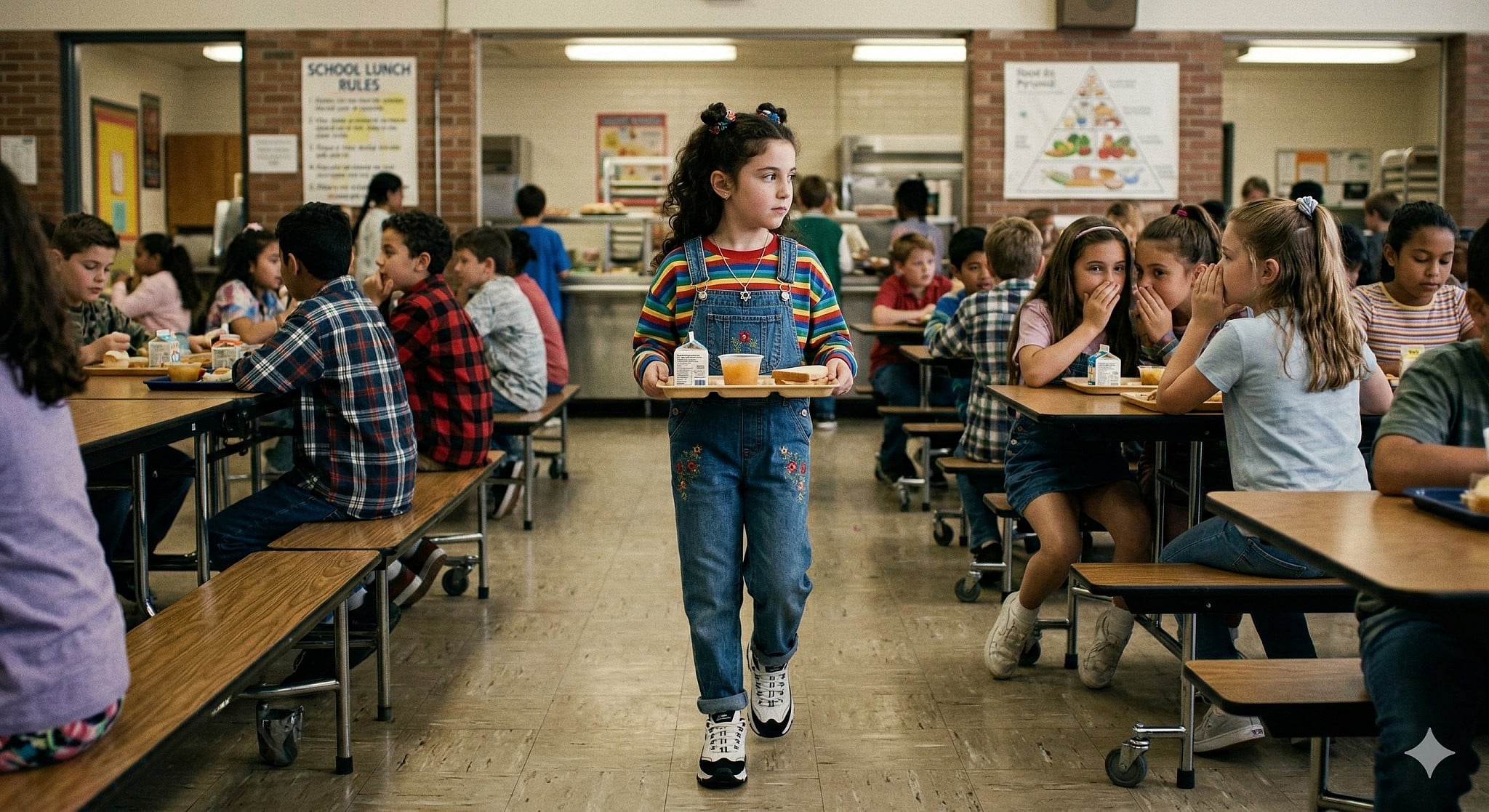
My parents never had a conversation with me about antisemitism. For the most part, they didn’t need to.
I grew up in Orlando, Florida—about 160 miles north of where the vast majority of Jews in the state tend to congregate, but home to a decent-sized Jewish community all the same. I went to public school my entire childhood. Depending on the year, I was either the only Jewish kid in my class or one of two or three, though I was never the only one in my grade. It was never an issue. Or at least antisemitism was never something I was conscious of—which was probably the point.
Except it was an issue. I just didn’t know it yet.
The year was around 1998. The Spice Girls were all the rage. I was your typical eight-year-old girl—head-to-toe Limited Too, platform Skechers, trying my absolute hardest to be one of the cool kids. Given the Spice Girls obsession and the frizzy curly hair, the natural path to optimum cool-girl status was, in my mind, to channel Scary Spice. I made the half-up, half-down mini-buns situation she popularized my signature look. And I loved it.
Until the day I realized people were laughing at me. Whispering behind my back. A girl in my neighborhood—let’s call her Madeline—someone I thought was my friend, had started a rumor that the reason I wore my hair like Scary Spice every day was to hide my horns.
I was eight. I had no idea what that meant. I just knew kids were being cruel and it felt awful. So, I stopped wearing my hair that way. The rumors passed. I stopped being friends with Madeline. It became a blip.
It was not until years later that I understood what actually happened. Madeline was not just a mean girl. She was a mean girl deploying one of the oldest antisemitic tropes in existence—the medieval myth that Jews have horns, rooted in a centuries-old mistranslation of the Bible, used to dehumanize Jewish people for over a thousand years. She was eight. I was eight. And that particular piece of hatred had already traveled from her parents’ dinner table to our third-grade classroom.
Why I Got Lucky
Here is the thing about my story: in the end, it did not matter. In 1990s suburban Orlando, that incident was an anomaly. I went back to school the next day and the next year, and nobody else said a word about horns. I did not need the framework to name what happened to me, because it happened once and then it was over.
Kids today are not that lucky.
The world they are growing up in is fundamentally different from the one I grew up in. Antisemitism is no longer an occasional schoolyard cruelty a child might encounter once and never again. It is in the classroom. It is in the curriculum. It is coming from teachers and administrators and the institutional structures of the schools we send children to every morning. And nearly all of the public conversation about antisemitism in education has been focused on college campuses—which matters, of course—but it is obscuring a crisis that starts much, much earlier.
What Is Happening in K-12 Schools Right Now
In September 2025, the U.S. House Subcommittee on Early Childhood, Elementary, and Secondary Education held a hearing on the spread of antisemitism in K-12 schools.[1] Witnesses testified that in some states, the antisemitic environment in public schools has become so hostile that Jewish children are withdrawing and transferring elsewhere. Two months later, Committee Chairman Tim Walberg launched formal investigations into three school districts—Berkeley, Fairfax County, and Philadelphia—citing “disturbing reports” of Jewish students being harassed in their classrooms and hallways.[2]
The allegations are specific and alarming.
In Berkeley, teachers and staff allegedly urged students to join walkouts that isolated Jewish students. At one walkout, students chanted “Kill the Jews.” A teacher at Berkeley High displayed an image of a fist destroying the Star of David and described it as “standing up for social justice.” At Malcolm X Elementary, a second-grade teacher instructed students to write “messages of anti-hate,” then allegedly placed the resulting signs—which read “stop bombing babies”—outside the classroom of the school’s only Jewish teacher.[3]
In Fairfax County, Jewish students faced classmates making the “Heil Hitler” salute and throwing coins at them. One school for years allegedly refused to remove a hallway display in which 40 percent of the tiles featured swastikas and Nazi flags. MSA chapters distributed flyers on the anniversary of October 7 showing a map with Israel erased, and more recently reenacted the October 7 kidnappings in a promotional video.[4]
In Philadelphia, the district employs educators who allegedly promote antisemitic content using materials that rationalize terrorist violence. One teacher has allegedly threatened Jewish parents and students online. The district’s own director of social studies curriculum has been widely condemned for a pattern of denying the Jewish connection to Israel.[5]
These are not college campuses. These are elementary schools, middle schools, and high schools.
This Is Not Random
Congressional testimony and recent reporting paint a picture that is more structural than most people realize. Anti-Jewish ideology is becoming institutionalized in K-12 education through teacher training programs, foreign-funded learning materials, radical union members, and activist curriculum-development organizations.[6] A February 2026 report found that radical ideological frameworks have come to dominate key education institutions, with teachers’ unions and activist nonprofits embedding radical content into professional development that bypasses traditional oversight.[7]
Parents assume curricula are standardized by the state. They are not. Teachers have enormous flexibility in choosing their own materials, and organized networks have exploited that flexibility to push content into classrooms that no parent would approve if they saw it.
The Lawsuit
In February 2026, a coalition of civil rights organizations and a major law firm filed suit in Los Angeles County Superior Court alleging that California has systematically failed to enforce its own antidiscrimination laws against antisemitism in K-12 public schools.[8]
The individual stories will keep you up at night.
A student at Berkeley High—identified as A.D.—had a mother who reported concerns about an art teacher who bragged about his artwork depicting barbed wire in the shape of a Star of David with a fist punching through it. The teacher promoted an anti-Israel walkout during class time. The school’s response was to pull A.D. out of the class and sit him alone in the library. The child was denied instruction to protect the teacher’s right to keep espousing antisemitic ideology.[9]
Another student, B.R., at Daniel Pearl Magnet High School—named, with grim irony, after a Jewish journalist murdered by terrorists—had an honors chemistry teacher who wrote “Oy vey, it’s free” on the whiteboard on the anniversary of October 7, with an arrow pointing to the words “free Palestine.” When the family complained, the school removed B.R. from honors and placed him in a non-honors online course. B.R. had transferred to that school after being beaten unconscious at his previous one, where a student shouted “let’s get the Jew” during gym class. The attackers were not suspended. Some were placed back in his classes.[10]
Hundreds of complaints have reportedly been filed through California’s state system. Most are never investigated. Those that are rarely result in action. Jewish families are leaving public schools—not because they want to, but because nobody gave them another option.
Have the Conversation
If you are a Jewish person with children or grandchildren in school, the conversation about antisemitism cannot wait until college. It cannot wait until something happens. It needs to happen now, proactively, before a child walks into something they do not have the tools to understand—the way I did.
I know this is a hard sell. My parents did not have this conversation with me, and theirs did not have it with them. The instinct is always the same: do not burden the kids. Let them have a normal childhood. Deal with it later, or ideally never. That instinct made sense when a child might go through thirteen years of public school and encounter antisemitism exactly once, in the form of a third-grade rumor about horns. It does not make sense when the antisemitism is coming from the institution itself.
Have the conversation early. You do not need to terrify a six-year-old. But give them a framework. Tell them that some people have wrong ideas about Jewish people, that those ideas have been around for a long time, and that if anyone ever says something that makes them feel bad about being Jewish, they should come to you. Give them the vocabulary. My parents did not give me the vocabulary, and when it happened to me, I did not have words for it—not for them, not for my teachers, not even for myself.
Know what your child’s school is teaching. Ask about curricula and materials. Ask whether outside organizations are providing content. The American Jewish Committee has published a toolkit for parents of Jewish K-12 students with specific guidance on engaging administrators and advocating for protective policies.[11]
Document everything. If an incident happens, write it down. Save emails. Screenshot posts. Note dates and names. The families in the California lawsuit can pursue their claims because they built a record.
Do not accept a response that punishes the child instead of the problem. If a school responds to antisemitism by pulling your kid out of a class, that is not a solution. It is segregation. Name it.
Know the law. Title VI of the Civil Rights Act of 1964 requires any school receiving federal funding to maintain an environment free from discrimination. If your child’s school is failing, you can file a complaint with the Department of Education’s Office for Civil Rights. Organizations like The Lawfare Project litigate these cases pro bono and can help you understand your options.
What I Wish Someone Had Told Eight-Year-Old Me
I think about Madeline sometimes. Not with anger—she was eight, repeating what she learned at home. I think about what would have been different if someone had sat me down before that day and said, simply: some people believe untrue things about Jewish people, and if you ever run into that, it is not your fault, and you come to me.
If someone had told me that, I would have known what was happening when it happened. I would have told my parents. My parents would have told the school. Instead, I did what kids do. I stopped wearing my hair the way I wanted. I made myself smaller. I didn’t tell anyone, because I didn’t have the words.
In 1998, that was a manageable outcome. The world did not demand more of me. But in 2026, the people telling Jewish children there is something wrong with them are not just the Madelines on the playground. They are the teachers in the classroom, the curricula on the syllabus, and the institutions that are supposed to protect them.
Give them the words. Give them the armor. And if the school fails them, do not stay quiet.
I spent my childhood not knowing what to call what happened to me. The next generation deserves better than that. And the law—if it comes to it—is on their side.
[1]Subcomm. on Early Childhood, Elementary, & Secondary Educ., Hearing: “From Playground to Classroom: The Spread of Antisemitism in K-12 Schools,” H. Comm. on Educ. & the Workforce (Sept. 10, 2025).
[2]Press Release, H. Comm. on Educ. & the Workforce, Chair Walberg Launches Nationwide Investigation into Antisemitism in K-12 Schools (Nov. 24, 2025).
[3]Letter from Chairman Tim Walberg & Chairman Kevin Kiley, H. Comm. on Educ. & the Workforce, to Superintendent Enikia Ford Morthel, Berkeley Unified Sch. Dist. (Nov. 24, 2025).
[4]Letter from Chairman Tim Walberg, H. Comm. on Educ. & the Workforce, to Superintendent Michelle Reid, Fairfax Cnty. Pub. Schs. (Nov. 24, 2025).
[5]Letter from Chairman Tim Walberg & Rep. Ryan Mackenzie, H. Comm. on Educ. & the Workforce, to Superintendent Tony Watlington, Sch. Dist. of Phila. (Nov. 24, 2025).
[6]Brandy Shufutinsky, Understanding the Root Causes of Antisemitism in K-12 Education, Testimony Before the H. Subcomm. on Early Childhood, Elementary, & Secondary Educ. (Sept. 10, 2025).
[7]Haley Cohen, New Report Warns About the Rise of Activists Pushing Antisemitic Content in K-12 Schools, Jewish Insider (Feb. 9, 2026); see also N. Am. Values Inst., When the Classroom Turns Hostile: A Strategic Response to Extremism and Antisemitism in K-12 Education (2026).
[8]Aaron Bandler, Lawsuit Alleges Jew-Hatred ‘Persistent, Prevalent’ in Public California Schools, JNS (Feb. 26, 2026).
[9]Id.
[10]Id.
[11]Am. Jewish Comm., Confronting Antisemitism In Our Schools: A Toolkit for Parents of Jewish K-12 Students (2025).