
The Teachings of Parashah Miketz
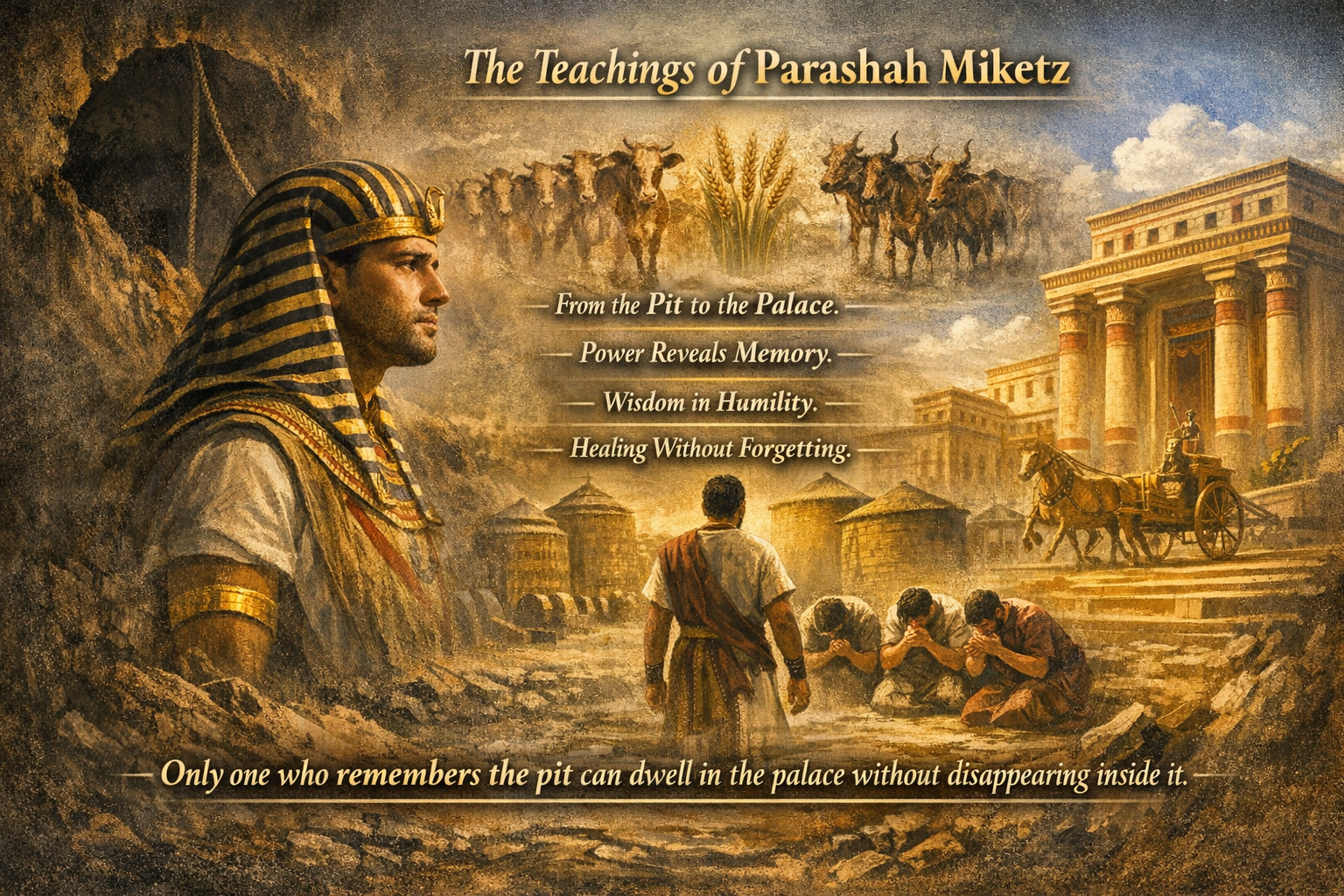
The Teachings of Parashah Miketz
Parashah Miketz is not a story of redemption, nor of success. It is a study in transformation under reversal: what happens to a human being when the conditions that shaped them are violently replaced by their opposite. Its question is neither moral nor psychological, but ontological: can a self formed in descent survive ascent without being overwritten—or must it be transformed to endure it?
The parashah opens against the unresolved wound of Vayeshev. Yosef is forgotten—not betrayed again, not attacked, simply erased. This erasure is not dramatic, but it is lethal. To be forgotten while still alive is a form of burial. Yet Miketz does not hurry to repair this injustice. Instead, it introduces time: “at the end of two years.” These years are not punishment; they are calibration. The silence is not empty. Something is being measured. Miketz insists that providence does not act when suffering is loud, but when necessity reaches its exact proportion. Meaning ripens in darkness, and history moves only when the world is ready to receive what has been formed there.
Power enters the narrative through dreams. Pharaoh dreams, but cannot understand what he sees. The Torah draws a sharp line between perception and comprehension. Power can receive images, warnings, and signs, yet lack the inner reader required to translate them into meaning. Dreams without interpretation are noise. Miketz suggests that the failure of empires is not ignorance, but unreadability of the soul. When reality speaks in symbols and no one understands, it is not because meaning is absent, but because the capacity to listen has fallen asleep.
Yosef’s rise is abrupt, almost violent. He is not elevated gradually; he is torn from the pit and made to run. The Torah emphasises urgency, not celebration. There is no pause in which identity can catch up with circumstance. Some callings do not wait for readiness; they impose responsibility. What was learned in obscurity is now tested in visibility. The descent was not a rehearsal; it was formation. But that formation was not the destruction of Yosef’s ego—it was its breaking open.
Yosef began his path with a powerful ego: favoured, robed, and carrying dreams of greatness that he did not yet know how to bear. The pit does not erase that ego; it dismantles its centre. What emerges in Miketz is not a man without ego, but a man whose ego has been reoriented. At the centre of the parashah stands Yosef’s defining refusal: “It is not in me.” This is not modesty, and it is not self-negation. It is a declaration of alignment. Interpretation, in the Torah’s vision, is not self-expression but service. Yosef does not own the dream; he transmits it. He translates vision into structure, prophecy into logistics, meaning into a system that can sustain life. Wisdom here is not illumination but architecture. The dream does not crown him; it passes through him and settles in granaries.
When power arrives, the true examination begins. Linen, gold, chariots, crowds—yet the Torah shows Yosef counting, measuring, ordering. Power neither intoxicates nor glorifies him; it tests what has been done with the ego that once sought centrality. The pit revealed fragility; the throne tests continuity. Miketz does not allow a simple conclusion: Yosef governs Egypt without becoming Egypt, and yet he governs Egypt. He saves lives, but he does so by consolidating order. Grain becomes structure. Structure becomes dependence. The same administration that preserves life also fixes hierarchy. The Torah does not hide this tension.
This tension is encoded in the names Yosef gives his children. Menasheh and Ephraim are not names of healing, but of transformation. Menasheh does not erase pain; it places it behind him so it no longer governs. Ephraim does not deny affliction; it produces fruit within it. Together they express the Torah’s teaching: memory must be integrated, not erased; ego must be redirected, not destroyed. Healing here is not innocence regained; it is strength made responsible. And responsibility, even when just, is never neutral.
The encounter with the brothers completes the arc. Yosef recognises them; they do not recognise him. The asymmetry is exact and deliberate. In his youth, Yosef saw what his brothers could not see—and spoke. Now he sees what they cannot see—and remains silent. The pattern is the same, but the posture has changed. Vision once carried without restraint produced rupture; vision now carried with restraint sustains survival. They bow not to his greatness, but to sustenance. Yosef does not flee the past, nor does he avenge it. He governs it. This is not cruelty, but it is not softness either. It is restraint shaped by memory and power shaped by service. Miketz refuses to sentimentalise reconciliation: the past is neither forgotten nor allowed to rule.
Miketz is not a narrative of success. It is a narrative of ego transformed into service under pressure. Dreams become plans. Plans become systems. Systems become bread. Bread sustains life, but it also binds those who depend on it. The Torah does not pretend otherwise. It insists only on this: that forgetting is more dangerous than power, and ego without service is more dangerous than ego itself.
The enduring teaching of Parashah Miketz is therefore precise: ascension always exacts a cost, but it also demands transformation. Memory does not erase that cost; it anchors responsibility. Only one who remembers the pit—and channels what was forged there into service—can dwell in the palace without disappearing inside it.
And this is where the text turns toward us.
Miketz does not ask whether we will rise. Many do. It asks what will happen to the ego that rises: whether it will demand recognition, visibility, and permanence, or whether it will accept the harder task of service without guarantee of remembrance. The fear of being forgotten never fully disappears. What changes is whether that fear drives us to seek the centre, or allows us to carry responsibility without needing to be seen.
The Torah does not promise that such a transformation will feel whole or resolved. Something is always left behind. But it insists on this: that ego disciplined by memory can sustain life, while ego left untransformed—especially when armed with power—will eventually consume it.
That is the quiet, demanding teaching of Miketz.