


The Tehran Threshold
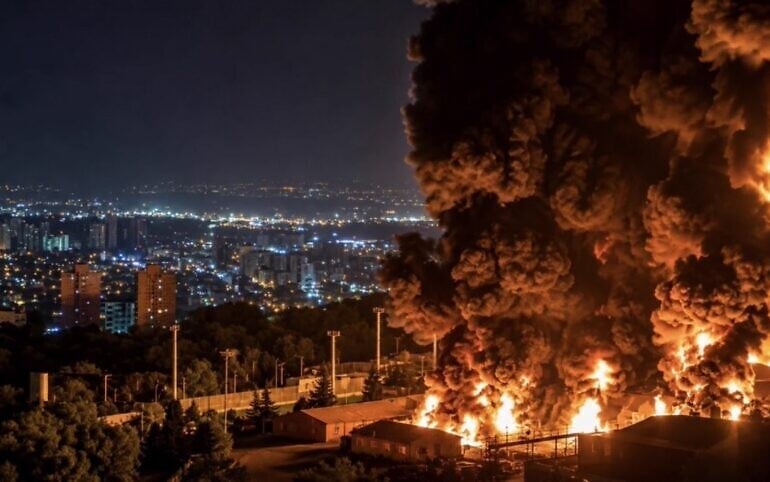
Hitting to negotiate: the new US bet on Iran.
The new US strikes against Iran, since July 6, 2026, give the impression of a brutal return to military logic. After the Iranian attacks on navigation and US interests in the region, Washington responded with force. Donald Trump raised his voice. The United States struck. Commentators, however, rushed to say, “I had said it,” “I was right,” and “the war was inevitable.”
But in geopolitics, we must be wary of certainties that are too rapid.
The situation is more complex: the US may not have moved from a strategy of peace to one of total war. They may have moved on to something else: coercive diplomacy. To strike, not to destroy the Iranian regime, but to change its calculation. Strike to remind Tehran that the Strait of Hormuz cannot become a permanent instrument of blackmail. Strike to negotiate, but from a position of strength.
That is the ambiguity of current US policy.
Donald Trump probably wants to avoid a long war. This issue is an essential point. He does not want a new Iraq. He does not want a military stalemate in the Middle East. He wants to be able to say that he imposed a balance of power, that he protected American interests, and that he prevented Iran from going too far, while keeping open the possibility of an agreement.
But the Revolutionary Guards also understood this US limit.
They know that Washington wants peace, or at least a negotiated exit. They know that the US would rather not settle into an uncontrollable regional war. And it is precisely this US desire to avoid escalation that Tehran may be tempted to exploit. By attacking shipping, indirectly threatening the Strait of Hormuz, and increasing pressure on oil markets, Iran is reminding itself that it does not only possess missiles or drones. It also has a geopolitical nuisance capacity.
This is where the heart of the problem lies.
The nuclear issue remains important, of course. But for now, the real political theater is Hormuz. This strait is not just a maritime passage. It is a global strategic lever. When Iran threatens Hormuz, it does not just talk to the Americans. It speaks to Europeans, Chinese, Japanese, Indians, the Gulf monarchies, financial markets, insurance companies, shipowners, and energy consumers.
Iran says in essence, “If you want to weaken us, we can make the world more nervous.”
The US response thus seeks to restore a limit. It says, “You can negotiate hard, you can challenge the regional order, but you cannot turn freedom of navigation into a permanent hostage.” That is why the US strikes should not be read only as military anger; they are also a political message.
The message is simple: peace remains possible, but it will not be achieved under the threat of Hormuz.
This does not mean that Washington is in control of everything. On the contrary, the main danger comes from misreading each other’s intentions. The US may believe that its strikes will bring Tehran back to negotiations. But Tehran may think that the higher the tension, the more its bargaining value increases. Perhaps each believes the other. And it is precisely in this type of moment that crises become dangerous.
So two mistakes must be avoided.
The first mistake would be to say the United States now wants war. This is not certain. Everything indicates that they want to restore their credibility without switching to an unlimited military campaign.
The second mistake would be to say, “Iran is totally weakened.” Again, that would be too quick. A country can be hit militarily and still have political clout. Iran knows it; the Revolutionary Guards know it even better. Their strength is not just to win a battle; it is to make every outcome costly for the opponent.
That is why this crisis is so difficult to decipher.
We are not in a classical war. Nor are we in true peace. We are in a grey area: strikes, messages, reprisals, indirect negotiations, threats, mediations, energy calculations, and psychological warfare.
Commentators often like definitive sentences. But geopolitics is rarely played out in certainties. It is played out in perceptions, thresholds, signals, and misinterpretation.
At this point, American diplomacy has not disappeared. It has hardened. It has become punitive. It is trying to tell Iran that we may want peace, but not at any cost.
It remains to be seen whether Tehran will take this message as an invitation to negotiate or as yet another reason to test America’s limits.
This is where the real risk lies. Not just in the strikes themselves, but in what each side believes it understands from the other.