The Terrible Ledger of Death
As images of catastrophic destruction emerge from Nepal, the approach of Rosh Hashana forces an uncomfortable reckoning with God and human responsibility.
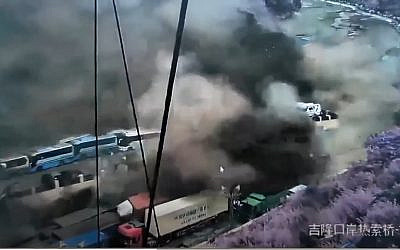
I watched the televised images from Nepal in disbelief.
A monstrous wall of water and debris came down the mountain. Multi-ton boulders moved downstream like pebbles. Cars, trucks and buses were kicked around like toys. People ran. At a border crossing, they fled moments before the structure itself was overtaken. Bridges buckled like broken cigarettes.
It was difficult to comprehend the scale of what I was watching. Human beings, their machines, their roads, their buildings — all the things by which we measure our dominion over the earth — suddenly seemed very small.
A raging river. A raging earth.
Or a raging God?
At any time of year, such images raise questions for which I have no satisfactory answers. But they come as Rosh Hashana approaches, when Jews will enter synagogues around the world and explicitly invoke God as sovereign, judge and arbiter of life and death.
On the first night of Rosh Hashana, many Jews recite Achot Ketana, with its haunting refrain asking that the year and its curses come to an end. Its final refrain changes: Let the new year and its blessings begin.
I have recited those words many times. This year I find myself stumbling over them.
What gives us confidence that turning a page on the calendar separates curse from blessing?
We don’t have to look very far back for a terrible challenge to that proposition.
On Yom Kippur, Jews recite Unetanah Tokef. We contemplate the terrifying uncertainty of the coming year: who will live and who will die, who by fire and who by water, who by sword, who by hunger and who by plague. Tradition describes the judgment as sealed on Yom Kippur.
Days later, on October 7, 2023, Jews were slaughtered in their homes. How is a believing Jew supposed to process that? There are answers I cannot accept.
I cannot accept the religious reflex, heard too often in some circles after catastrophe, that searches for the transgression that supposedly explains the dead. I categorically reject the suggestion that victims of a flood, massacre, epidemic or other calamity somehow had it coming to them.
It is an especially cruel theology because the dead cannot answer it.
Job’s friends tried to make suffering morally intelligible. Terrible suffering must have a reason; therefore the sufferer must somehow have merited it. The Book of Job does not vindicate them.
Nor does Jewish history permit such easy arithmetic.
Jews prayed in ghettos. They prayed in camps. They prayed in towns and villages before their inhabitants were taken away and murdered. They observed Rosh Hashana and Yom Kippur where and when they could. Their prayers did not provide immunity from the gas chamber or the killing field.
To say this is not to abandon God. It is to refuse to make the victims responsible for preserving our theology.
And yet I am not prepared to let God off the hook either.
Abraham did not. Confronted with the threatened destruction of Sodom, he demanded: “Shall the Judge of all the earth not do justice?”
It is one of the most audacious sentences in Scripture. Abraham does not say that God’s ways are mysterious and leave it there. He challenges God according to the very standard of justice that God represents.
So after watching a wall of earth and water consume almost everything before it, I think we retain the right to ask:
Where were You?
But then comes another question.
Where were we?
Abraham Joshua Heschel famously turned the question of Auschwitz from God’s absence toward human responsibility: before demanding where God was, we must confront where man was.
It is an indispensable question. But it cannot be the only one.
But “Where were we?” cannot mean that every tragedy belongs equally to all of us. No individual watching the images from afar could have stopped a glacier from collapsing in Nepal. If failures of monitoring, planning or warning compounded the disaster, those questions properly belong to the authorities and institutions responsible for them. Human responsibility must be assigned where human agency actually existed.
But this year has supplied unsettling examples of where that line becomes much harder to draw.
Consider the tens of thousands of deaths attributed to extreme heat in Europe. Heat is a force of nature. But the world in which that heat occurs is also increasingly a human construction. We have altered the climate. We determine how cities are built. Governments determine how they prepare for extreme temperatures. Societies decide how much protection to provide their elderly and vulnerable. Europeans lived for generations in homes designed for climates in which air conditioning was considered unnecessary or undesirable. As the climate changes, those assumptions carry consequences.
Where does the act of God end and the act of man begin?
Then consider measles.
For centuries, people watched children die from diseases they could neither understand nor prevent. Pestilence belonged naturally in the terrifying catalogue of Unetanah Tokef.
But we live after Pasteur, after Salk, after generations of immunology and public health. We possess vaccines against diseases that once terrified parents. Measles was declared eliminated from continuous transmission in the United States more than a quarter-century ago.
Now vaccination rates have fallen, measles has surged again, and deaths associated with the disease are again being reported. Scientists and public-health officials warn about the consequences of allowing preventable diseases to regain a foothold.
If people die because a mountain falls upon them, I can ask God where He was.
But if people die from a disease against which humanity possesses a safe and effective means of protection, can I place that death on God’s ledger without first examining our own?
“Who by plague” sounds different when we know how to prevent the plague.
That may be one of the great religious complications of modernity.
Our ancestors were overwhelmingly powerless before nature. We aren’t.
And yet we are.
We can split the atom but cannot stop an avalanche. We can alter the atmosphere but cannot command a river. We can eradicate a disease and then, through our own choices, allow it to return.
We possess nuclear weapons capable of destroying cities in moments. We possess scientific knowledge that previous generations could scarcely have imagined. We have acquired powers once associated with gods while retaining all the fear, tribalism, vanity, cruelty and capacity for self-deception that have accompanied humanity from the beginning.
We are terrifyingly powerful. And terrifyingly powerless.
There is another danger. We become accustomed to death.
Ukraine offers a grim example. A missile strikes an apartment building. Civilians die. Another attack follows. Then another. What once would have dominated our attention becomes another item in the day’s news. The avalanche in Nepal arrests us partly because we have never seen a boulder move that way. Perhaps the ruined apartment building no longer arrests us because we have seen too many of them.
But to the person underneath either one, there is nothing routine about death.
And so I approach Rosh Hashana this year with fewer answers than questions.
The shofar will sound. We will proclaim God King. We will ask to be inscribed in the Book of Life. We will ask that the curses of the old year end and that the blessings of the new one begin.
And perhaps, somewhere within that encounter, God will ask humanity:
Where were you?
Did you do more than pray for the welfare of your government?
Did you demand something of it?
When disease could be prevented, did you defend the knowledge that could prevent it? When the vulnerable could be protected from heat, flood or hunger, did you insist that they be protected? When civilians were being killed, did their deaths still disturb you after the headlines became repetitive? When human beings possessed the means to diminish suffering, did you act — or did you leave the matter to God?
Those are questions we should be prepared to answer.
But they do not dispose of ours.
For when the earth swallows human beings; when children die; when innocent people run and there is nowhere left to run; when prayers rise and protection does not come, I do not believe faith requires us to avert our eyes from Heaven.
Rosh Hashana places us before God in judgment.
Perhaps it also gives us the audacity to stand there with questions.
Where were we?
We have much to answer for.
Where were You?
I am still waiting for an answer.