


The Theological-Political Turn: A Critique (Polity, 2026)
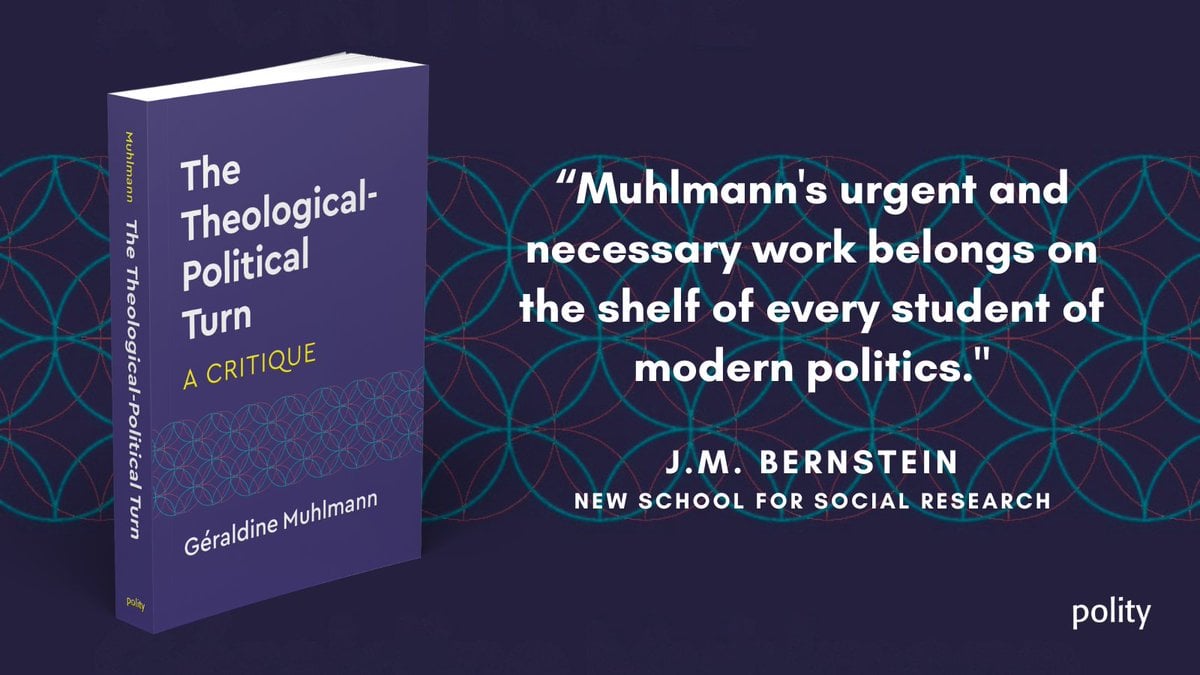
Two Spanish-language reviews, published a year apart, offer a close reading of the argument developed in L’imposture du théologico-politique. Géraldine Muhlmann published the book with Les Belles Lettres in 2022, and Polity translated it into English under the title The Theological-Political Turn: A Critique. Micael Alcalde Ordóñez, a doctoral researcher at the Complutense University of Madrid, presented it in Ingenium (no. 18, 2023, pp. 53–55) as the culmination of ten years of research. Mario Donoso Gómez, of Paris 8 University, reviewed it in Res Publica (27/3, 2024, pp. 405–406).
The two reviews approach the book differently. Alcalde Ordóñez reconstructs its architecture: its objectives, four principles, and three strands. Donoso Gómez focuses on the post-Schmittian wave, the distinctive mechanisms at work in each author, and the ferocity of Muhlmann’s attack. Taken together, they provide a fairly comprehensive picture of the book. One qualification is necessary: Muhlmann herself is quoted only in fragments— in French by Alcalde Ordóñez and in Spanish by Donoso Gómez.
An Imposture, a “Coup d’État” in Philosophy
Donoso Gómez first draws attention to the book’s tone: from its opening line, “theological-political” thought is declared an imposture (p. 9). For Muhlmann, it represents a regression, from the late 1980s to the present, toward a substantialization of history and politics.
Alcalde Ordóñez situates this regression within the history of philosophy. In his account, the rise of contemporary political theology over the past three decades reflects philosophy’s attempt to reckon with its own theoretical exhaustion, a symptom of its failure to confront what the political experiences of the twentieth century contained that could not be assimilated. He sees this as an epistemological reversal, a veritable “coup d’État” within philosophy: the reintroduction of religion as a means of seeking a theoretical absolute that had long been thought vanquished. He even wonders whether the word “imposture” is an allusion to Bernanos.
From this, he derives Muhlmann’s definition of political theology: the philosophical interpretation of the history of political ideas as religious ideas, in the hope of finding an original cause in history—namely, “the supposed action of a deep religious substance” (p. 11). The book has two explicit objectives: to show how what is now understood as political theology operates, and to classify its various forms. Alcalde Ordóñez attributes a third, implicit and “propaedeutic” objective to it: to prepare the ground for a critique of reconstructions of totalitarianism as secular religions, which may lead to dangerous revisions of historical events.
A Political Theology That Is Not Schmitt’s
Both reviewers emphasize a point that helps avoid a misunderstanding: the wave Muhlmann targets is not simply an inheritance of Carl Schmitt. Donoso Gómez notes that, in the chapter devoted to Schmitt and Blumenberg, she does not seek to reconstruct the genealogy of political theology along Schmittian lines. Rather, she aims to understand the earliest formulations of secularization theory in order to explain the new formulation that emerged in the late 1980s and 1990s—the “Carl Schmitt seduction” (p. 124). The chapter also contains a critique intended to unmask Schmitt, notably through an analysis of the grandiose victimization narrative in Ex Captivitate Salus (p. 134).
Donoso Gómez identifies three differences between this new wave and political theology of Schmittian origin. First, it dismantles the structural antagonism associated with sovereignty and distances itself from any theory of the enemy. Second, it revalorizes religion as a means of combating a certain modern despair or practical immobility, in both Rorty (p. 145) and Habermas (p. 147). Finally, it cannot be reduced to theological frameworks or logics (p. 149), and it pursues other horizons, such as religion transformed into poetry in Rorty’s work.
Alcalde Ordóñez makes the same point in four parts. The new wave no longer seeks to revalorize modernity by identifying its theological origins; instead, it offers a source of meaning and transcendence to a society deemed to be in “decline.” It does not undertake Schmitt’s “sociology of concepts.” It makes excessive use of secularization, losing the agonistic dimension of Schmitt’s conception of history: rupture and the enemy disappear. Finally, it employs an ambiguous concept of religion, a kind of “religious feeling” that always points toward something deeper. He concludes that this wave needs only a simple intellectual gesture—the designation of a religious substance at the heart of politics (p. 34)—to qualify as political theology. Muhlmann nevertheless retains the term.
A Sign of the Times
Where does this wave come from? Alcalde Ordóñez answers through intellectual history. Beginning in the late 1980s, a reaction against the philosophical effects of May 1968 turned toward religion as a restorative impulse for philosophy. This required setting aside the Marx–Nietzsche–Freud triad, as well as the sociology of Weber, Simmel, and Durkheim, which had served as theoretical firewalls against philosophy’s thirst for absolutes. The idea took hold that these thinkers had missed the essential dimension of politics, or had even “mistreated” it. Turning to religion made it possible to move beyond the old principles of rationalism without appearing to reintroduce a philosophy of history.
Four Principles
Alcalde Ordóñez extracts four operating principles of the theological-political from Muhlmann’s account.
- Modernity is understood as a transformed continuation of theological reality, rather than as a rupture with it. Muhlmann calls this a gesture of “radical anti-Spinozism” (p. 79), one that denies the processes through which Western political thought became autonomous.
- Blumenberg’s secularization theorem is used in an exaggerated manner (p. 115). Muhlmann draws on Blumenberg’s critique of the slide from analogy—a structural similarity between functions—to genealogy, according to which every political concept has its historical origin in a religious concept. The result is a substantialization of religion, presented as the driving force of political history, and of history itself. Donoso Gómez offers the clearest illustration: the secularization thesis, defended by Schmitt and analyzed by Blumenberg, introduces a religious substance into history as a kind of trap. What modernity appeared to have wrested from religion turns out to be yet another transformation of religion.
- Religion remains ambiguous. It is not constructed from religious thought itself, but through a shift from theology toward “the relationship with the sacred in history” (p. 382). Traditional transcendence is avoided, obscuring the process through which philosophy is reabsorbed into religion.
- Political theology is, above all, a philosophy of history: an “history-as-solution” (p. 44), an allusion to Leo Strauss. Political philosophy shifts its attention away from politics itself toward a comprehensive reading of history, in which it hopes to find solutions to its problems. Muhlmann warns against the “opportunistic use of the ‘invisible’” (p. 118). The further politics appears to move away from religion, the more an “adequate” historical interpretation can reveal it to be religious. Only the philosopher can read this invisible history, which is, by definition, unfalsifiable.
According to Alcalde Ordóñez, the imposture is complete when philosophy, unable to assimilate the complex consequences of totalitarianism, seeks to “absorb evil” (p. 368) by applying these principles. The forbidden desire for the sacred is transformed into a legitimate interest in the relationship between the sacred and history. The equally forbidden desire for a totalizing account of history is recast as a legitimate interest in processes of secularization.
Three Strands, One Underlying Matrix
One chapter of the book divides this wave into three strands, which both reviewers describe.
The “hyper-Romantic” strand takes its guiding figure from the later Bergson and finds its principal representative in Rorty, with his “religious romance” (p. 156). Alcalde Ordóñez describes it as vitalist and anti-intellectualist: our lives are supposedly governed by an emotional substratum derived from religious life, which serves as the ferment of modern political phenomena.
The “apocalyptic-messianic” strand appears, according to Donoso Gómez, in the later Heidegger, whose legacy Agamben inherits. Alcalde Ordóñez elaborates on this account. History is conceived as a process in which evil is redeemed through destruction. Agamben interprets law (nomos) through the exception (anomie), thereby revealing the entire history of politics through the passage from biopolitics to thanatopolitics. His guiding reference is the Heidegger of the Letter on Humanism: the history of Being is connected to the sacred, and openness to the appearance of a god becomes the only way out of the withdrawal of Being.
The “Old Hegelian” strand takes its guiding figure from the later Hegel rather than the Hegel of the Phenomenology, Donoso Gómez argues. Alcalde Ordóñez adds that Hegel’s interpretation of the state and Reformed Christianity as the fullest expression of Spirit helped nourish the topos of the “end of history.” Its representatives include the later Habermas, whose taste for “long history” reveals, in Muhlmann’s words, “the Hegelian note” (p. 197), and Charles Taylor, who posits a shared Christian substratum that mobilizes the currents of history.
Donoso Gómez quotes the common thesis underlying these strands: human history supposedly follows a deep and recognizable logic to which “religious thought” can connect (p. 402). The substance varies: a vital dynamism in Bergson, an apocalyptic tension between danger and salvation in Heidegger, and the rational realization of a Christian foundation in Hegel. It also serves different purposes. For Taylor, it combats estrangement from a certain fullness; for Habermas, it revives communicative theory in the face of increasingly arid affective exchanges; for Rorty, it provides the poetic impetus that invigorates solidarity; and for Agamben, it produces a future.
Agamben, Heidegger, and the Question of Auschwitz
Donoso Gómez sees Agamben’s case as the most radical expression of the thesis Muhlmann seeks to criticize. He considers her attack visceral, at times so forceful that it risks becoming excessively aggressive in its attempt to unmask the author. He cites arguments such as the Schmitt–Benjamin axis, brought together by a form of Paulinism that Agamben supposedly inherits from Taubes (p. 230), and the shadow of Heidegger—and “with it, a certain antisemitism”—behind Agamben (p. 190).
Alcalde Ordóñez is more blunt in his assessment of the substance of the argument. Muhlmann, he writes, is particularly critical of this strand because she considers Agamben’s interpretation of the Holocaust and of the figure of the Muselmann to come close to Holocaust denial.
“A Radical Critique”
Donoso Gómez argues that Muhlmann’s radical critique stems from political theology’s closure of politics and history, undermining democracy’s open-ended creativity (pp. 404–405). Alcalde Ordóñez notes her return to Feuerbach’s critique of philosophy’s religious temptation (p. 387).
Two Judgments
Both reviewers recognize the book’s value but differ on tone. Donoso Gómez praises its methodological rigor while criticizing its excessive attack. Alcalde Ordóñez leaves the question open: political theology concerns philosophy’s transformation of historical concepts into metaphysics. Politics exceeds theology because its true foundation remains unknown—a question political philosophy must confront.