
The Torah Was Not Given to Be Explained
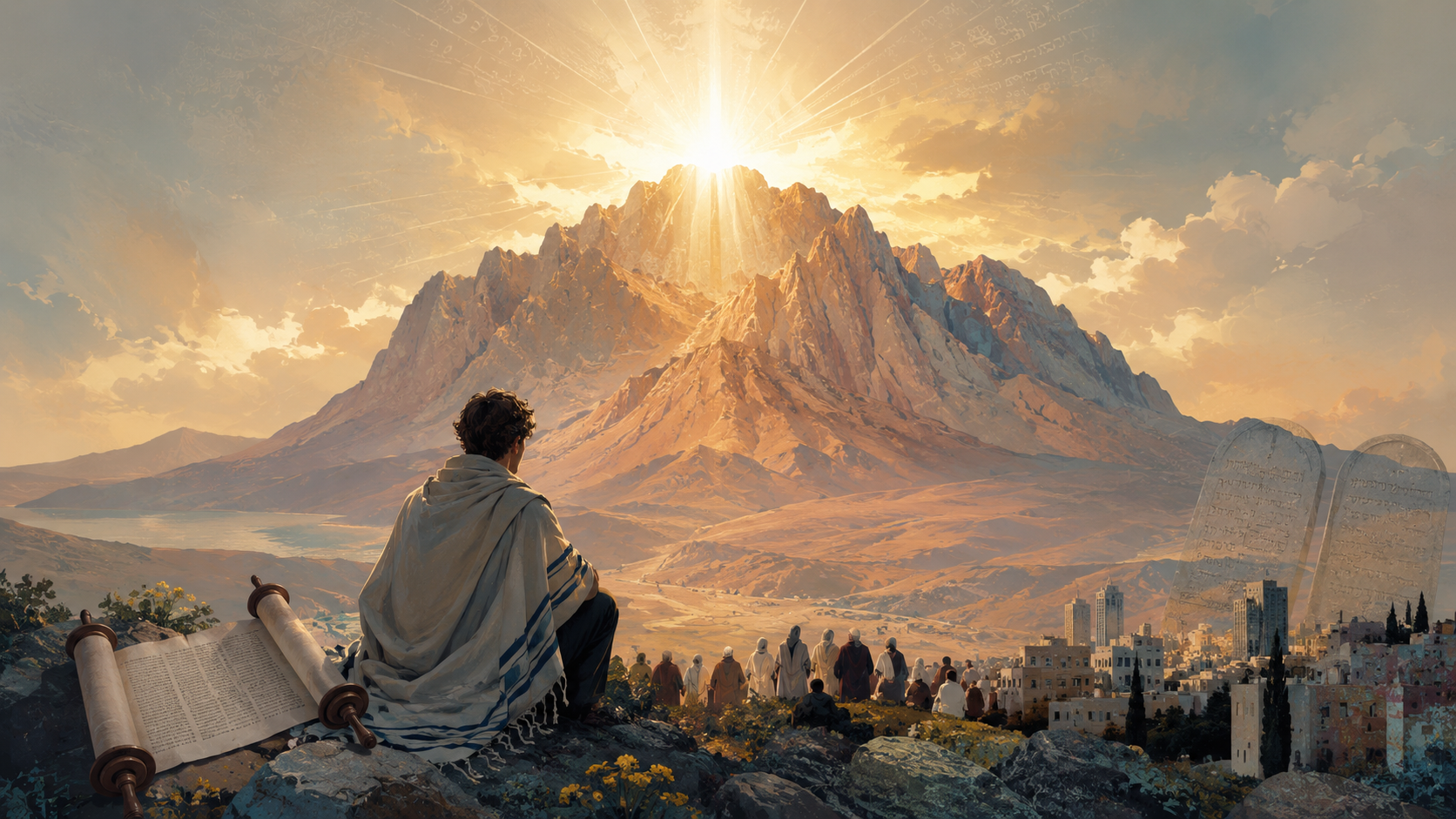
Shavuot: The Torah was not given to be explained, but inhabited
Shavuot is usually remembered as the festival of the giving of the Torah.
And yes, it is that.
But if we stay only with that phrase, something goes cold. The Torah becomes a religious object: something to be looked at, studied, commented on, defended. And that is not enough. Because the Torah was not given simply as law, nor as doctrine, nor as national memory. It was given as a form of life. As an architecture capable of ordering human consciousness from within.
It does not celebrate merely that a text descended into the world.
It celebrates that the human being was called to respond.
Before Sinai there is preparation. There is waiting. There is boundary. There is silence. That matters. Revelation does not fall upon an inwardly scattered multitude. The Torah does not enter a soul full of noise. To receive the word, Israel must stop. Separate itself. Learn that nearness is not possession, and that not every religious emotion is revelation.
Sinai does not begin with explanation.
It begins with boundary.
The mountain cannot be invaded. The fire cannot be manipulated. The voice cannot be captured. There is something in the giving of the Torah that forces the human being to recognize their place: not as owner of the word, but as someone who listens with trembling.
And that trembling is not primitive fear.
It is consciousness.
The Torah, read from its living depth, does not come to resolve human responsibility from the outside. It comes to awaken it. It does not decide for us. It obliges us to decide. It does not remove difficulty. It gives it form. It does not offer spirituality without structure; it offers a structure in which life can become more faithful to itself.
That is why Shavuot cannot be understood only as a vertical moment: God speaks, Israel receives. That image is true, but it stays incomplete if it ends there. The decisive thing begins afterwards, when the word received at Sinai descends to the ground. When it touches concrete life. When it enters justice, money, harm, the stranger, the widow, the orphan, the vulnerable body of the other.
Revelation that does not become responsibility ends up becoming sacred noise.
That is why, after Yitro, comes Mishpatim.
After the fire come the laws.
After the mountain comes daily life.
There one sees one of the deepest truths of the Torah: the divine is not verified only in the intensity of the experience, but in the form that experience produces in the world. Having listened is not enough. One must respond. Having felt is not enough. One must order life. Having stood at the foot of the mountain is not enough. One must know what to do with the neighbor when the mountain is no longer before one’s eyes.
Shavuot, then, is not nostalgia for an ancient revelation.
It is a present question.
Can the human being still listen?
Not hear. We do that all the time. We hear voices, messages, opinions, screens, news, explanations, commentaries. We live surrounded by words. But listening is something else. To listen is to allow a word to claim us. To place us before a responsibility we cannot evade without losing something of our own soul.
The contemporary world does not lack information.
There is far too much of that.
What is missing is form. Direction. Real listening.
That is why Shavuot becomes more urgent today than ever. The question is not only whether the Torah was given. The question is whether we are still capable of receiving it. And to receive it does not mean repeating correct phrases. It means allowing its architecture to act upon us. To separate us from the noise. To return our name to us. To teach us boundary. To make us responsible for the other.
The Torah does not ask first to be defended.
It asks to be inhabited.
To inhabit the Torah means to enter its movement. Not to observe it as an ancient artifact, but to recognize that its scenes continue to take place within human life: the chaos that needs form, the exodus that demands departure, the desert that purifies, the mountain that calls, the law that turns fire into justice.
Shavuot is not only the anniversary of a giving.
It is the instant in which life asks whether we are willing to receive a form.
Because a Torah that is only studied may remain an idea.
A Torah that is only discussed may become a system.
A Torah that is only defended may become a banner.
But an inhabited Torah changes the way we look, speak, decide, repair, love, and uphold justice when no one is watching.
That is the true giving.
Not only that the Torah was given.
But that it can still enter us.
And if it enters, it does not leave us unchanged.
Shavuot celebrates that sacred danger: that an ancient word may become present again and oblige us to live with greater truth.
The mountain burns once.
But responsibility burns every day.
Perhaps that is why the Torah does not end at Sinai. Because revelation does not want to remain in height. It wants to walk. It wants to become relationship. It wants to become bread, judgement, boundary, rest, repair, memory, compassion.
It wants to become life.
Shavuot does not ask us only what our fathers received.
It asks us what form we are willing to receive.
Because the Torah was not given to be explained from the outside.
It was given to be inhabited from within.