The Tower of Babel and the AI Boom: A Weekly Torah Reading for Our Tech Moment
The Tower of Babel and the AI Boom: A Weekly Torah Reading for Our Tech Moment
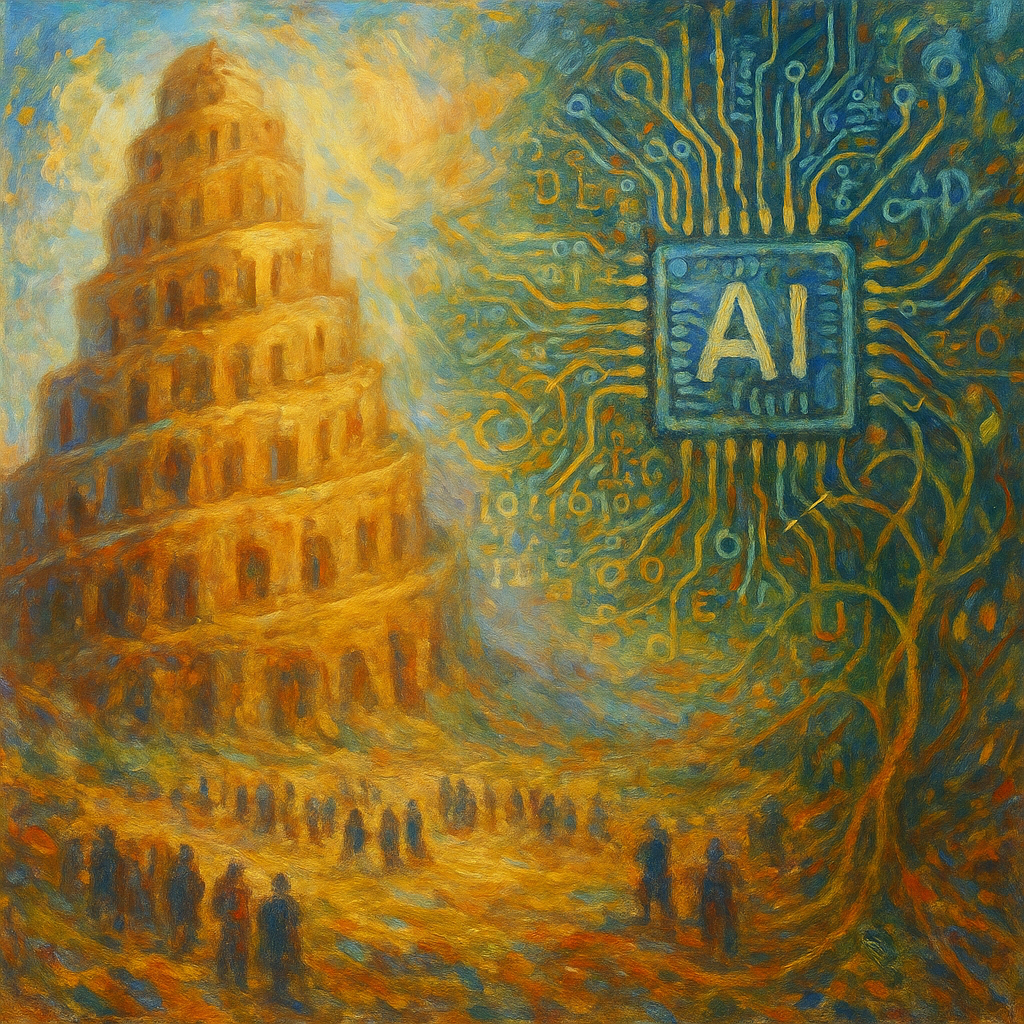
Parashat Noach (Genesis 11:1–9) arrives just as the world rides a crest of AI exuberance. The Torah’s brief, piercing tale of a people unified in purpose and language—who set out to “make a name” by building a tower to the heavens—lands like a moral seismograph for an age racing to scale systems faster than we can ask why.
When bricks matter more than people
The classic midrash paints a chilling scene: if a brick fell from the tower, the builders lamented; if a worker fell, they shrugged and kept laying brick. That is the Babel warning in a single image: when the project becomes the point, human beings become expendable. Efficiency eclipses dignity; speed outpaces judgment; ambition detaches from accountability.
AI’s promise is real. It can help us heal, learn, create, and extend human capability in extraordinary ways. But the most celebrated near-term use case has not been the betterment of society; it has been the wholesale replacement of human tasks—what many call “productivity gains”—delivered through disembodied bots. We know the science-fiction trope where humanoid robots take over. AI feels less threatening because it’s mostly invisible: not steel and servos, but code and clouds; not a marching army, but an API call. Yet the moral risk is the same one Babel dramatizes: treating human beings as costs to be minimized rather than image-bearers to be elevated.
One language, one stack, one story—until it breaks
The Babel story begins with technical elegance: “the whole earth was of one language and of unified words.” Standardization is powerful. Shared protocols accelerate progress. But uniformity can seduce us into mistaking seamlessness for goodness. The desire to “make a name” and prevent dispersion—the fear of pluralism—drives centralization. In our AI economy, centralization shows up as concentrated compute, data moats, and winner-take-most platforms. It shows up as monocultures of metrics: optimize for engagement, for throughput, for cost, for latency. Then we act surprised when those optimizations crowd out other values.
Divine “confusion” at Babel is often read as punishment. It also functions as mercy. By shattering a fragile monoculture, the Torah re-seeds the world with many languages—many ways of seeing, naming, and building. Diversification prevents the single point of moral failure. The failure mode of AI at Babel-scale is not just a rogue system; it is a society that forgets what it is for.
Humanity 2.0 after a hard reset
The Tower rises only a chapter after the Flood—a “hard reset” on civilization. One might expect humility. Instead, anxiety about dispersion curdles into a grand project of self-deification. The text is delicate: they don’t say, “Let us serve one another.” They say, “Let us make bricks… and build ourselves a city and a tower… and make a name for ourselves.” It’s not that cities or towers are bad; it’s that the purpose is misaligned. The tools are brilliant; the telos is small.
AI is another post-reset tool. After a pandemic that laid bare our inequities, we could have chosen to prioritize health systems, education gaps, and climate resilience as the first use cases for our most powerful general-purpose technology in decades. Many are doing exactly that—and they deserve more oxygen than they get. But the gravitational center of the AI narrative has been cost-cutting and substitution at scale. We should be honest about that.
The gods of this generation?
The Torah’s critique is not anti-engineering; it is anti-idolatry. Babel idolizes the project and the prestige—“make a name.” In our moment, the “gods” are not silicon deities; they are we, the builders, when we confuse capability with wisdom, speed with discernment, scale with significance. And here a harsher truth emerges: the AI boom is already sketching a bifurcated humanity.
On one side are the winners—the investors who fund the compute, the visionaries who set the narratives, and the engineers who architect the models. They accrue outsized returns from network effects and capital-intensive barriers to entry. On the other side grow the losers—the vast share of workers whose tasks are the first to be modularized, mimicked, or made redundant by bots. Whether the displaced eventually prove to be 30%, 50%, or—as some fear—something closer to four-fifths of current roles as AI scales through management layers as well as front-line functions, the direction of travel is unmistakable: the gains concentrate while the losses distribute. That is Babel in economic form: a single, gleaming tower casting a very long shadow.
The confusion that undoes Babel is not a glitch; it is a safeguard against the totalizing logic of single-metric success. In a world where “productivity” becomes the only language, human meaning goes wordless. The tragedy is not that the tower falls; it’s that we no longer know how to speak to the people crushed beneath it.
Israel’s tech ecosystem: a covenantal test
Israel is a global AI innovator. That is something to celebrate—and to steward. We can model a post-Babel posture: startups that keep human dignity at the center; universities that teach alignment as an ethical craft, not just a technical discipline; regulators close enough to the ground to see impacts before they calcify into inequity. Our national experience—ingathering of exiles, many languages at one table—equips us to resist the siren song of a single “language” and a single metric. The covenant asks more of us: to harness power for chesed (care), tzedek (justice), and emet (truth).
“Let us go down and see”: the theology of inspection
“Let us go down and see” is the Torah’s grammar for governance—and, in the Babel story, it signals divine intervention that disrupts a project careening toward dehumanization. But we should not confuse that mercy with a modern safety net. We cannot count on a providential deus ex machina to scatter our monocultures or to rescue us from the consequences of our own designs. In our age, “going down to see” must be our work: leaders and builders drawing close enough to witness real-world effects, regulators and communities auditing systems before harms harden, and citizens insisting that power remain answerable to human beings. Inspection is not suspicion; it is love taking responsibility. If we will not “go down and see,” reality will come up and correct us—often with more pain than we intended.
After we survive it
We may one day look back at the “AI Tower of Babel” as we do the original—misguided and foolish—after we survive it. Survival here is not about outsmarting a superintelligence; it is about outgrowing our own hubris. The Torah does not condemn technology; it disciplines desire. It does not ban towers; it blesses households, marketplaces, study halls, and courts where the measure of greatness is how we lift the vulnerable, not how high we stack the bricks.
This week’s reading therefore does not hand us a checklist. Instead, it issues an inference and an imperative: if AI is to avoid Babel’s fate, we must define—explicitly, publicly, and soon—the purposes that transcend speed and scale, the boundaries that honor human worth, and the terms by which power disperses rather than concentrates. Without that shared moral language, the code will compile—and our society will not. Babel warns us that confusion is what comes when we refuse to do the harder work of meaning.
In an age of breathtaking capability, the most advanced technology may be neither model nor machine, but the ancient art of speaking many languages to serve one humane end.