
The Trappings of Israel
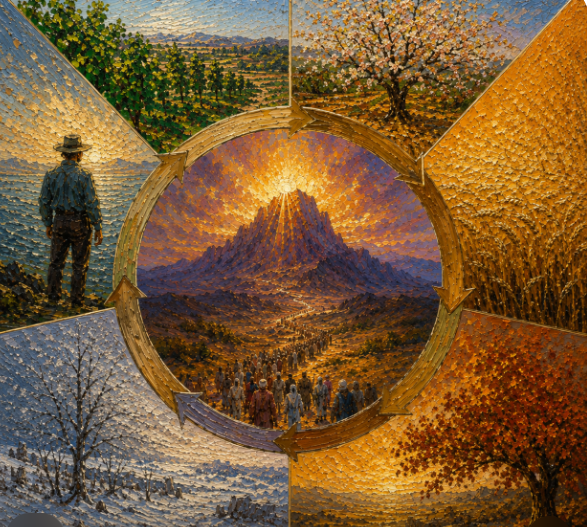
Almost all great civilizations have a common life cycle. They organize, ascend, mature, overextend and decline. Their rise often comes from a collective narrative or goal. Their descent, from abandoning or not cherishing it. Their rise often comes from the toil of earlier generations. Their decline, from the sloth of their successors. The cycle is predictable: the motivation for hard work is often privation; the temptation of laziness is born from excess. The cycle can rarely be broken.
In this week’s parashah, we encounter a phenomenon that may be designed for that purpose. Parashat Behar begins with the mitzvah of Shmitta, the sabbatical year, in which no agricultural work is permitted:
God spoke to Moshe on Mount Sinai, saying: Speak to the Israelite people and say to them: When you enter the land that I am giving you, the land shall observe a Shabbat to God. Six years you may sow your field and six years you may prune your vineyard and gather in the produce. But in the seventh year the land shall have a Shabbat of complete cessation, a Shabbat to God; you shall not sow your field nor prune your vineyard… (Vayikra 25:1–4)
This mitzvah is interesting, but its framing is intriguing: the Torah specifies that this mitzvah was given on Sinai. This need not be said. The Jews had not left Mount Sinai. Hundreds of other mitzvot were given there. The location of where a mitzvah was first commanded is not generally mentioned. It is irrelevant; it is bound to neither that particular time or place. Thus, almost all the main commentators are bothered by this question: What is it about Shmitta that lends it to be associated with Mount Sinai above and beyond all other mitzvot?
To understand this mystery, we must understand the purpose of Shmitta. Every seventh year we must not do any agricultural work. This is not easy in any society, certainly not an agricultural one. People need to eat. The Torah addresses these fears directly:
And when you ask, “What are we to eat in the seventh year, if we may neither sow nor gather in our crops?” I (God) will direct My blessing for you in the sixth year, so that it shall yield a crop sufficient for three years. (Vayikra 25:20–21)
Shmitta is a year of faith. We live fully dependent on God’s blessing. It will be the mercy of God, not our labour, that will feed us. This teaches us a crucial lesson: we live not by the strength of our economy, but on God’s grace. Humans are fickle and quick to forget. We rush to take credit and tarry in being appreciative. So, we have this reminder built into the calendar: a lesson taught once every seven years, but one that must be lived through the following six.
This idea runs deeper. There was another time in Jewish history when we lived solely on God’s direct kindness, a period in which we were given a lesson in gratitude. The Jews lived in the desert for forty years, living on bread that came from the heavens. The Torah tells us why:
He subjected you to hardship, and allowed you to go hungry and then fed you manna, which neither you nor your ancestors had ever known, in order to teach you that Man does not live on bread alone, but rather on the word that emanates from God’s mouth does man live. (Devarim 8:3)
The desert was a long tutorial. The Jews would enter and settle the land. This would bring with it all the trappings of wealth and security. They would take their ownership as a given, forgetting the crucial suffix: that it was given by God. Before entering, they had to have hardwired in their collective psyche: Man does not live on bread alone, but rather on the word that emanates from God’s mouth…
This explains the connection between Shmitta and Sinai. Experientially, they are the same. Shmitta is a way of reliving the desert-Mount Sinai experience. Every seven years, the land is left fallow and desert-like. We are fully dependent on God’s blessings. Although we are to settle the land, we are given this deliberately unsettling commandment.
Traditionally[1], the year of Shmitta was also seen as a year in which people would study Torah. Freed up from their agricultural obligations, the Jewish people would make use of their newfound time for spiritual rededication. Living on Divinely inspired food and studying Torah – this is Sinai recreated. Shmitta is the way we ensure that although we left Sinai, Sinai never left us.
This idea returns in the penultimate mitzvah of the Torah:
Moses instructed them as follows: Every seventh year, at the time of the (end of the) Shmitta year, on Sukkot, when all of Israel comes to appear before Hashem your God in the place that He will choose, you shall read this Torah aloud in the presence of all Israel. Gather the people: men, women, children, and the converts in your communities; that they may hear and so learn to revere Hashem your God, and to observe faithfully every word of the Torah. Their children, too, who have not had the experience, shall hear and learn to revere Hashem your God, as long as they live in the land that you are crossing the Jordan to possess. (Devarim 31:10–13)
This mitzvah, known as Hakhel, has a very clear motive. Only one generation of Jews stood at Sinai, and only two experienced the miracles of the desert. There would be hundreds of generations afterwards who were not privy to that experience and to the spiritual stimulus that it provided. The solution? They would recreate Sinai. The entire nation would gather around to hear the Torah being read. Thus, ensuring this national renewal that was so critical to Jewish continuity. When? At the tail end of a Shmitta year. Why? The year in the recreated desert culminates with a reliving of Sinai[2]. The implication of the final passuk is clear: to live in the land, the Jews must remember that it was not a given, but God-given.
[1] See Ibn Ezra, Devarim 31:12 and Sefer HaBrit Parashat Behar
[2] See Rambam, Hilkhot Hagiga 3:6
וגרים שאינן מכירין חייבין להכין לבם ולהקשיב אזנם לשמוע באימה ויראה וגילה ברעדה כיום שניתנה בו בסיני, אפילו חכמים גדולים שיודעים כל התורה כולה חייבין לשמוע בכוונה גדולה יתרה, ומי שאינו יכול לשמוע מכוין לבו לקריאה זו שלא קבעה הכתוב אלא לחזק דת האמת ויראה עצמו כאילו עתה נצטוה בה ומפי הגבורה שומעה, שהמלך שליח הוא להשמיע דברי האל.
Converts who do not understand are obligated to concentrate their attention and direct their hearing, listening with reverence and awe, rejoicing while trembling as on the day the Torah was given at Sinai. Even great Sages who know the entire Torah are obligated to listen with exceedingly great concentration. One who is unable to hear should focus his attention on this reading, for Scripture established it solely to strengthen the true faith. He should see himself as if he was just now commanded regarding the Torah and heard it from the Almighty. For the king is an agent to make known the word of God.