


The Treasure is Very Close to You
A famous Chassidic story tells of a simple Jew named Yankel who lived in Krakow. He was poor, but he never stopped believing that G-d had not forgotten him.
One night, Yankel dreamed that a treasure was buried beneath a bridge in the distant city of Prague. At first, he ignored the dream. But when it returned again and again, he finally packed a small bag and made the long journey to Prague, hoping his treasure was waiting for him.
When he arrived, his heart sank. The bridge was guarded day and night. Yankel walked around it for several days, trying to determine how he could dig without being arrested.
Eventually, a guard confronted him. Unable to think of a good excuse for loitering near the bridge, Yankel reluctantly explained his dream.
The guard began laughing.
“You traveled all the way from Krakow because of a dream? If I believed dreams, I would have traveled to Krakow long ago. I keep dreaming that beneath the stove of a Jew named Yankel is a buried treasure.”
Yankel said nothing. He hurried home, moved his stove and began digging.
And indeed, he found his treasure.
I have heard this story told countless times. It may, or may not, have happened. But this week, it really did happen.
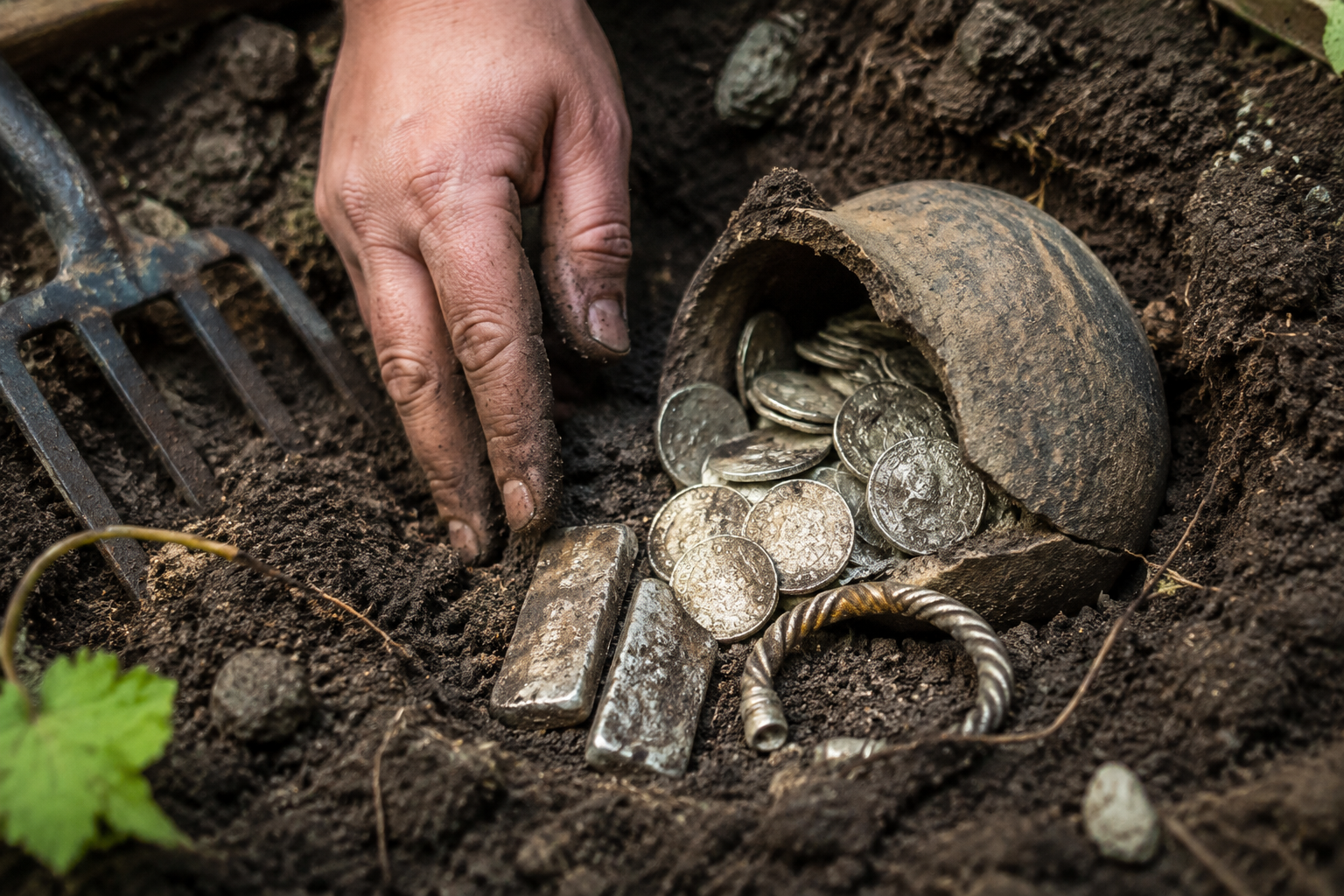
A homeowner in Rebild, Denmark, who is remaining anonymous, went into his backyard to clear away grass and stones for a new patio. It was supposed to be just a few hours of work.
About half an hour into the job, his garden fork struck something hard. It made a strange metallic sound.
At first, he thought it was old iron or fencing wire. Then he noticed pieces of pottery. He dropped to his knees and began carefully digging with his hands.
One metal object emerged. Then another. Then another.
There were silver bars, bracelets, coins, jewelry fragments and even a tiny Thor’s hammer. Beneath the ordinary dirt of his backyard was a clay vessel containing the largest known Viking silver treasure ever discovered in Denmark.
The treasure weighed more than forty pounds and contained approximately 700 objects and fragments. It had been buried during the tenth century, waiting more than one thousand years for someone to begin digging.
When I read that story, I immediately thought of the famous words in this week’s Torah reading.
“This commandment which I command you this day is not concealed from you, nor is it far away. It is not in heaven, that you should say, ‘Who will go up to heaven for us?’… Nor is it beyond the sea, that you should say, ‘Who will cross to the other side of the sea for us?’…”
“Ki karov eilecha hadavar me’od,” Moses continues. “For the matter is very close to you, in your mouth and in your heart, to do it.” (Deut. 30:11-14)
Such a powerful verse.
We often imagine that meaningful Jewish life exists somewhere far away. It belongs to rabbis, scholars or people who grew up more religious. If we want to find it, we will have to fly to the heavens, or cross a great ocean to change our lifestyle and become someone completely different.
Not true, says the Torah. It is close. Very close.
The Ramban (Nachmanides) explains that the commandment Moses is describing here as close is Teshuvah. Teshuvah is commonly mistranslated as repentance, but its literal meaning is “return.”
Judaism is not something foreign that a Jew must bring into his or her life. It is not an identity we manufacture or a personality we put on. It is buried within us because it is our deepest and most natural state.
Teshuva is close because it is already part of you. We are returning home to who we truly are.
A story is told of a professor who complained to the Rebbe about human nature. People may initially appear kind and caring, he said. But when you dig beneath that pleasant exterior, you discover selfishness, arrogance and ego.
The Rebbe asked him to picture a beautiful street lined with trees, homes and gardens. On the surface, everything looks lovely. But if you take a shovel and begin digging, you will soon encounter dirt and mud.
The professor nodded. That was exactly his point.
But the Rebbe had not finished.
If you do not stop when you reach the mud, the Rebbe explained, and you continue digging deeper, you will eventually discover precious minerals and diamonds.
The professor had discovered something real about people, but he had stopped digging too soon. He dug deeply enough to discover the dirt, but not deeply enough to discover the treasure.
Sigmund Freud described the primitive urges and self-centered drives within the human personality as the “id.” Judaism does not deny that we possess selfish impulses and complicated desires.
But beneath the id is the Yid.
Beneath the impulse is the Jew. Beneath the confusion is a soul that remains bound to G-d. Our mistakes are real, but they are not our deepest identity.
If you dig beneath the polite exterior, you may indeed find ego and selfishness. But if you dig beneath that ego, you will discover faith, goodness, sacrifice and a desire to connect with G-d.
The Baal Shem Tov explained this idea through a verse in the prophet Malachi describing the Jewish people as G-d’s “Eretz Cheifetz,” His cherished land. Just as no one can calculate all the treasures concealed beneath the earth, no one can measure the spiritual treasures hidden within a Jew.
Sometimes those treasures are covered by years of distraction, pain, disappointment and bad decisions. Habits can become deeply rooted and difficult to break.
But the treasure remains.
The High Holidays help us remove the layers that have accumulated over the past year, or perhaps over many years. Hearing the shofar and fasting on Yom Kippur do not create a Jewish soul. They only reveal the precious soul that was always there.
So here is both my warning, and my advice.
Next week, many of us will walk into synagogue for the first time in a while. We may come because it is tradition. Because our parents came. Because something inside tells us that on these days, a Jew belongs in shul.
And then, you may hit metal. You may feel something stirring inside, making strange sounds.
Perhaps it will be the sound of the shofar. Perhaps a beautiful melody. Maybe it will be something the Rabbi says, or a quiet moment when a memory suddenly returns.
You may find yourself thinking some seemingly crazy Jewish thoughts.
Maybe I should come to shul more often. Maybe I should put on tefillin each morning. Maybe I should light Shabbat candles on time and make my home feel like Shabbat every Friday night. Maybe I should begin attending Torah classes, make my kitchen kosher or finally do that mitzvah I have been postponing for years.
Do not ignore that sound.
Do not tell yourself, “This is not me. I am just emotional because it is Rosh Hashanah.” Do not decide that you struck some old rusty metal and quickly cover it over again.
Start digging.
Take that inspiration seriously. Dig beneath the distractions and old habits. Keep digging past the disappointment and pain.
You may discover that what you struck was not an obstacle at all.
It was treasure.
Not an ancient artifact from a vanished Jewish past, but a living, pure and priceless soul.
Still connected to G-d. Still waiting to be uncovered.
So when your soul makes that strange sound this Rosh Hashanah, do not cover it back up.
The treasure you have been searching for is closer than you ever imagined.
It is waiting within you.
Good Shabbos!
Rabbi Yankie & Chana Denburg