


The Truth About Dr. Hussam Abu Safiya
Over the past week, an international campaign calling for the immediate release of Dr. Hussam Abu Safiya from Israeli prison has gained renewed momentum, claiming that his life is in imminent danger.
Ironically, some of the campaign’s strongest advocates are Israeli media outlets.
Haaretz declared that “the global campaign to free Dr. Hussam Abu Safiya is justified,” citing what it described as “genuine, growing, and well-founded concern for his life.”
The popular Israeli news website Ynet reported on a petition signed by 1,000 medical professionals calling for the release of the doctor, describing his alleged offense merely as being “suspected of ties to Hamas.”
Many other Israeli and international media outlets have echoed the same narrative.
The campaign rests on two central claims.
As this article will demonstrate, both are false.
The first concerns Abu Safiya’s alleged medical condition in prison.
The second conceals his senior role within Hamas—the very reason for his imprisonment.
Let’s begin with the first claim: that Abu Safiya’s life is in immediate danger.
The allegation originated with his attorney, Nasser Odeh, who stated after visiting his client that Abu Safiya told him his life was in danger because of abuse by prison guards and that this was, in his words, “the last time you will see me alive.”
Odeh further claimed that when he met Abu Safiya, he observed severe injuries to his head, around his eyes, ears, and neck—to such an extent that he initially struggled to recognize him.
Yet a recently published photograph tells a very different story.
Abu Safiya appears healthy and shows no visible injuries whatsoever—not to his head, nor anywhere else on his body.
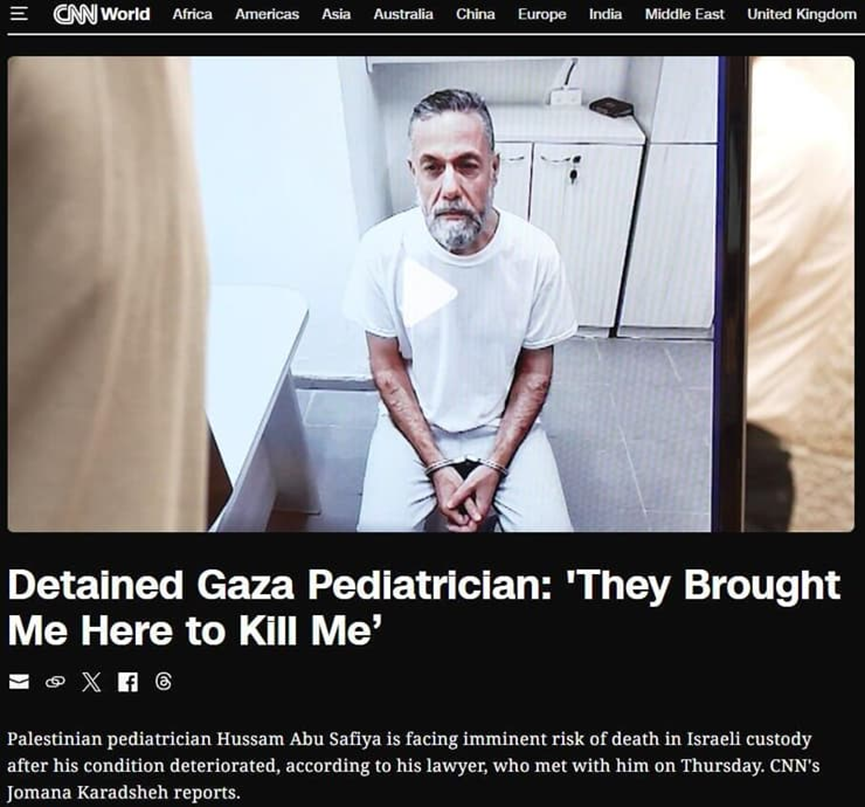
Judge for yourself.
Does this look like a man who has been beaten so severely that his life is in immediate danger?
Moreover, in an official response, the State of Israel categorically rejected the allegations, describing them as “false claims lacking any factual basis.”
The conclusion regarding the first pillar of the campaign is therefore straightforward.
His attorney claims he has been brutally beaten and is facing imminent death.
The State of Israel officially denies those allegations.
The available photographs strongly support Israel’s position and cast serious doubt on the attorney’s claims—the very claims that triggered the international campaign.
Now to the second claim: that Abu Safiya is merely a devoted physician and hospital director whose only offense is being “suspected of ties to Hamas.”
This, too, is false.
According to Israel, Abu Safiya transformed Kamal Adwan Hospital, which he directed, into a Hamas terrorist headquarters.
During the IDF operation against the compound, Israeli forces discovered numerous explosive devices and booby traps inside and around the hospital, arrested hundreds of Hamas operatives, and seized weapons including assault rifles, hand grenades, and large quantities of ammunition.
The hospital served as such a significant Hamas military facility that the IDF took the unusual step of permanently sealing the entire building to prevent any future military use.
Nor is Abu Safiya merely “suspected of ties to Hamas.”
According to Israel, he holds the rank of colonel in Hamas’s military wing and has been photographed attending a military ceremony wearing Hamas uniform and insignia.
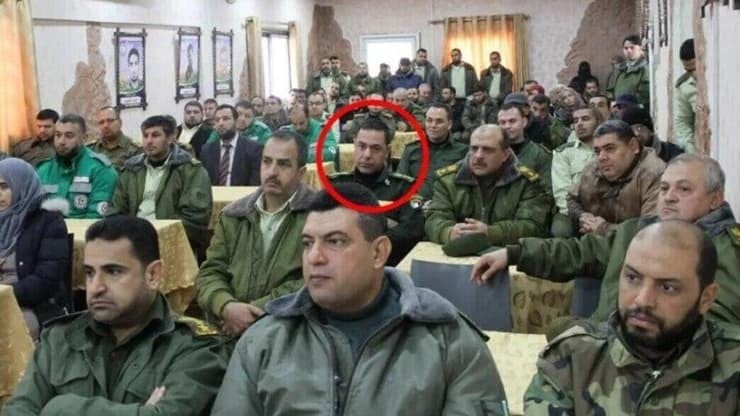 Furthermore, Israeli authorities reportedly consider his role within Hamas sufficiently senior that they refused to include him on any list of prisoners released as part of hostage exchange negotiations.
This leads to a reasonable hypothesis.
Abu Safiya may have concluded that Israeli authorities possess substantial evidence regarding his senior role within Hamas and intend to prosecute him for terrorism offenses carrying a lengthy prison sentence from which he may never be released.
If so, inventing an unfounded story of imminent death—with the assistance of his attorney—would be an effective way to generate international pressure for his release.
There is little point criticizing Abu Safiya or his lawyer for pursuing every available avenue to secure his freedom.
That is precisely what defense attorneys are expected to do.
The more important question is different:
Why are Israeli and international media outlets so eager to join a campaign built on claims they have made little effort to verify?