
Where Objectivity Meets Reality
The truth: Arab states, not Israel, betrayed Palestinians
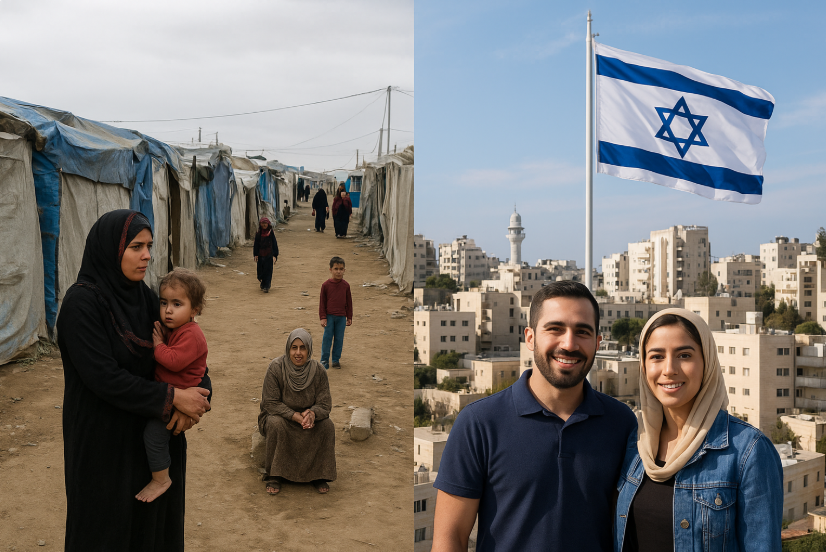
Contrast between Arabs in a refugee-camp and Israeli Arabs (generated picture)
In the West, when discussing “Palestinian refugees,” Israel is often automatically presented as the moral and legal responsible party. A close look at the historical facts, however, shows that much of the Palestinian suffering stems from decisions by Arab states themselves: refusal to integrate, keeping refugees in camps, and the unilateral revocation of Jordanian citizenship in 1988. Israel, which never granted these people citizenship, is nevertheless often blamed, while it did fully absorb and grant equal rights to the Arab residents who remained in Israel in 1948.
Jordan: citizenship, international obligations, and political convenience
After the independence of Israel (1948), Jordan annexed the West Bank. All residents were granted full Jordanian citizenship, including voting rights, social benefits, and legal protection. These Arabs were formally citizens of Jordan, and Jordan thereby bore both legal and moral responsibility for their welfare.
In 1988, during the First Intifada, King Hussein unilaterally revoked the citizenship of West Bank Arabs, without referendum, consultation, or legal procedure. Hundreds of thousands of people suddenly became stateless, while Israel, which had never made them citizens, was instantly designated as responsible.
This is problematic under several international treaties:
- Geneva Convention (1949, IV): protects civilians during war and occupation; states remain responsible for protecting their citizens. Mass unlawful revocation of citizenship can be considered a violation.
- Universal Declaration of Human Rights (1948, Article 15): every individual has the right to a nationality, and no one shall be arbitrarily deprived of it or denied the right to change it.
- Convention on the Reduction of Statelessness (1961): obliges states to prevent statelessness; mass revocation of citizenship without alternatives is considered a violation.
Morally and legally, Jordan chose political, but criminal, convenience: passing the problem to Israel instead of taking responsibility for its own citizens.
It is important to emphasize that West Bank Arabs thus have a technical homeland: Jordan. Historically, legally, and under the Mandate for Palestine (1922), they fall within the Jordanian state structure. Holding Israel responsible for their situation is legally and historically inaccurate.
Israel as a contrast: Arab Jews vs. ‘Palestines’
Israel demonstrates that integration is possible. Between 1948 and 1970, approximately 800,000 Jews arrived from Arab countries such as Iraq, Egypt, Libya, Syria, and Morocco, many being expelled and arriving with nothing, primarily in Israel. They initially stayed in temporary transit camps, but within a few years were fully integrated: they received Israeli citizenship, access to work, education, housing, and political participation.
Meanwhile, the 2 million Arab citizens of Israel, descendants of Arabs who remained in Israel at the independence in 1948, enjoy full citizenship, voting rights, access to education and healthcare, and representation in the Knesset. Some were even part of a recent government.
The contrast with Arab countries is stark: in Lebanon, Syria, Egypt, Kuwait, and even Jordan, Arab refugees (‘Palestinians’) live for generations in camps, without citizenship and often amid conflicts. They are sometimes treated as less than second-class citizens. Israel, which never made them citizens and thus technically bears no responsibility, fully assumed responsibility for the populations it did integrate.
Arab camps: cemeteries of hope
The Arab world has always used — or rather abused — Palestinians as a political instrument, never as citizens. In Lebanon, roughly 250,000 Palestinians live in refugee camps, without voting rights, limited work opportunities, and no property rights. Their presence contributed to the Lebanese Civil War (1975–1990).
In Syria, Palestinians were similarly confined to camps. During the civil war from 2011, tens of thousands were killed or displaced, including in the notorious Yarmouk camp near Damascus. The Assad regime used Palestinians as leverage, while the Arab world remained inactive.
Kuwait expelled over 300,000 Palestinians after the Gulf War in 1991 because the PLO supported Saddam Hussein.
Even Jordan experienced violent conflicts with its Palestinian population: the most notable example is “Black September” in 1970, when tens of thousands were killed or displaced because the PLO attempted to create a state within a state. This is not an Israeli crime; it is Arab reality.
And more recent: even today, Egypt still keeps the Rafah border closed, preventing thousands of Gazans from receiving food or medical care, fearing that Hamas might settle in the Sinai.
“There is no Palestinian people”
Perhaps most revealing are the statements of Arab leaders themselves. Zuhayr Muhsin, PLO military leader, stated in 1977 in Trouw:
The Palestinian people does not exist. There is no difference between Jordanians, Palestinians, Syrians, and Lebanese. We are all part of one people, the Arab nation. Only for political reasons do we carefully emphasize our Palestinian identity. Because it is of national interest for the Arabs to defend the existence of Palestinians to balance Zionism.
Hafez al-Assad also openly stated in 1976, during a meeting with the PLO, that Palestinians are not a distinct people but part of broader Arab groups:
You do not represent Palestine as much as we do. Never forget this point: there is no Palestinian people, there is no Palestinian entity, there is only Syria! You are an integral part of the Syrian people, and Palestine is an integral part of Syria.
The so-called Palestinian people is therefore primarily a political instrument, used to delegitimize Israel and give Arab regimes internal and external advantages.
UNRWA: Interest organization versus Humanitarian need
The UNRWA structure artificially maintains the problem. While refugees worldwide disappear from statistics after one generation, UNRWA counts Palestinians indefinitely. Today there are over 5.9 million registered Palestinian refugees, compared to only 700,000 in 1948. UNRWA’s existence relies entirely on the continuation of the Palestinian victim narrative — a unique situation globally. One could call it criminal, even.
Conclusion: Hypocrisy and responsibility
The hard reality is this: Arab countries have systematically used and neglected Palestinians for generations. Israel, which never made them citizens, is systematically held responsible. The political truth is different:
- Jordan had and has the legal and moral duty to care for West Bank residents, including restoring or respecting their citizenship.
- Arab countries refused integration, used Palestinians as pawns, and let them languish in camps.
- UNRWA depends on maintaining this situation.
- Israel is the only country in the region that genuinely integrated Arab populations.
Any discussion holding Israel solely responsible is historically inaccurate and ethically absurd.
Bibliography
Books and Academic Articles
- Albanese, F. P., & Takkenberg, L. (2020). Palestinian refugees in international law (3rd ed.). Oxford University Press.
- Bowen, J. (2017). 1967 war: Six days that changed the Middle East. BBC News. https://en.wikipedia.org/wiki/Palestine%E2%80%93Syria_relations
- Cattan, H. (1988). The Palestine Question. Macmillan.
- Charles D. Smith. (2010). Palestine and the Arab-Israeli Conflict. Bedford/St. Martin’s.
- Gilmour, D. (1983). The Middle East: A History. Harper & Row.
- Harris, W. W. (1997). Faces of Lebanon: Sects, Wars, and Global Extensions. Princeton University Press.
- Lauterpacht, E. (1958). The British Mandate for Palestine. Cambridge University Press.
- Reich, B. (1990). The Palestinian Exodus from Lebanon: A Study in Forced Migration. Middle East Journal, 44(1), 61–76.
- Seale, P. (1990). Asad: The Struggle for the Middle East. University of California Press.
- Smith, C. D. (2010). Palestine and the Arab-Israeli Conflict. Bedford/St. Martin’s.
- Takkenberg, L. (1998). The Status of Palestinian Refugees in International Law. Clarendon Press.
Legal Documents
- International Committee of the Red Cross. (1949). Geneva Convention relative to the Protection of Civilian Persons in Time of War. https://www.un.org/unispal/document/auto-insert-200116/
- United Nations. (1948). Universal Declaration of Human Rights. https://www.un.org/unispal/document/auto-insert-200116/
- United Nations. (1961). Convention on the Reduction of Statelessness. https://www.un.org/unispal/document/auto-insert-200116/
- United Nations High Commissioner for Refugees. (1951). Convention Relating to the Status of Refugees. https://en.wikipedia.org/wiki/Convention_Relating_to_the_Status_of_Refugees
News Articles and Reports
- Human Rights Watch. (2010). Stateless Again: Palestinian-Origin Jordanians Deprived of their Nationality. https://www.hrw.org/report/2010/02/01/stateless-again/palestinian-origin-jordanians-deprived-their-nationality
- The Jerusalem Post. (2024, March 5). Debunking the Myth of a Historic ‘Palestinian State’. https://www.jpost.com/opinion/article-737420
- The New York Times. (2019, August 30). Puncturing the Lie of Palestinian Identity. https://www.nytimes.com/2019/08/30/opinion/palestinian-identity.html
Interviews and Documentaries
- Dorsey, J. (1977, March 31). Interview with Zuheir Mohsen. Trouw. https://www.afsi.org/wp-content/uploads/2017/08/PalestiniansKahn1.pdf
- YouTube. (1977, May 13). SYND 13 5 77 Zuheir Mohsen Interview on Palestine. https://www.youtube.com/watch?v=5cSpgoH_QUk
Other Sources
- Wikipedia contributors. (2025). Palestinians in Jordan. In Wikipedia. https://en.wikipedia.org/wiki/Palestinians_in_Jordan
- Wikipedia contributors. (2025). Jordanian Nationality Law. In Wikipedia. https://en.wikipedia.org/wiki/Jordanian_nationality_law
- Wikipedia contributors. (2025). Jordanian Annexation of the West Bank. In Wikipedia. https://en.wikipedia.org/wiki/Jordanian_annexation_of_the_West_Bank
Related Topics
Related Posts