
Bridging faith. Defending truth. Confronting hate
The Two Faces of Islamic Antisemitism: Shia Revolution and Sunni Activism
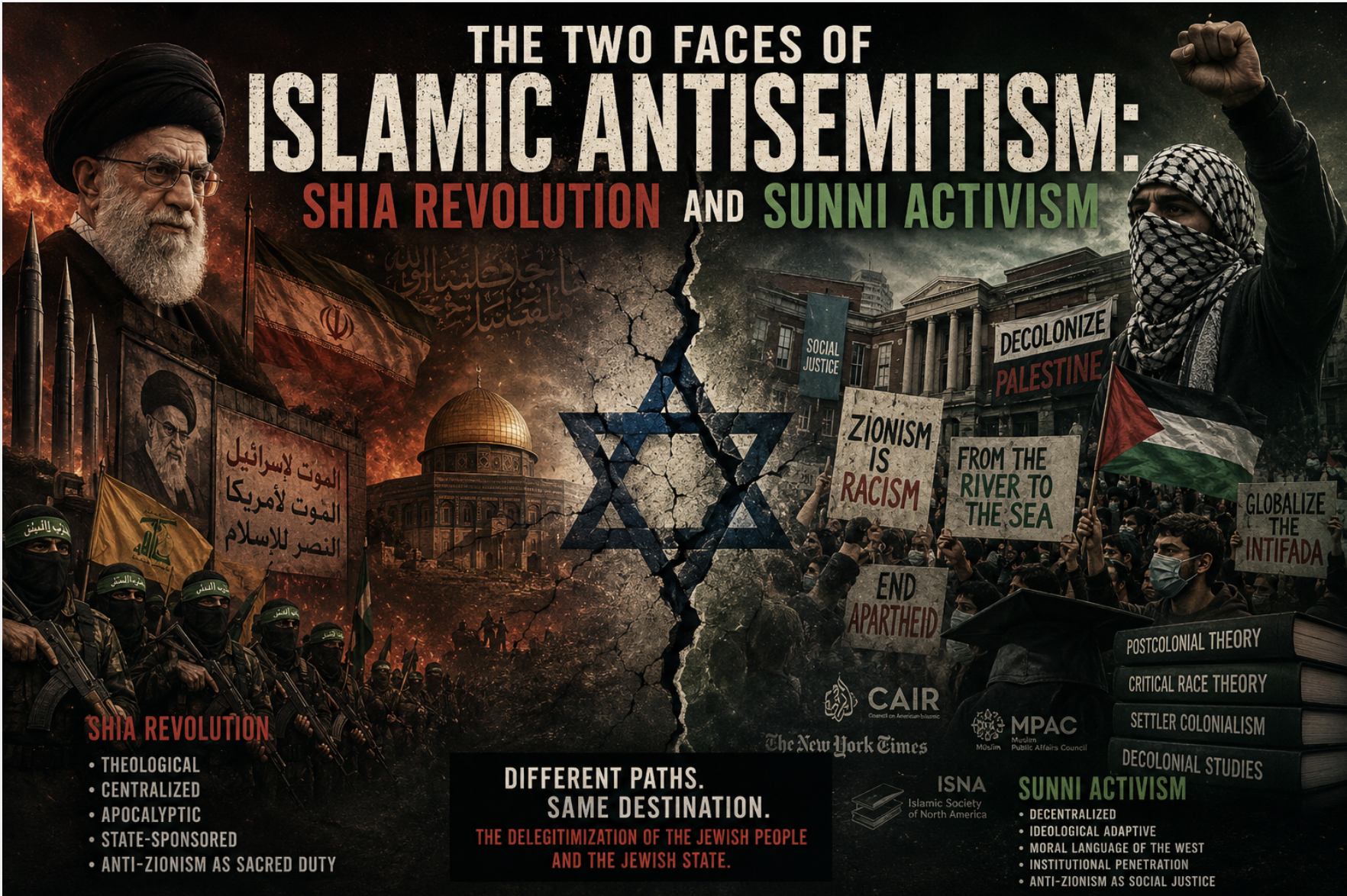
Image created from ChatGPT by Tim Orr
For years, conversations about Islamic antisemitism in the West have usually stayed far too shallow. Most explanations follow familiar patterns: imported prejudice, Middle Eastern politics spilling over into Europe and America, failed integration, or religious extremism carried through immigration. There is truth in all of those explanations, but none of them fully explains what has happened over the last several decades.
Something larger has developed beneath the surface: a growing convergence between certain Islamist moral frameworks and Western ideological systems that increasingly view Jewish continuity, Jewish influence, and especially Jewish sovereignty as obstacles to a morally redeemed world.
What makes this especially important is that the convergence did not emerge in just one form, but rather through at least two overlapping streams. One is the Shiʿi revolutionary model tied closely to the Islamic Republic of Iran, while the other is a Sunni Islamist model that became much more embedded within Western universities, activist spaces, nonprofits, journalism, and progressive political culture. The distinction matters because it shows that Islamic antisemitism in the modern West is not simply inherited hatred frozen in time. It adapts. It learns the moral language of the culture around it, and gradually reframes itself in ways that sound ethical, liberatory, and socially acceptable.
The Shiʿi revolutionary model is more centralized, theological, and openly ideological. Since the Iranian Revolution in 1979, the Islamic Republic has incorporated antisemitism alongside a sacred political vision in the guardianship of the jurist (wilāyat al-faqīh) where political authority is clothed in a kind of suspended sacred legitimacy linked to the Hidden Imam rather than real-world authority that can only arrive with the Mahdi’s return.
This structure is important because it elevates political conflict with Israel beyond ordinary geopolitics. Jewish self-determination itself becomes symbolically intolerable because it constitutes a rival claim to legitimacy within a framework already steeped in narratives of humiliation, restoration, revolutionary redemption and sacred fruition – hence the tendency for Iranian talk about Israel to slip into apocalyptic, cosmic language. Israel is not simply a state rival or an occupying power. The conflict is at once political, civilizational and theological.
Contrastingly, the Iranian revolutionary model has achieved far less mass social reach in the West outside of activist networks, online propaganda spaces, specific academic relationships, and those whose worldview has been significantly shaped by a knowledge of Iranian geopolitics. Despite being one of the Middle East’s most prolific sponsors of Islamist militants, having outfitted Hezbollah with a sophisticated broadcast and communications network, and despite launching an international Arabic-language satellite news channel staffed in large part by Lebanese Hezbollah members in 2007, Iran’s reach in spreading its revolutionary ideals lies far short of that embodied by the Sunni Islamist movements. It flourishes best within highly politicized spaces that already tend toward anti-Western and anti-imperialist ideas; here Iranian revolutionary themes can be seamlessly fused with ideas about colonialism, oppression, humiliation, resistance, and liberation. The antisemitism can be intense, but the reach is comparatively limited.
The Sunni Islamist model evolved quite differently, because it became much more fluent in the moral language of the modern West itself. In particular, influenced in part by networks tied to the Brotherhood and linked revivalist movements, this ecosystem gradually figured out how to translate Islamic civilizational grievances into the language of contemporary activism. In America, the institution-building of CAIR, Islamic Society of North America, etc., built bridges to these places and their ideological frameworks have thoroughly permeated academia, journalism, activism, race discourse, interfaith work, and progressive politics. That is not to say that these organizations can simply be equated with antisemitism; they cannot, and distinctions are important.
Muslim conservatism, anti-Zionism, Islamism, and antisemitism are not interchangeable categories. But the deeper issue is that certain Islamist frameworks gradually fused with activist-left moral systems already searching for broad explanatory categories of oppression, injustice, privilege, and historical evil.
This alliance endured not only because of shared political interests, but because both systems came to conceive of moral disorder in the same way. Much of the activist left now interprets history through the binaries of oppressor and oppressed, colonizer and colonized, privileged and marginalized. These paradigms are appealing answers to the challenge of suffering and inequity, because they make moral anarchy legible. But such totalizing salvation stories always encounter a fundamental problem: the universe resists classification. Some peoplehoods and stories don’t fit into binaries.
Jewishness itself is a case in point. For almost 2000 years, Jews have existed without political autonomy, achieved identity without assimilation, and maintained memory without victory. In modernity, they have come to represent precarity and privilege, exile and salvation, weakness and power, Diaspora and return, minority and nationhood. Israel only heightened the paradox: Jews couldn’t be assigned to the category of either victims or perpetrators. Jewish history overcomes the very binaries such utopian ideologies need in order to function.
The reason radical simplification is important is that highly moralized systems often depend on the psychological dynamics of symbolic coherence, and when reality complicates the picture, pressure starts to build within the system. Typically, there are two options at this point: societies can either tolerate ambiguity and contradiction, or they can project contradiction outward onto some symbolic obstacle that is preventing redemption from being fully realized. In Jewish history, this is where antisemitism reliably reenters the picture.
During these processes, “the Jew” is reduced to a person and employed as a kind of explanatory category: Jews are associated with secret power, subverted influence, dual loyalty, monetary manipulation, colonial mastery, or impediment to utopian fulfillment. Although the language shifts from civilization to civilization, the structure remains remarkably constant; and antisemitism persists not by staying the same but by adapting to the dominant moral language of an era.
In the Christian era, Jews represented a testament to failed covenantal legitimacy or, alternately, an obstacle to fulfillment of a divine order. In periods of European racial nationalism, they embodied a form of genetic pollution inhibiting the health and success of a particular nation; in revolutionary Marxist states, they were often recast as exemplars of bourgeois degeneracy, capitalist conspiracy, or counterrevolutionary activity. These systems are worlds apart, yet each eventually externalized contradiction into “the Jew” as an explanation for why utopian redemption had not yet been achieved.
The fact that this pattern keeps recurring is important because it suggests something about the nature of antisemitism itself. Most prejudices fade when populations disappear or epochs change. Antisemitism constantly reappears because its purpose is not only emotional: it is also explanatory. This goes some way toward explaining why Jews so often serve this function within universalist systems. Jewish existence presents certain challenges to civilizations predicated on absolute answers or grand unifying theories. Jews have lived through and without fully assimilating within empires, and survived the destruction of their civilizations to later reconstitute themselves as a People without conforming to its categories.
By the 2010s, this expansion of Islamist-influenced narratives far outside of the mosque and into journalism, academia, activist coalitions, nonprofits, student activism, and mainstream political discourse was complete. The reaction to October 7 was, to those of us who caught onto it, only illustrative of how deeply these frameworks have permeated the West. And what alarmed many observers was not only the venom against Israel, which is, after all, quite familiar and often unsurprising: It was the instantaneousness with which Jewish suffering was subsumed into pre-formulated ideological narratives before the shock of the attack had even settled.
Over the years, it has been amazing to watch how quickly, in many activist circles, Israelis ceased to function as civilians and instead became abstractions in a predetermined moral tale. The killings were understood not as a human calamity but as proof of theories about colonialism, race, and power. Something much deeper was revealed in that response than mere political rhetoric. Jewish agency itself has become disruptive for many ideological systems, since sovereign Jews upend systems that subconsciously relied on Jews remaining mere examples of victimhood instead of actors in history.
For centuries, Jews could function as symbolic victims, warnings, theological counterpoints, nationless collective minorities, and moral abstractions. Jewish sovereignty modifies the calculus of the spiritual stratification, since sovereign Jews act in history, instead of merely existing in someone else’s moral universe. Accordingly, Israel is controversial not only for its policies, but because Jewish collective power destabilizes frameworks that subconsciously depended on Jews to remain symbolic instead of physical.
This is part of why antisemitism tends to proliferate most intensely in civilizations focused on their own moral redemption. Antisemitism allows such societies to maintain self-confidence while cognitively relocating paradox. The system is able to remain theoretically pure while failure is pushed outward onto a symbolic impediment that is preventing redemption from arriving in its entirety. That is why modern antisemitism almost never experiences itself as hatred of Jews. It experiences itself as moral lucidity, anti-racism, anti-colonialism, liberation, revolution, and human rights.
The danger of the present moment is therefore much larger than extremism alone. The deeper danger is the normalization of explanatory systems in which Jews once again become symbolic instruments through which civilizations interpret disappointment, inequality, contradiction, moral anxiety, and historical failure without confronting instability within their own structures. The problem here is not just bigotry. The problem is the development of ethical systems that are able to render antisemitism the result of ethical necessity. This renders the new antisemitism flexible, because it does not feel itself to be hatred. It feels itself to be righteousness. And history has shown that societies become particularly potent when their Jew hatred is linked to a moral mission.
Endnotes
- David Nirenberg’s Anti-Judaism: The Western Tradition was especially helpful for thinking about how anti-Jewish ideas repeatedly adapt themselves to different civilizations and moral systems rather than remaining fixed in one form. Hannah Arendt’s The Origins of Totalitarianism also remains important for understanding the relationship between antisemitism, ideology, and modern political movements.
- For background on the Islamic Revolution, Shiʿi political theology, and the development of wilāyat al-faqīh, see Ruhollah Khomeini’s Islamic Government, along with Hamid Dabashi’s Theology of Discontent and Vali Nasr’s The Shia Revival.
- David Cook’s work on Islamic apocalypticism was particularly useful for understanding how revolutionary and redemptive language functions within some Islamist movements. See especially Contemporary Muslim Apocalyptic Literature. See also Mehdi Khalaji’s discussion of apocalyptic themes in Iranian political discourse.
- On Muslim Brotherhood–influenced activism and institution building in Europe and North America, see Lorenzo Vidino’s The New Muslim Brotherhood in the West. While scholars debate aspects of Vidino’s conclusions, his work remains influential in discussions surrounding Islamist networks in the West.
- Bassam Tibi’s Islamism and Islam is helpful for distinguishing between Islam as a religion and Islamism as a political project. Jonathan Sacks’ Future Tense is also valuable for understanding the relationship between anti-Zionism, Jewish legitimacy, and modern moral discourse.
- René Girard’s The Scapegoat helped shape some of the discussion surrounding symbolic enemies and the externalization of social contradiction. Eric Voegelin’s The New Science of Politics was also influential in thinking about ideological movements that frame politics in redemptive or quasi-religious terms.
- Simon Rawidowicz’s essay “Israel: The Ever-Dying People” remains one of the most profound reflections on Jewish continuity, survival, and historical persistence. Daniel Boyarin’s A Traveling Homeland provides a very different but equally important perspective on Jewish identity, Diaspora, and peoplehood.
- For broader reflections on contemporary antisemitism, anti-Zionism, and the moral framing of Jews in modern Western culture, see Dara Horn’s People Love Dead Jews, David Baddiel’s Jews Don’t Count, and Deborah Lipstadt’s Antisemitism: Here and Now.
Related Topics
Related Posts