
The Two-Year Exit: A Unity Deal Israel Can Actually Swallow
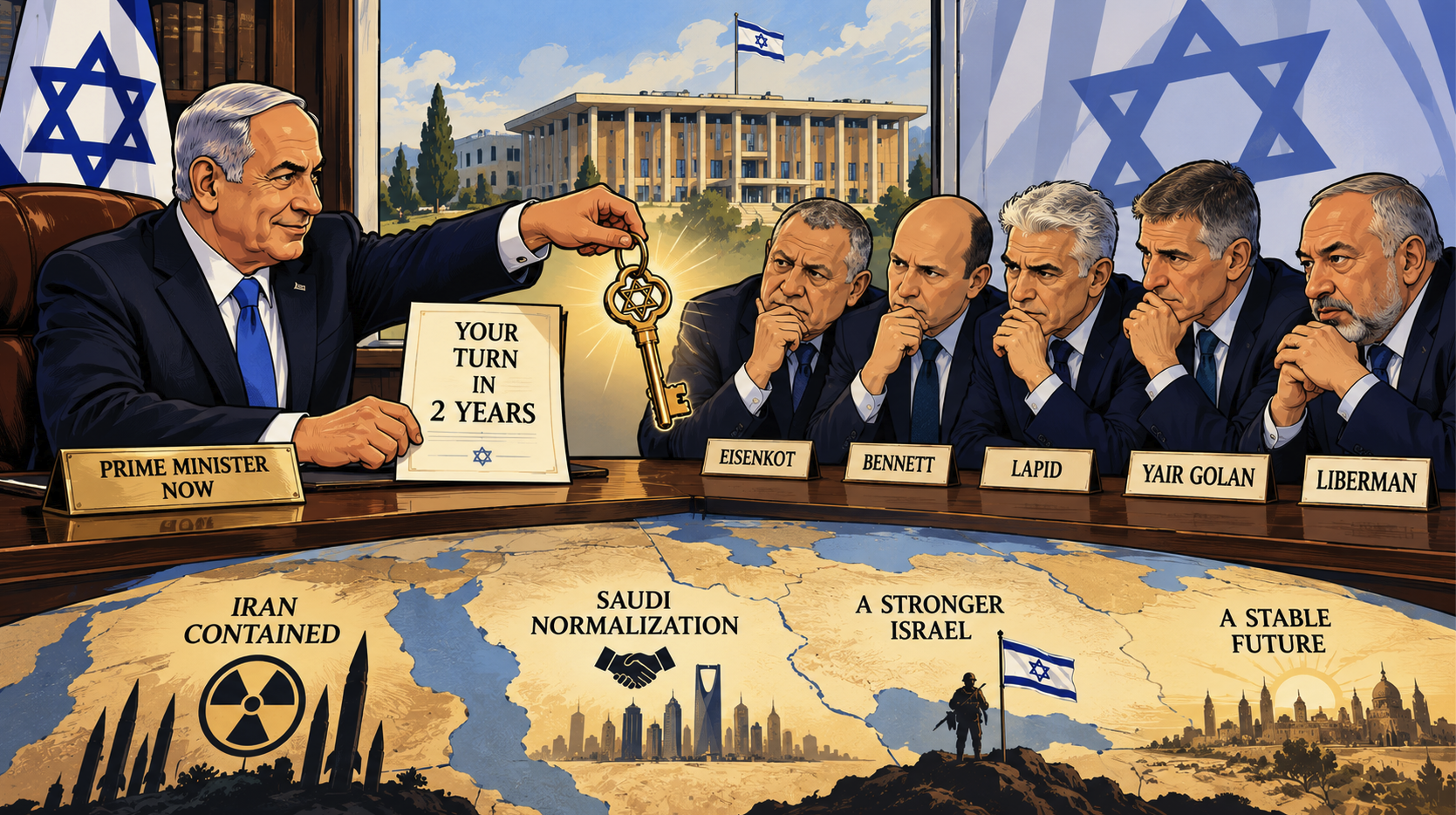
Israel went to the polls on Tuesday and did what it does best: it split the difference. With most ballots counted, Prime Minister Benjamin Netanyahu’s bloc sits at 53 seats, eight short of a majority. Gadi Eisenkot’s camp can’t reach 61 either, not without the Arab parties, which took a record 19 seats.
We know where this road leads. Between 2019 and 2022 we held five elections in under four years. We lived under caretaker governments, went years without a budget, and stopped believing the next vote would settle anything. We can’t afford a repeat. Not with Iran’s unfinished business, Saudi normalization on the table, and an American president with two years left to help us close it out.
So here’s a proposal. It won’t make anyone fully happy. That’s the point.
Eight seats for the keys
Netanyahu keeps his current coalition intact. Then he makes a public, open offer to every Zionist opposition party: bring me eight seats, and the premiership is yours in two years.
Not a back-room deal with one man. An open offer to the whole bench: Eisenkot, Lapid, Bennett, Liberman, whoever wants it. Eisenkot has pledged he won’t serve under Netanyahu even in a rotation. Fine. Once the offer is public and open to all, the question is no longer whether Eisenkot breaks his word. It’s whether he watches someone else take the job. That changes incentives fast.
Why does Netanyahu go first? Because, like it or not, he won. October 7 happened on his watch. The opposition spent years on mass protests, a criminal trial, and a campaign built around one goal: removing him. And still his bloc took 53 of the 101 seats won by Jewish-majority parties, and Likud is again the largest party. Most Jewish Israeli voters looked at everything and chose him anyway. Any deal that pretends otherwise won’t survive its first week.
The right keeps its prime minister, and the voters who made Likud the largest party aren’t told their vote didn’t count. The center gets a fixed date on which the Netanyahu era ends. Each side gets the one thing it actually needs.
A rotation with teeth
Everyone remembers 2020. Benny Gantz signed a rotation, the government collapsed over a budget before his turn came, and he walked away with nothing. No opposition leader will sign that paper twice. This rotation needs teeth Netanyahu can’t chew through. Three of them:
1. Close the loophole. Write it into Basic Law: if the government falls before the handover date, for any reason, the designated successor becomes the transitional prime minister. Not Netanyahu. Blowing up the coalition stops being an exit.
2. Plea, then pardon. President Herzog has said he wants the parties to reach an agreed resolution of the criminal case before he rules on a pardon. Give him one. Netanyahu pleads to a reduced count, an admission of wrongdoing without moral turpitude. The other side gets its vindication: the prime minister admitted something. The pardon follows, timed to the handover. Walk away from the rotation, and you walk back into a courtroom.
3. Give him somewhere to go. The biggest reason a politician won’t leave is that he has nowhere to go. Give Netanyahu somewhere.
Herzog’s term ends in the summer of 2028, and the Knesset elects his successor. Make Netanyahu the coalition’s agreed candidate for president, with the vote tied to the handover.
Whatever you think of his politics, almost no one disputes that he is the most effective advocate Israel has ever put in front of a camera. That is the president’s job: the country’s voice abroad, at the UN, in Washington, in the capitals that need persuading. It’s ceremonial at home and consequential overseas, exactly where his skills help most and his domestic polarization matters least.
One honest note on timing: summer 2028 is closer to 20 months into a government formed this winter than a full 24. That’s a feature. A shorter wait, a hard date nobody controls, and the President’s Residence as the reward for keeping your word.
If Trump wants the play, this is it
Washington is already in the room. Trump’s aides have reportedly discussed a Netanyahu–Eisenkot unity government with Israeli officials, and the framework reported in the Israeli press looks a lot like this one: Netanyahu for up to two years, then out. Riyadh has reportedly signaled that normalization depends on a different government configuration in Jerusalem.
The calendar lines up almost perfectly. Trump is in office until January 2029. Netanyahu would hand over the premiership in mid-2028. For the stretch that matters most (finishing the job on Iran, closing the Saudi deal, widening the Abraham Accords) the two leaders who know each other best stay in place. Then Trump blesses the handover, and Netanyahu moves to the role that suits him.
An American guarantee is also a fourth set of teeth. No Israeli leader wants to be the one who broke a deal the President of the United States brokered.
The only math that works
The numbers are blunt. With the Arab parties holding a record 19 seats, neither Zionist camp can govern alone. Either the Zionist parties learn to share power, or we keep going back to the polls until something breaks. A country with our security picture doesn’t get to do that indefinitely.
We’ve heard plenty about what each side refuses to accept. Here’s something both could:
Netanyahu gets his final act. The opposition gets a date certain and an admission. The country gets a government. And in 2028, Israel gets a president who can make its case to the world better than almost anyone alive.
That’s not surrender for either side. It’s a deal.