


The UN and Its Bodies are Overt Accomplices in Violation of International Law
Alsace-Lorraine or Elsass-Lothringen?
Imagine this for a moment…
In current official United Nations documents, Nancy, Metz, and Strasbourg would not be described as part of Alsace-Lorraine—their legitimate French designation—but as belonging to the province of Elsass-Lothringen, a name imposed during the German occupations of 1870–1918 and 1939–1945.
What an absurdity, isn’t it?
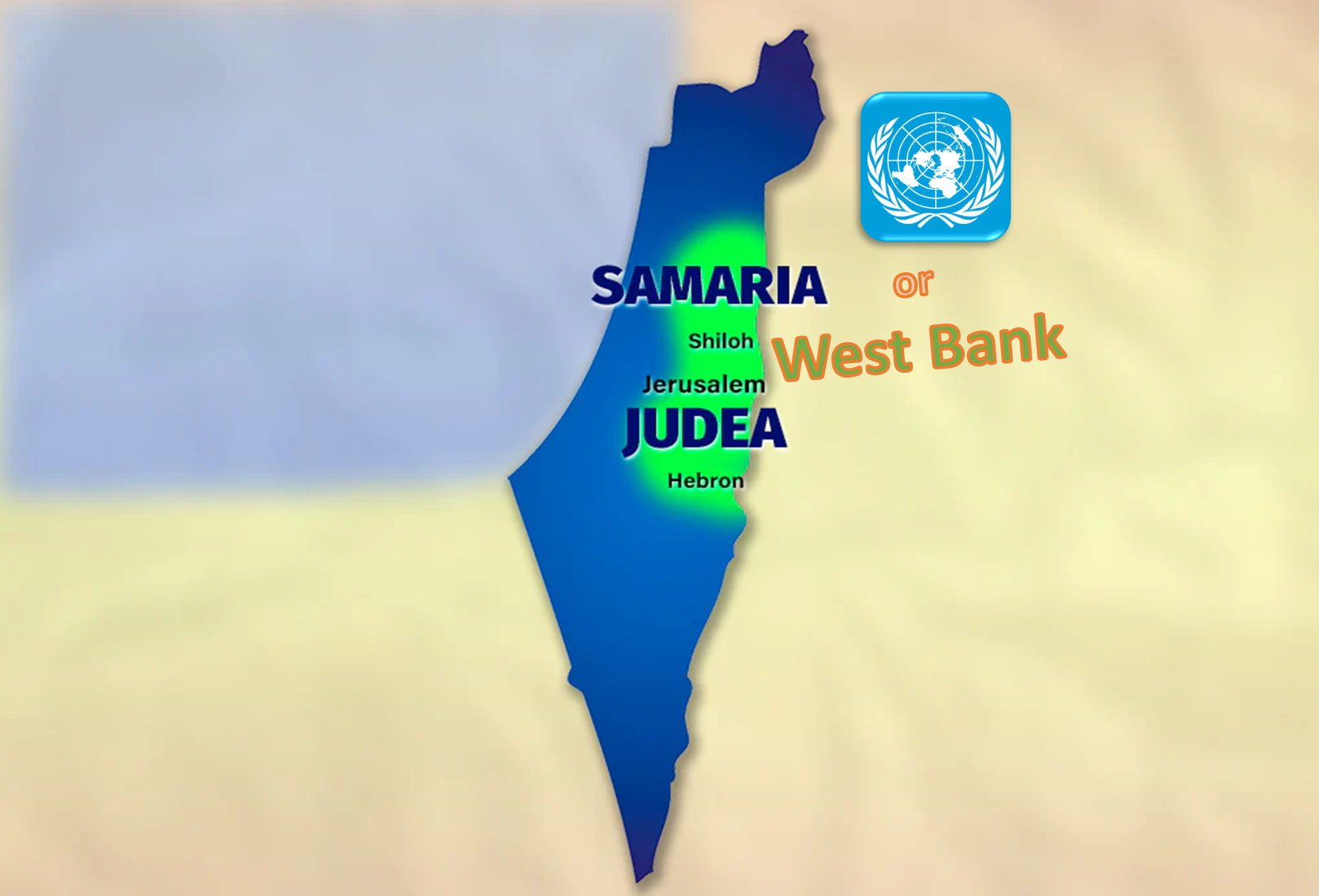
And yet, this is precisely what the United Nations does systematically when it refers to Judea and Samaria as the “West Bank.”
Elements of explanation of why such a disparity?
1. Historical background
From 1517 to 1917, the Ottoman Empire exercised sovereignty over the Middle East. It was defeated in the First World War (1914–1918) and lost all of these territories. In 1917, British forces liberated the region from nearly 400 years of Ottoman rule.
Between 1920 and 1923, the Ottoman possessions in the Middle East were formally dismantled. Turkey renounced all sovereignty over these territories through the Treaty of Sèvres (10 August 1920), and subsequently through the Treaty of Lausanne (24 July 1923).
In the 1920s, the League of Nations —the predecessor of the United Nations—established a system of international mandates to administer these liberated territories. Their explicit purpose was to manage institutional development and prepare them for eventual independence.
Three mandates were created:
- two entrusted to Great Britain (Mesopotamia and Palestine),
- one entrusted to France (Syria).
The Mandate for Palestine (1922)
The Mandate for Palestine, adopted on 24 July 1922, covered:
- 92,000 km² east of the Jordan River (present-day Jordan),
- 26,000 km² west of the Jordan River.
This mandate explicitly recognized the historical connection of the Jewish people with Western Palestine. Its fundamental objective (Article 6) was the establishment of a Jewish national home, obligating the Mandatory Power to facilitate:
- Jewish immigration,
- close settlement of Jews on the land, including state lands and uncultivated areas.
Article 25 of the mandate authorized Great Britain to organize the territory into two distinct administrative units, while maintaining the legal unity of the mandate:
- east of the Jordan River, Eastern Palestine, intended for Arab population, from which Jewish immigration was excluded;
- west of the Jordan River, Western Palestine, designated for the implementation of the close settlement of Jews, in accordance with the original purpose of the mandate.
2. Eastern Palestine: from the Emirate of Transjordan to the Hashemite Kingdom of Jordan
Eastern Palestine became the Emirate of Transjordan in 1922; it achieved independence in 1946 as the Hashemite Kingdom of Transjordan. The Jordan River constituted its western international border.
In May 1948, the TransJordanian army crossed this international border and militarily occupied part of the territory west of the Jordan River.
In 1950, this territory was illegally annexed, in flagrant violation of international law, which denies the acquisition of territory by force, in accordance with the fundamental principle: Ex injuria jus non oritu (no legal right can arise from an injustice) and in direct contradiction to Article 2(4) of the United Nations Charter.
Following this annexation, the Hashemite Kingdom of Transjordan adopted the name Hashemite Kingdom of Jordan, now comprising two territorial entities:
- Transjordan,
- the West Bank (a designation derived exclusively from an illegal occupation).
3. Western Palestine
In Western Palestine, escalating tensions between Jews and Arabs led the newly established United Nations (1945) to propose a partition plan, adopted on 29 November 1947 as UN General Assembly Resolution 181.
This resolution provided for:
- a Jewish state,
- an Arab state,
- an international regime for Jerusalem and its surroundings, including Bethlehem.
The resolution describes the borders of the two states with remarkable topographical precision. In Part II, devoted to the boundaries of the Arab state, the UN text explicitly refers to Samaria and Judea:
………‘The boundary of the hill country of Samaria and Judea starts on the Jordan River at the Wadi Malih south-east of Beisan and runs due west to meet the Beisan-Jericho road and then follows the western side of that road in a north-westerly direction to the junction of the boundaries of the Sub-Districts of Beisan, Nablus, and Jenin’……..’From here the boundary runs southwestwards, including the built-up area and some of the land of the village of Kh. Lid in the Arab State to cross the Haifa-Jenin road at a point on the district boundary between Haifa and Samaria west of El- Mansi’…….’From here it follows the northern and eastern boundaries of the village of Ar’ara rejoining the Haifa-Samaria district boundary at Wadi ‘Ara.’ (end of quotation)
Thus, the territory known today as the “West Bank” was officially designated in UN documents of 1947 as Judea and Samaria.
In June 1967, the Six-Day War broke out between Israel, Egypt, Syria, and Jordan. Israel repelled Jordanian forces back to the recognized international border.
The territory referred to as the “West Bank” for 19 years was then liberated from Jordanian occupation, an illegal occupation according to International Law.
4. The legal consequences of the term “West Bank”
Referring to this territory as the “West Bank” rather than by its original name, Judea and Samaria, implicitly amounts to:
- recognizing the validity of an illegal occupation and annexation under international law,
- contradicting the principle of non-recognition of territorial acquisition by force, one of the cornerstones of international law.
By persisting in the use of terminology derived from an illegal occupation, the United Nations becomes an accomplice to a manifest violation of international law.
To comply with international law, this territory should be designated by its original name, as it appears in UN documents prior to the Jordanian invasion: Judea and Samaria, including Jerusalem, Bethlehem, Hebron, Nablus (Shechem), Jenin, and the shores of the Dead Sea.
5. Why does the UN persist?
The answer is purely political.
- Judea and Samaria explicitly evoke Jewish history and its civilizational cradle.
- West Bank carries an Arab connotation and erases Jewish historical reality.
The ’international community’ thus seeks to dissociate this territory from Jewish heritage and attach it exclusively to an Arab entity.
Imagine if international law were respected; the formulation would read:
“Israel – the Jews- occupies Judea and Samaria since 1967 and must withdraw from Judea and Samaria in order to establish a Palestinian state.”
Or, in solemn UN headlines: GENERAL ASSEMBLY ADOPTS TEXT REQUESTING INTERNATIONAL COURT OF JUSTICE TO ISSUE ADVISORY OPINION ON THE WEST BANK WALL which would become:
GENERAL ASSEMBLY ADOPTS TEXT REQUESTING INTERNATIONAL COURT OF JUSTICE TO ISSUE ADVISORY OPINION ON THE JUDEA–SAMARIA WALL.
Using “West Bank” in international decisions:
- is neither neutral,
- nor legal,
- but political and instrumentalized to obscure history.
By continuing to use this terminology without considering its origin or legal implications, the international community does not uphold international law—it betrays it.
Is that surprizing? Not really. One should recall that the United Nations is a purely political body and only a source of international law in extremely limited circumstances. In this respect, it echoes the closing lines of Jean de La Fontaine’s fable The Animals Sick of the Plague:
“According as you are powerful or wretched,
The judgments of the court will render you white or black.”
6. Upholding international law
The efforts led by Yossi Dagan, as Chairman of the Samaria Regional Council, to restore the territory’s original legal designation—prior to Jordan’s illegal Arab occupation in violation of international law—are beginning to bear fruit.
Several U.S. states and political actors have started to adopt the terminology Judea and Samaria, marking the first cracks in a decades-old semantic violating international Law.
As of January 2026, there is a significant push within both the U.S. Congress and the Israeli Knesset to officially replace the term “West Bank” with “Judea and Samaria.” While the U.S. State Department’s broad official policy traditionally uses “West Bank,” recent legislative and administrative shifts indicate a move toward biblical terminology.
U.S. Legislative and Administrative Actions
- Congressional Bills: In early 2025, Republican lawmakers introduced the Recognizing Judea and Samaria Act (S.384), which seeks to mandate that all official U.S. government documents use the term “Judea and Samaria” instead of “West Bank”.
- House Foreign Affairs Committee: In February 2025, Representative Brian Mast, chair of the House Foreign Affairs Committee, formally instructed staff to use “Judea and Samaria” in all official committee correspondence and documentation.
- Trump Administration Support: President Trump has reportedly pledged support for this terminological shift, describing it as a “priority task” during meetings with Israeli officials in early 2025.
- State-Level Action: Some U.S. states, such as Arkansas and Florida, have pursued or passed their own legislation to ban the term “West Bank” in official state-level materials.
Still much to do!