
CEO of Time to Stand Up for Israel
The UN’s Permanent Trial of Israel
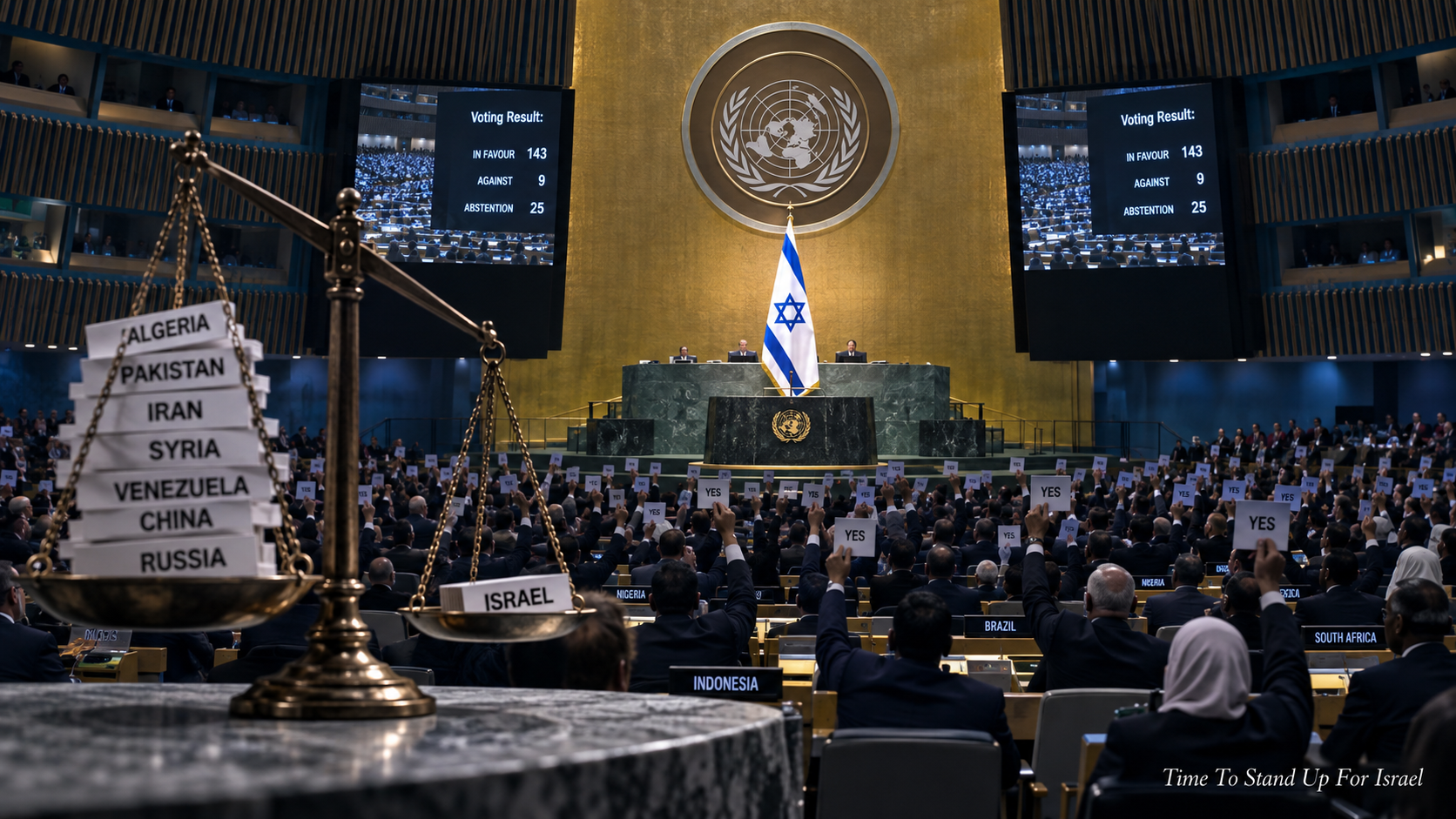
Photo Credits: Sabine Sterk(AI)
The UN’s Permanent Trial of Israel
The United Nations was created from the ashes of the Second World War with a promise to defend peace, human dignity and the equality of nations. For Israel, however, the UN has too often become something very different: a political courtroom in which the Jewish state is permanently placed in the dock while some of the world’s most brutal regimes sit among the judges.
This hostility did not begin after October 7. It did not begin with the war against Hamas, and it cannot honestly be explained as criticism of one Israeli government. The institutional obsession with Israel has existed for decades.
In 1975, the UN General Assembly adopted the infamous resolution declaring Zionism to be a form of racism. Zionism is the national liberation movement of the Jewish people, the movement that restored Jewish sovereignty in the Jewish ancestral homeland after centuries of persecution, expulsion and genocide. Yet the UN placed it in the same moral category as racial supremacy. The resolution was finally revoked in 1991, but the political culture that produced it never truly disappeared.
Israel remains the only country subjected to a permanent dedicated agenda item at every regular session of the UN Human Rights Council. Under Agenda Item 7, Israel is automatically investigated and condemned, while every other country, including Iran, North Korea, Syria, China, Russia and Afghanistan, is considered under the general human rights agenda. Israel does not have to do anything to be placed on the agenda. Its existence is apparently sufficient.
The numbers reveal how extreme this imbalance has become. According to the UN Watch resolution database, between 2015 and 2024 the General Assembly adopted 173 resolutions against Israel and only 80 against all other countries combined. In 2024 alone, the General Assembly adopted 17 resolutions singling out Israel, compared with only six concerning the rest of the world.
In November 2025, the General Assembly adopted six resolutions singling out Israel in one day, while adopting none on Sudan, despite the catastrophic bloodshed, mass displacement and humanitarian devastation there. This is not proportional scrutiny. It is institutional fixation.
Israel is also repeatedly singled out in bodies whose purpose has little apparent connection to the conflict. The Commission on the Status of Women has repeatedly condemned Israel as the only country in the world accused in a country specific resolution of violating women’s rights. Apparently, a democracy where women serve as judges, scientists, soldiers, members of parliament and leaders deserves unique condemnation, while the systematic oppression of women under the Taliban and the persecution of women in Iran are treated without the same ritualized focus.
Then there is UNRWA, an organization that has allowed the Palestinian refugee issue to grow across generations instead of moving toward resolution. Refugee status is inherited indefinitely, meaning that the number of people classified as Palestinian refugees has expanded from hundreds of thousands to millions. No other refugee population has its own permanent UN agency operating under this exceptional system.
The UN has repeatedly demanded that Israel cooperate with institutions that Israel argues have already prejudged it. Commissions of inquiry have been established with broad, continuing mandates, while the crimes of Hamas are frequently treated as background information rather than the cause of the war. UN reports cite figures originating from authorities controlled by Hamas, yet Israeli evidence is often introduced only as a denial, as though the accusation carries more authority than the response.
After October 7, the moral failure became impossible to ignore. Hamas invaded Israel, murdered approximately 1,200 people, committed sexual violence, burned families alive and dragged hostages into Gaza. Yet the UN General Assembly repeatedly demanded ceasefires without consistently making the unconditional release of every hostage the central requirement. Israel was expected to stop defending itself while Israeli civilians remained imprisoned by a genocidal terrorist organization.
The same pattern is visible during the UN General Assembly week of September 20 through September 27, 2026. Since today is September 23, events later in the week have not yet occurred and should not be invented. But what has already happened is revealing.
On September 22, Turkish President Recep Tayyip Erdoğan used the General Assembly platform to attack Israel, promote wider recognition of a Palestinian state and accuse the international community of failing Gaza. Yet his intervention placed pressure on Israel without an equivalent public demand that Hamas surrender, release every hostage and end its use of civilians as instruments of war.
Secretary General António Guterres again promoted a two state solution during his final General Assembly address, while the gathering placed Gaza and Israel at the center of its discussions alongside several enormous global crises. Once again, the diplomatic formula asks Israel to accept another Palestinian state while the international system has still failed to establish how such a state would be prevented from becoming another base for terrorism.
The problem is not that Israel should be immune from criticism. No democracy should be. The problem is that criticism becomes discrimination when standards are created for one country and abandoned for everybody else.
Israel is condemned for responding to missiles, blamed for checkpoints created after terrorism, attacked for security barriers built to stop suicide bombers and denounced for fighting enemies that openly promise its destruction. Meanwhile, the ideologies, regimes and terrorist organizations that created these security necessities are frequently reduced to secondary details.
The UN could have been an honest mediator. Instead, too many of its bodies have rewarded automatic majorities, political alliances and the obsessive targeting of one small Jewish state.
Israel does not need the UN to approve its existence. The Jewish people did not return to their homeland because the world suddenly became generous, and they will not surrender it because an automatic majority passes another resolution.
The UN was founded to ensure that the horrors inflicted upon the Jewish people would never happen again. Its treatment of Israel increasingly suggests that it has forgotten why that promise was necessary.
Related Topics
Related Posts