
CEO of Time to Stand Up for Israel
The Victims Nobody Wants to See
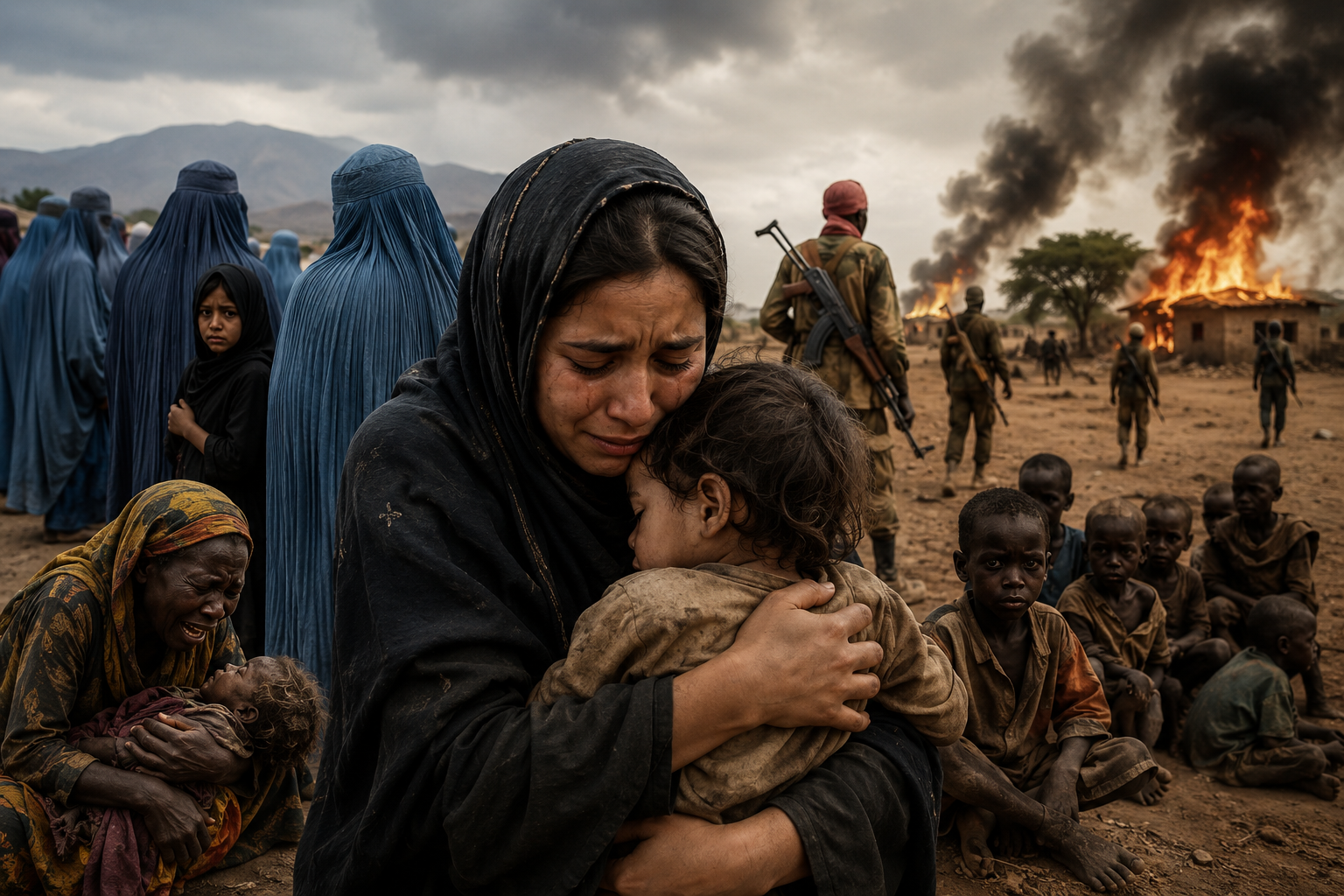
Photo Credits: Sabine Sterk (AI)
The Selective Moral Compass: Why Global Tragedies Are Ignored Until They Can Be Blamed on Jews
It is a mind blowing reality of modern journalism that the most severe humanitarian crises in the world are routinely dismissed as irrelevant. Day after day, global commentary focuses with singular obsession on a single conflict, while genuine, unparalleled catastrophes across the globe are relegated to the dark corners of backpage news. I am a concerned Israel advocate, but the essay that follows is the precise piece that professional journalists need to write, yet refuse to touch.
The global media apparatus has completely lost its direction. I am sick and tired of every journalist writing about Gaza like October 7th never occurred, treating a complex defensive war against terror as political theater while completely erasing active, monstrous atrocities happening right now. The double standard is blindingly obvious. Why are the world’s most devastating disasters ignored? The uncomfortable, unavoidable truth is simple: they cannot blame them on the Jews.
Every day we are told that Gaza is the defining moral issue of our time. News broadcasts lead with Gaza. University protests revolve around Gaza. International organizations issue statement after statement about Gaza.Yet beyond the cameras, beyond the hashtags, beyond the political theater, millions of human beings are enduring horrors that receive only a fraction of the attention.The world has become obsessed with one conflict while turning its back on catastrophes of staggering proportions.
When do we start to open our eyes? When do we realize that if a movement has to constantly improvise scenes, weaponize propaganda, and spread fake narratives to display its suffering, it is because there is a distinct lack of raw, unmanipulated reality behind their international stage management? Meanwhile, authentic, industrial scale suffering goes completely unnoticed because it does not fit the prevailing anti Israel script.
The Total Erasure of Afghan Women under Gender Apartheid
Look at Afghanistan, where a horrific reality is unfolding daily under the radar of Western mainstream attention. Afghanistan remains one of the world’s largest, most complex humanitarian disasters, with 21.9 million people requiring assistance. Over 17.4 million people face acute food insecurity, 3.7 million children suffer from acute malnutrition, and an influx of nearly 5.9 million refugees forced back from Pakistan and Iran has strained basic resources to the absolute breaking point.
Most devastatingly, the country is trapped in a state of absolute gender apartheid. The Taliban’s sweeping edicts have systematically and brutally excluded women and girls from public life.
Women are barred from receiving a secondary or university education, stripping generations of young girls of their basic future and literacy. They are largely banned from the workforce, meaning female employees of the United Nations and civil servants have been summarily dismissed or prevented from working, cutting off vital lifelines for families.
The restrictions control every single aspect of existence. Afghan women must adhere to strict hijab rules and cannot even leave their homes without a strict male guardian mandate, effectively reducing them to prisoners in their own households. New, escalating decrees even forbid women from speaking or showing their faces in public, meaning their voices are legally erased from society.
Where are the massive campus protests, the international outcries, and the non stop headlines for the systematic destruction of women’s lives in Kabul?
Sudan: The Unparalleled Scale of Global Collapse
The answer is painfully clear when you look at the rest of the world. By any objective metric, the situation in Sudan is unparalleled. The World Health Organization tracks it as the largest health and hunger crisis on the planet, where over 33 million people require basic survival packages due to total state collapse.
A catastrophic civil war between the government led Sudanese Armed Forces and the paramilitary Rapid Support Forces has killed over 150,000 people. The assault on El Fasher alone resulted in a massacre of an estimated 60,000 to 150,000 civilians, bearing the distinct hallmarks of genocide against non Arab ethnic groups.
Sudan is also the world’s largest internal displacement crisis, forcing roughly 14 million people from their homes. Official famine zones have been declared, severe acute malnutrition threatens nearly 800,000 children with imminent death, and more than 70 percent of the nation’s hospitals are destroyed or non operational. Massive outbreaks of cholera, dengue fever, and malaria are spreading rapidly because water supply systems have collapsed. Yet, the international community looks away.
Chronic Decay in Yemen and Mali
Consider the long term structural decay in Yemen and Mali, where permanent crises mean entire generations are losing access to healthcare, education, and basic human rights.
In Yemen, over 18 million people require urgent protection. The country suffers from total economic breakdown, a severe liquidity crisis, hyperinflation, and recurrent outbreaks of vaccine preventable diseases. Millions live in informal settlements with zero access to clean water, while Houthi militants enforce severe control in the north and actively destabilize global trade through military strikes in the Red Sea.
In Mali, an escalating armed conflict involving Al Qaeda linked groups and northern separatists has displaced over 730,000 people, leaving 1.5 million in acute food insecurity. Militants have laid an active economic blockade and siege around the capital, Bamako, while the ruling military junta cracks down on political opposition and the media. Outbreaks of diphtheria and mpox rage through vulnerable populations.
A Broken Moral Compass
These are not stage managed political theaters. These are absolute, verifiable collapses of human civilization. Yet, because these mass atrocities involve Arab nations fighting Arab nations, or Islamic regimes terrorizing Muslim populations, they fail to ignite global outrage.
The international media and activist classes have proven that their underlying motivation is not a universal care for human life. If it were, the millions of starving, displaced, and oppressed people in Africa and Central Asia would be front page news. Instead, the world remains singularly obsessed with demonizing a tiny Jewish democracy defending itself from annihilation.
The moral compass of humanity is fundamentally broken. When will a mechanic finally stand up and repair it? It is time for journalism to reclaim its integrity, reject the weaponized narratives, and look at the world through a lens of true, unbiased human value rather than selective geopolitical prejudice.
Related Topics