A Blend of Cultures. A Clear Point of View.
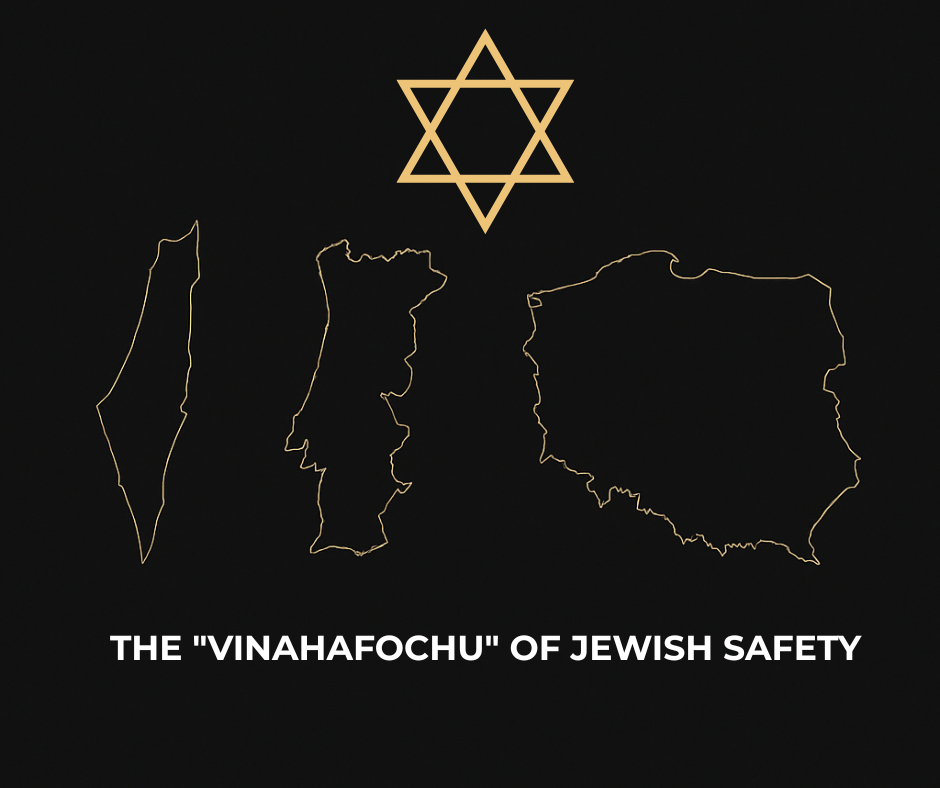
The “Vinahafochu” of Jewish Safety
When I started my Portuguese passport process through Touti Ashbel, it felt simple — a small administrative way to reconnect to a piece of Sephardic history my family never fully spoke about. I wasn’t thinking about safety, politics, or moving anywhere.
But in one of our early conversations, they mentioned something that stuck with me:
More Jews than ever are applying for passports
to countries that once persecuted their families.
Portugal.
Poland.
Spain.
Italy.
It’s a real “vinahafochu” — and it’s not even Purim.
Because if you look around the Jewish world today, it’s hard not to notice the reversal:
Countries like the U.S., the U.K., and France — where Jews felt safe for decades — suddenly feel unstable or unpredictable.
Meanwhile, countries like Portugal and even Poland, places that carry deep scars in Jewish memory, are statistically among the calmest, lowest-crime environments in Europe.
It doesn’t make them “better.”
And it definitely doesn’t make them a substitute for Israel.
Israel remains home — emotionally, spiritually, historically.
But here’s the quiet truth people rarely admit out loud:
Most Jews aren’t talking about moving.
They’re talking about having something.
A foothold.
A document.
A symbolic key to the world,
“just in case.”
For some, Portugal becomes part of that discussion because it’s calm, it’s rebuilding — and yes, for younger Jews who can’t afford to buy in Israel right now, it’s simply more attainable. Not instead of Israel. Not in competition with it.
Just a way to own some piece of land in their lifetime.
Poland appears in the same conversation — not because Jews want to return there, but because history has flipped itself in a way our ancestors could never have imagined.
Beginning my passport process didn’t make me want to live anywhere else.
But it opened my eyes to a reality many Jews — in Israel and abroad — are navigating quietly:
The places we once trusted feel shaky,
and the places we fled now feel strangely calm.
A modern vinahafochu.
And in that upside-down world, Jews are once again doing what we’ve always done:
seeking stability, keeping options open, and finding continuity where history once told us we had none.
This isn’t a story about Portugal or Poland becoming new Jewish centers.
It’s a story about the moment we’re living in —
one where identity, memory, and practicality collide,
and Jews everywhere are asking the oldest question we know:
Where do we feel safe — and what do we hold onto just in case?
Related Topics